
When Saint Louis coach Josh Schertz talks with recruits, he promises them three things should they commit to his program. One, they will be a part of a great culture. Two, they will join a work environment designed to help them unlock the best versions of themselves. And three, everything they earn, they will get.
What he doesn’t promise them, critically, is anything specific about roles or playing time, even though that’s often the first thing they ask about.
In a college basketball world shaped by NIL and the transfer portal, building a cohesive team has proven to be an immense challenge. Rosters loaded with talent have fallen drastically short of expectations because the pieces simply don’t fit. Amid this chaotic new landscape, Saint Louis has demonstrated the right way to go about roster construction. Schertz and his staff have assembled one of the nation’s top teams without the highest payroll or the biggest names.
After an emphatic 102-71 victory over Dayton on Friday night, the No. 21-ranked Billikens are 21-1 (9-0 in the Atlantic 10), their best start in program history. They are composed of 10 new players (six transfers and four freshmen) and rank 179th in minutes continuity, according to KenPom. And yet, few teams, if any, have displayed more chemistry than SLU, including those with considerably less roster turnover.
Saint Louis has eight players averaging at least 7.3 points per game. Its top scorer, 6-foot-10 senior center Robbie Avila, is posting just 12.8 points in 25.6 minutes, yet the program still has a top-10 offense and leads the NCAA in scoring margin (+23). The Billikens share the ball as well as any team in the country, ranking sixth in assists and fifth in three-point percentage. They also have the NCAA’s best field-goal percentage defense (36.2 percent). Schertz’s primary rotation consists of three returnees and six transfers, all of whom came from different schools. “In a million years you never would dream that you would go six-for-six (in the portal),” he says. “But we truly went six-for-six in terms of talent fits, system fits and cultural fits.”
So, how did they do it?
It all started with an embarrassing 103-78 loss to Arkansas State in the first round of last year’s NIT. Saint Louis had struggled throughout the 2024-25 campaign, in large part due to a slew of injuries, but this was still an eye opener. “It showed the chasm that existed between where we were and where we wanted to be,” Schertz tells Hoops HQ. “Maybe if we didn’t play that game, I wouldn’t have been quite as aggressive in renovating the roster as I was.”
Schertz knew that he had to make significant upgrades across the board. But first, he had to focus on retaining a few crucial pieces, including Avila, 6-foot-6 sophomore guard Amari McCottry and 6-foot-6 redshirt junior guard Kellen Thames.
Avila, who made the 2024-25 All-Atlantic-10 Second Team, has been with Schertz his entire collegiate career, beginning with two years at Indiana State. He would have been highly sought after in the portal had he opted to go that route. Instead, he committed to SLU quickly and without drama. The deal ensured Avila would be the highest paid player on the team while giving the staff the flexibility to construct a solid roster around him.
This was Schertz’s first true offseason at Saint Louis. He was hired in early April 2024, several weeks after the portal had opened, and found himself scrambling to put together a team. This time, his approach was much more calculated. He assessed his roster, noting the biggest holes and what was needed to optimize Avila. Rather than chasing the most talented players his program could afford, Schertz targeted high-character, egoless guys who fit specific roles.
“We knew the guys we wanted,” he explains. “We were very targeted in terms of puzzle pieces and how they fit together. You want to get guys who won’t get in each other’s way and won’t step on each other’s toes. There are specific skill sets that we think fit systematically.”
While the recruiting process moves a lot faster in the portal than on the high school level, Schertz takes a number of precautionary measures to ensure his program locates the right fits. He understands that it’s nearly impossible to hit on every signing, but he does what he can to shrink the team’s margin for error.
During official visits, Schertz shares a one-on-one meal with every recruit. He doesn’t sugarcoat his pitch to try to get guys to the finish line; on the contrary, he makes zero guarantees about playing time and is very honest about the fact that no one player dominates the ball in his system. One recruit who visited wound up committing elsewhere because he was promised a central role in the team’s offense, while Schertz would make no such promise.
In the absence of high-profile names, Saint Louis’ transfer class was ranked 84th in the nation and fourth in the A-10 by 247Sports. But Schertz had gotten many of his top targets. The Billikens needed more three-point shooting and playmaking, so they brought in guards Ishan Sharma (Virginia), Dion Brown (Boston College), Trey Green (Xavier), Quentin Jones (Northern Illinois) and Brady Dunlap (St. John’s). To boost the interior and give Schertz the option of playing a two-big lineup, the program signed 6-foot-9 senior forward Paul Otieno from Quinnipiac. “You try to get like-minded guys,” Schertz says. “You want guys who are ambitious but don’t have agendas, who prioritize winning over stats and who have a growth mindset.”
“I heard from a few schools in the A-10 and a few schools in the ACC, but ultimately my end goal was to end up in the NCAA Tournament,” Brown, a 6-foot-3 senior, says about his recruitment process. “(Schertz) was just honest and straight up. I asked a question; he gave me a very direct answer. And my goals ultimately aligned (with his).”
Only the two mid-major transfers (Jones and Otieno) had averaged more than 26 minutes per game in 2024-25, but all six fit the program perfectly and made sense alongside Avila. “We got a lot of guys who bring different aspects to the game,” Avila told Hoops HQ in October. “We have a lot of versatility with the guys we got this year.” Avila welcomed the fact that the team’s new acquisitions would reduce the burden on his shoulders, even if that meant he would get fewer minutes and shot attempts.
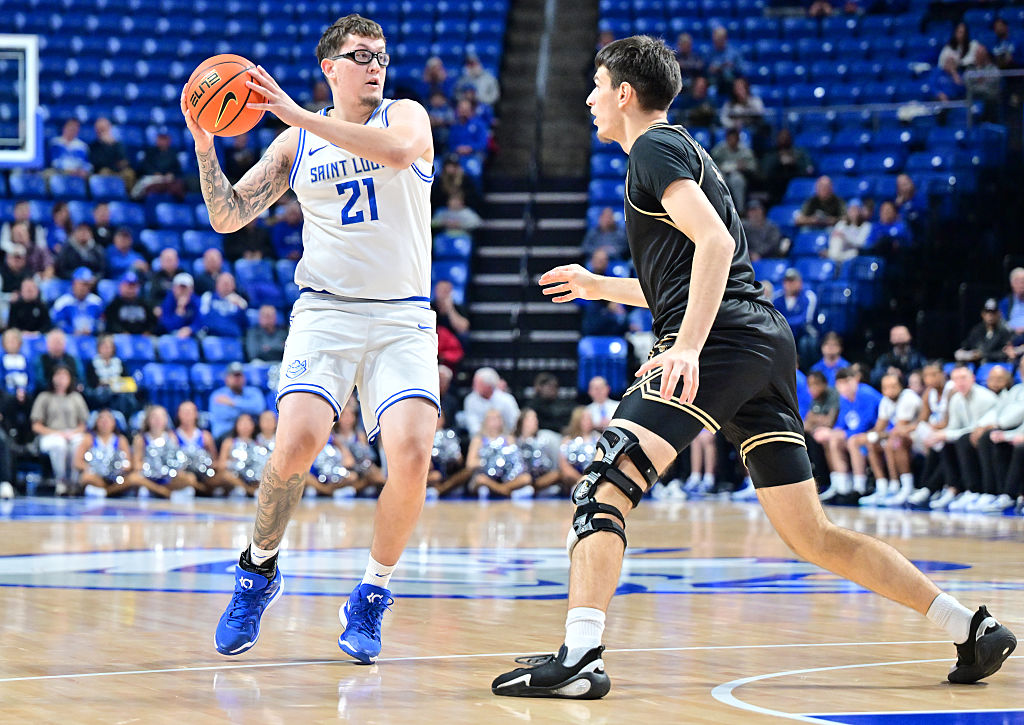
Once the puzzle was assembled, the staff took additional steps to facilitate chemistry building. There were a handful of players-only meals during the summer and fall in which no cell phones were allowed. In Schertz’s eyes, there is no better team-building exercise than practicing defense. To be good defensively requires the utmost communication and trust. Saint Louis ranks 22nd in the country in adjusted defensive efficiency, per KenPom, and has limited opponents to just 35.8-percent shooting from the field and 26.6 percent from three.
Similarly, Schertz’s offense requires complete buy-in. It is a conceptual system that emphasizes spacing, cutting, ball movement and working together to create advantages. Roles within it are very clearly defined. “We try to activate all five guys. It’s a very egalitarian way of playing,” Schertz explains. “It requires a really high level of humility and self-awareness to play the way we play.” The Billikens push the pace and hunt layups and three-pointers. They are currently connecting on 61.7 percent of their twos and 40.5 percent of their threes.
“Each night we have a game, we’re likely going to have a different leading scorer,” says Brown, who’s averaging 11 points per contest. “If Robbie’s our best chance of winning that night, we’re giving the ball to him. If it’s Trey, we’re giving the ball to him. If it’s Amari, we’re giving the ball to him. We know that collectively our goal is not to be a good team in the A-10. We want to go as far as we can, and we know the best chance of doing that is to play selflessly and get everybody involved as much as we can.”
Men’s Basketball Top 25: Small Step for Illinois, Giant Leap for St. John’s
Jan 26: UConn faces adversity. Illinois sends Purdue packing. Auburn teeters. Three schools join the ballot, including a dominant mid major.
At the heart of it all is Avila, who has sacrificed more than perhaps any other star in college basketball. Over the past two seasons, the big man averaged 17.3 points, 6.7 rebounds and 4.0 assists in 32.5 minutes. His playing time has decreased significantly to 25.5 minutes, so his topline stats have gone down. But his efficiency has been through the roof — 54 percent from the field and 47.1 percent from three — and he continues to average 4.0 assists, which leads all centers in Division I. Avila has yet to attempt more than 13 shots in a game and has taken six or fewer on seven occasions.
“He’s the hub, the centerpiece, the fulcrum of the entire program because he sets the tone for everything we do,” Schertz says. “Winning matters to him more than anything else.”
On Tuesday, Saint Louis trailed George Washington 43-33 at halftime before coming alive. The offense started clicking, and the Billikens went on a 15-0 run to take the lead. With the score knotted at 76 and less than 20 seconds remaining, Schertz drew up an action for Avila and guard Kellen Thames. The floor was spread with Green, Sharma and Jones, who stayed glued to the perimeter. Avila set a screen for Thames, then popped to the top of the key. When the defense collapsed on Thames, he calmly kicked it to Avila for the game-winning three.
Much of the team had struggled that night. Battling foul trouble, Brown and McCottry contributed just five total points. Sharma and Jones combined to shoot 3 of 16 from the field. But there were zero signs of frustration after Avila’s shot found the bottom of the net. Teammates swarmed him by the scorer’s table, celebrating with their arms wrapped around each other.
“We could have been on the bench pouting,” Brown says. “Rob hits the game winner and we’re so focused on our own individual performances that we’re not happy. No, we won the game. We got the job done. Our record goes up. Our guy hit a big shot, something he’s going to do again and again. But it doesn’t matter who hit it. It could have been Kellen. It could have been Ish. Robbie didn’t hit the shot. We hit it. That’s our mentality.”
Meet your guide