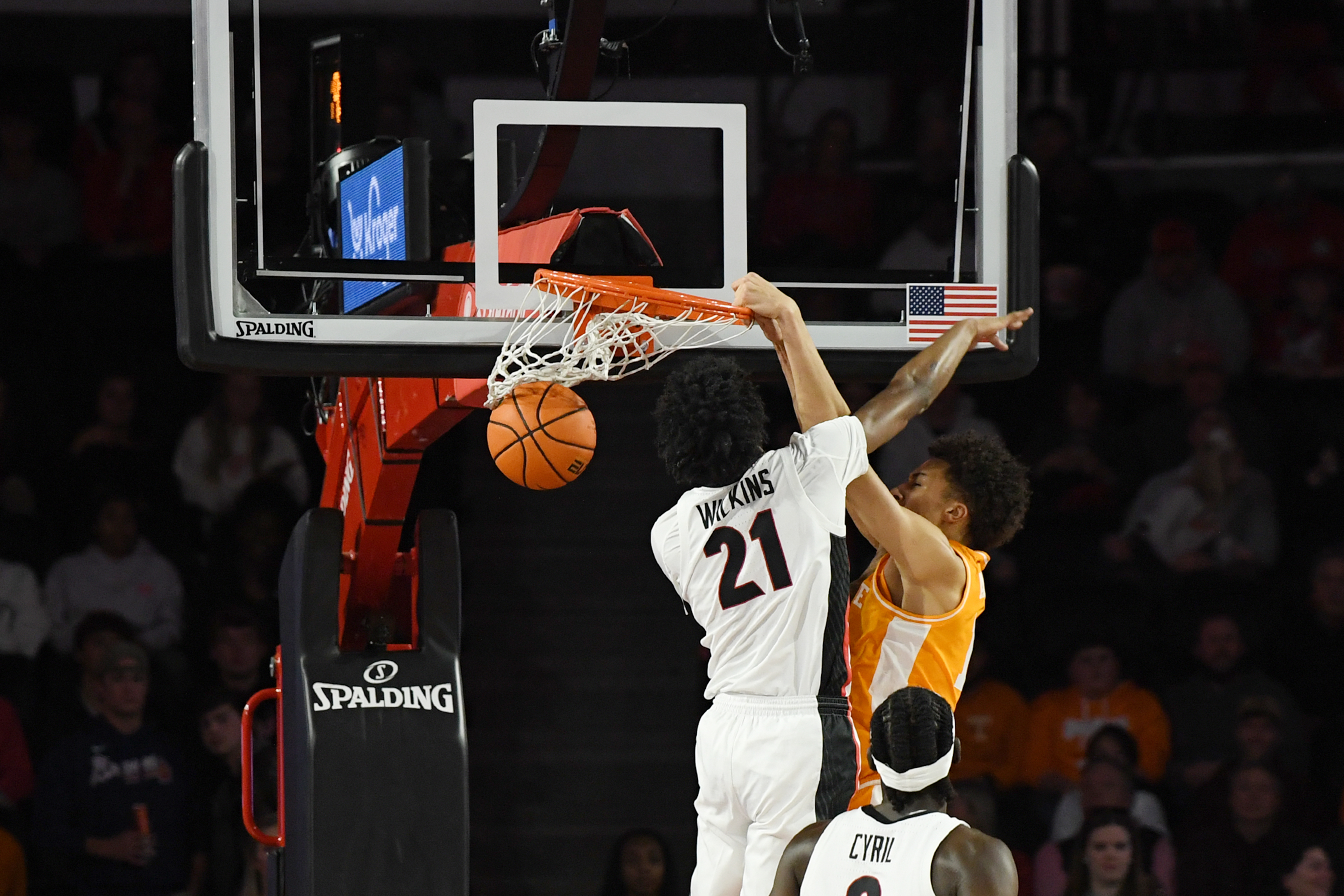
Early in the second half of Tennessee’s Jan. 24 game at Alabama, Nate Ament, the Vols’ 6-foot-10 freshman, received a pass beyond the left side of the three-point line, and after blowing past his defender, 6-foot-8 freshman London Jemison, took off toward the rim. Ament was quickly met there by the Crimson Tide’s 7-foot center Charles Bediako and 6-foot-10 junior Taylor Bol Bowen. Ament rose, absorbed contact with Bol Bowen, lifted the ball over his head, brought it down to shoulder level and then bounced it off the backboard and into the basket. Bol Bowen was whistled for a foul.
When Ament’s feet touched the court again, he let out a yell and did a semi-chest bump with teammate Jaylen Carey.
For Ament, whose default setting is resting mellow face, that basket and his reaction to it were a revelation. This was Mr. Spock letting his human side take over his Vulcan stoicism and cracking a smile. Ament’s uncharacteristic show of emotion spoke volumes to fans, NBA scouts and pundits who create mock drafts. Call it Ament’s Ascension — the moment in which a kind, unselfish-to-a-fault, 19-year-old kid signaled that he had become The Man.
“That play, it was like a sign,” Ament tells Hoops HQ. “It was a sign that I was doing what I’m capable of, and what my teammates expect from me. It was a moment of celebration, where I could be grateful I can make plays like that.”
Over the last month, Ament has been making plays like that on the regular. Before the season began, he was regarded as one of the top two or three freshmen in a rookie class some recruiting analysts think is the best in history. One final ranking of the class of 2025 placed Ament atop the list, ahead of Duke’s Cameron Boozer and BYU’s AJ Dybantsa, and he was a consensus top four pick. But whereas Boozer and Dybantsa — both bigger and more physical players than the 207-pound Ament — came roaring out of the gate, dominating opponents and clearly establishing themselves as the focal point of their respective teams, Ament played… well.
Ament averaged 17.8 points, 7.6 rebounds and 3.0 assists in his first eight games and won three of the SEC’s first four Freshman of the Week awards. As the competition began to ratchet upward and defenders became more physical with Ament, his statistics, particularly his shooting percentage, plummeted. He was 1 of 8 from the floor against Houston, 5 of 15 against Kansas, 2 of 10 against Syracuse and 4 of 14 against Illinois. Tennessee beat the Cougars but lost the other three games.
At times, Ament could also be turnover prone. He took those missed shots and miscues personally, as though he had let his team down.
The low point game in the Vols’ first two SEC games. On Jan. 3 at Arkansas. Ament scored 13 points but was an uncharacteristic 5 of 11 from the free-throw line in the Vols’ 86-75 loss. Three days later, in a homecourt win over Texas, Ament took just four shots and finished with eight points.
Some Tennessee fans, media and draft evaluators began to wonder whether Ament, a five-star prospect, had been overrated.
Tennessee coach Rick Barnes, while simultaneously claiming he hadn’t read stories or social media posts about Ament or paid attention to mock drafts, eventually felt compelled to defend him. If Barnes has said, “I wouldn’t trade Nate Ament for anybody,” once, he’s said it 100 times.
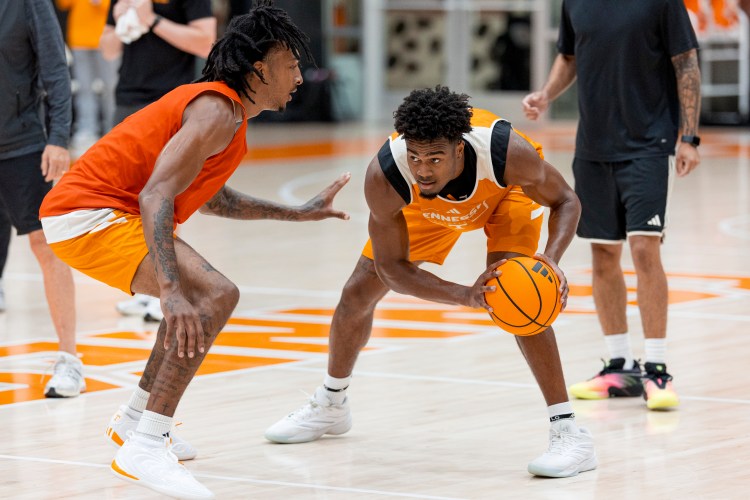
“Nate Ament has never disappointed me,” Barnes tells Hoops HQ. “I knew what he was going through physically and mentally. He had to learn a whole new game, a different position (small forward). Everybody thinks he’s a face-up four, but he can be whatever he wants to be. He had to learn to fight through double and even triple teams. He had to learn to chase smaller guards defensively. He had to get stronger and more physical.”
Despite what critics might have had to say or write about him, no one was harder on Ament than he was on himself.
“My expectation going into the season was that I wanted to be perfect,” Ament says. “No one can achieve perfection. I wasn’t giving myself enough grace to make mistakes throughout this process.”
Somewhere along the way, Ament had forgotten something one of his three older brothers, Frederick, once told him. “He gave me a great quote,” Ament says. “Can you be obsessed with the process of becoming a better basketball player without becoming emotionally attached with the result?”
Ament had no problem with the first half of that question. He’s a world-class gym rat who’s in the Vols’ practice facility before and after practices, and on off days, too. At all levels of basketball, there are players who like the game, some who love it, and the rare few who are obsessed with it. Ament falls squarely into that last camp.
The Top 100 Players in College Hoops: Part Three
Hoops HQ delivers you the definitive ranking of the top 100 players in college hoops for the 2026-27 season
The problem was, when Ament didn’t meet his own expectations, he began to put pressure on himself. That weighed him down, causing him to second guess everything he did. Barnes, one of the all-time great player development coaches, knew Ament was struggling. On Jan. 9, a day before the Vols were to play at Florida, Barnes decided the time had come for a conversation. After practice, with associate head coach Justin Gainey backing him up, Barnes sat Ament down and gave him some sage advice.
Ironically, he used a different sport to help drive home his point.
“I told him I can see you feel the weight of the world on your shoulders,” Barnes says. “So I played him a clip of (20-time major tennis championship winner) Roger Federer and told him Federer had won 80 percent of his matches but only 54 percent of his points. The message was, play one shot at a time, let it go, and move on to the next play.”
Barnes’ one-two punch also included a worst-case scenario.
“I know what (fans and pundits) are saying,” Barnes says. “You’ve been a disappointment. You’re falling in the draft. But don’t you think you’ve got a pretty good life? He said, ‘Yes sir.’ Let’s say you continue this trend. Maybe you’re just a first-round pick. Or how bad would it be if you came back to school for another year and transferred to North Carolina, Duke or Virginia? That’s a pretty good deal. He said he wouldn’t want to play anywhere else. My point was he’s got options. So he had to quit worrying about his game. I told him whoever’s in his head, you need to tell them to shut up and let us coach you.”
When Barnes says he wants to coach a player, he’s not kidding around.
“He coaches you hard,” Gainey says. “Sometimes, especially if you’re a young guy, you might not truly understand what that means. Coach is trying to help you become who you want to become. And probably something you never thought you could become. He’s not going to allow you to settle.”
That sit-down between Ament, Barnes and Gainey changed the course of Ament’s season and more than likely helped assure that Tennessee — 18-7 overall and 7-2 since the Florida game — will play in its eighth consecutive NCAA Tournament. As Ament has processed the feedback he received, his game has risen to another level.
“It’s a tough balance to understand,” Ament says. “I knew how tough coach Barnes was going to be on me, and how great he wanted me to be. But I had to realize it’s coming from a place of love when he pushes me to be so much better. I think that’s the deepest form of love, where someone can be honest with you and never just tell you what you want to hear.”
Even after helping Ament break out of his mental shackles, Barnes and his staff have continued to work on some physical aspects of his game. Barnes, who has always been a shot doctor, constantly stresses to Ament to utilize his height advantage over the typically shorter three-man who guards him. That meant establishing a higher release point on his shot. Barnes also wanted Ament to get more lower body into his shooting form. When Ament got to Tennessee last summer, his stroke was dominated by arm motion. It wasn’t a true jump shot.
Shot mechanics, not unlike a golf swing, are hard to change once they’re ingrained. But Barnes has helped Ament make tweaks here and there and thinks the NBA team that drafts Ament will make even more.
“We moved his feet under him so he could get more lift,” Barnes says. “Then we just tried to get him to play faster. More speed, more pace, more pop. We told him to get to his spots faster and get his shot from chin to rim a lot quicker. Even off the bounce.”
Unlike some latter-day coaches, Barnes loves the mid-range shot. So he encouraged Ament to get to the free-throw line extended, or into the lane, where he could use either his height advantage to shoot over smaller defenders, or his quickness to get around bigger and taller ones and score or get fouled. Through games of Feb. 14, Ament had attempted 185 free throws, fourth in the league and not too far behind leader Matas Vokietaitis of Texas (208).
All the effort coaching Ament — literally from head to toe — has paid off. Before the Florida game, Ament averaged 14.7 points, 6.5 rebounds and 2.6 assists and shot 40.0 percent from the field and 27.4 percent from three. Since then, he’s averaged 22.2 points, 6.3 boards and 2.5 assists and shot 44.4 percent from the floor and 38.5 percent from three. Per Luke Schapker, Tennessee’s director of video and analytics, Ament shot 24 percent from the midrange in his first nine high-major games and 39 percent in his next seven.
During his run, Ament has scored 29 points twice — against Alabama and Kentucky — and 28 against Ole Miss. On January 26, he shared the SEC Player of the Week Award with Hall, and he won consecutive league Freshman of the Week awards on Feb. 2 and Feb. 9, giving him a school-record five. That’s two off the league record set this season by Arkansas guard Darius Acuff Jr.
“It’s been great to see,” Gainey says. “Because we saw it in practice every day, and thought, ‘Man, when he unleashes that on the court…’ He’s so much more than a scorer. He has a high IQ and can really pass the basketball. Now he’s playing in games like he has in practice.”
Barmes’ latest effort on Ament’s behalf has been publicly discussing the way defenses have tried to check Ament and what referees are doing — or not doing — about it.
“Freedom of movement — that hasn’t been applied to Nate Ament,” says Barnes, a former chair of the NCAA’s rules committee. “Nobody’s been held up more than that dude. I don’t think he’s gotten a fair whistle all year.”
Regardless of how Ament is officiated, at winning time, the Vols almost always turn to him, just as they did with Northern Colorado transfer Dalton Knecht two years ago when he led the SEC in scoring and won the league’s MVP award, among many others.
Ament probably won’t collect a fireplace mantle’s worth of trophies the way Knecht did. But his ceiling is higher, whether he proves that in college or the NBA. Regardless of how Ament closes out his more than likely brief college career, Barnes is grateful to have had the chance to coach him.
“I’m proud of him because he’s real,” Barnes says. “He hasn’t changed a bit. All the good things that come his way, he’s handled with humility and class. Basketball is not who he is. It’s what he does. There’s so much more to Nate Ament than basketball.”
Meet your guide