
Was BYU at Kansas, Dybantsa vs. Peterson everything you hoped it would be? How serious is Darryn Peterson’s cramping situation?
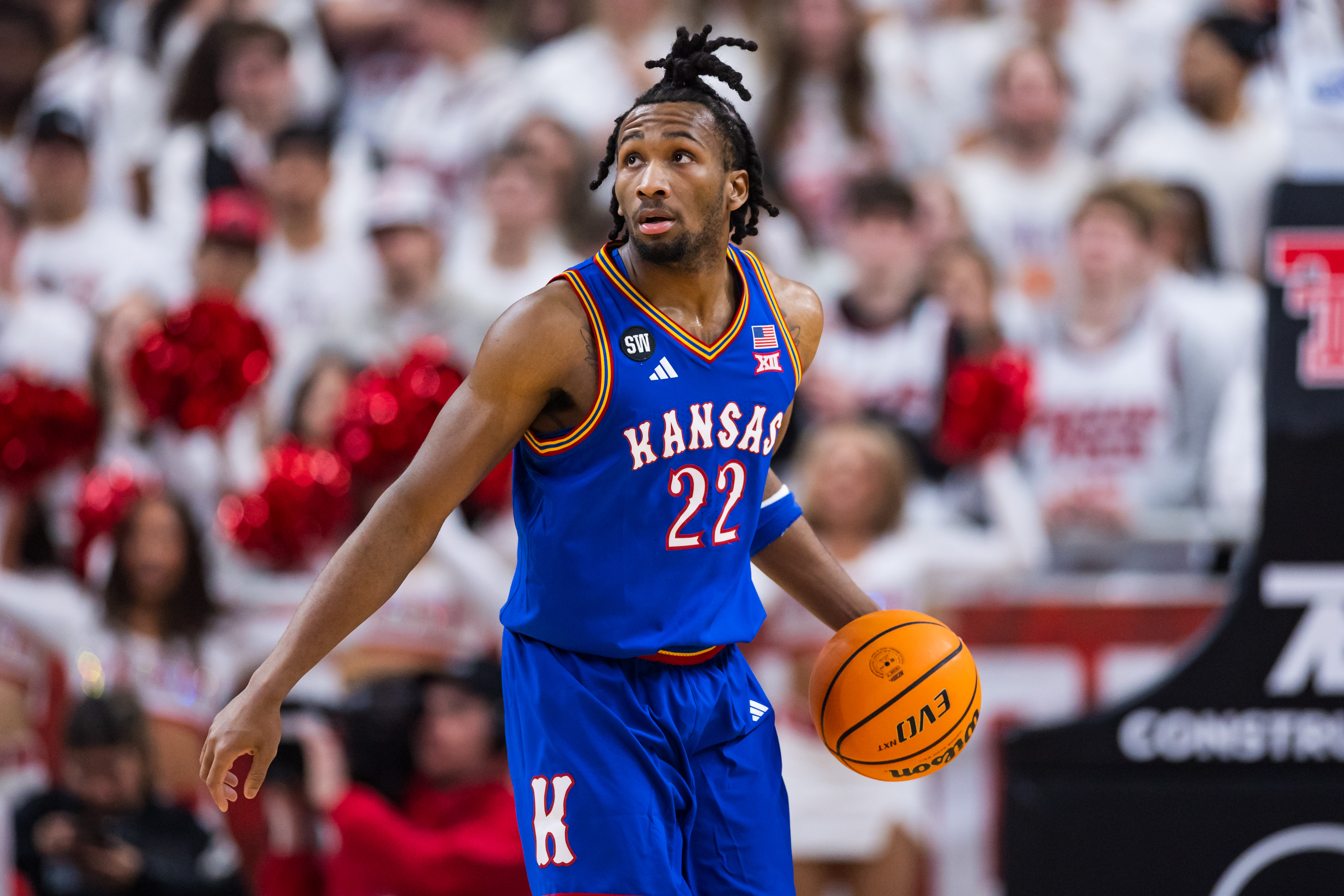
SETH DAVIS : Well, the good news is we were treated to that matchup. The bad news is it was only for about 20 minutes because while Darryn Peterson was sensational in the first half — he scored 18 points — about three and a half minutes in, he told Bill Self that once again, he’s developing cramps.
He sat the last 16 and a half minutes. They had a big lead at the time. BYU made it interesting. Kansas was able to win the game. But once again, dealing with this odd cramping injury with respect to Darryn Peterson, what is your take on his situation, Andy? How concerned are you that this is just a problem that’s not going to go away?
ANDY KATZ: Definitely concerned and I can tell you, as someone who did cramp in three of the four marathons that I ran, it is not fun to cramp at all and not easy to continue competing during it. You got to fight through it. It’s not easy. I’m not a professional athlete. I’m not destined to make millions. So I get it, I get why they’re being even more cautious with Darryn Peterson. He obviously knows his own body. He had the hamstring issue earlier, and now he’s got the cramps. Kansas’s athletic training department has got to get this under control.
And, I get why Peterson is being very cautious. We’re in an era where the coach does not have control. It’s that simple. The players have control. So the player can’t play, doesn’t want to play, is hurt, it’s them. It’s their call.
Seth: Yeah. And I can tell you, having spoken with Bill Self about this a couple of times, he’s as perplexed as anybody. It’s a real head scratcher, you know, there’s a different decision to be made on January 31st. If it’s a Sweet Sixteen game, you can maybe try to push through. Anybody criticizing Peterson for what’s happening is just wrong. Just factually wrong. He wants to play. He wants to go to a Final Four. This is not about shutting it down for the NBA. It is about being cautious and not re-injuring something that puts you out for another few weeks.
Hot Takes: Summer Recruiting, Dusty May, Eligibility and the 2027 NBA Draft
Seth Davis and Andy Katz discuss Dusty May’s jump to the NBA, the proposed 5-in-5 rule, the future of high school recruiting and more
What’s the status of the ongoing Charles Bediako eligibility case? What could the ramifications be?
Seth: Well, on Sunday, Alabama got destroyed at Florida with Charles Bediako playing. Off the court, the previous judge — an Alabama donor — recused himself, but there’s going to be an injunction hearing on Friday. Meanwhile, Amari Bailey, a former UCLA player, has said he’s going to try to come back. He’s actually played in the NBA.
Andy: This is an absolutely monumental hearing. People are not really grasping how serious it is. I think it’s just absolutely ridiculous on so many levels that if someone is trying to play again after being in college. You made a decision. I don’t care if you were 18, 19, if someone told you to do it. You agreed and you left for the money and the chance to be a pro. Now move on. You wanna go back and get your degree? Great, but not to play college basketball. To me, it’s a clear line. I just cannot fathom how people keep comparing this to these other examples. And that’s a larger issue.
G League, Euros, someone who never played in college — they’re all in one group. The guys that played in college and left and want to come back, they’re another group. If they win this case, then it really could open the floodgates.
But I’ll tell you who’s not speaking up right now, and that’s the school presidents and the athletic directors, because they are complicit here. No one has to play college basketball. You have to be admitted. You have to be in a class. And if you’re president of a university or an athletic director, you can easily say, “we are not admitting you.” Not to play — apparently we’re leaving that up to the courts, but to admit. You can’t sue to be a student at USC or wherever. You can’t do that. The judge can’t say, “you have to admit the student.” That doesn’t happen. So these schools could decide not to admit these students.
Seth: Well, neither of us are trained lawyers. But I just really disagree with this idea that the Charles Bediakos of the world shouldn’t use every tool at their disposal, including the courts. That’s what the courts are there for. It’s incumbent upon the schools and the NCAA to have rules that comply with the law. We got into this situation because for decades, they were denying rights to young athletes in violation of anti-trust laws and they got sued and the whole thing came crashing down. How can you begrudge somebody using every means? Someone like Amari Bailey can make millions of dollars by challenging this in court? Why would you tell them not to do that because of some higher principle, because Andy Katz and Seth Davis and other people in college basketball don’t like it?
Andy: I think it’s weak. I think if you’re Amari Bailey, you do not have the strength to be a professional. You’re giving up, move on with your life.
Seth: That’s why he wants to come back to college and make millions of dollars. Why should he move on? Why? When he can make millions of dollars. This is life. Life is you can take someone to court and you can sue for the ability to do something.
Andy: If you’re (UCLA athletic director) Martin Jarmond or (Alabama athletic director) Greg Byrne, you are way opening a can of worms. You think it’s going to stop here? I’m telling you, you just wait. You wait, Greg Byrne. You wait at Alabama until Auburn takes a football player off the practice squad or who has played in a game with the Jets, Falcons, you name it. And then he beats you in the Iron Bowl. Watch.
Seth: Well, you’re opening up a legal can of worms, by the way, if you’re going to start denying students admission to your school. You better have a really good reason to deny admission. You don’t have to play them. You don’t have to recruit them.
Big, big day on Friday. I’m hoping the judge rules against Bediako and says that the NCAA has the legal right to declare you ineligible based on the rules that you already know. That is my hope for the outcome. I don’t blame players for trying to take advantage of the court system.
Are the Kentucky Wildcats finally out of the woods?
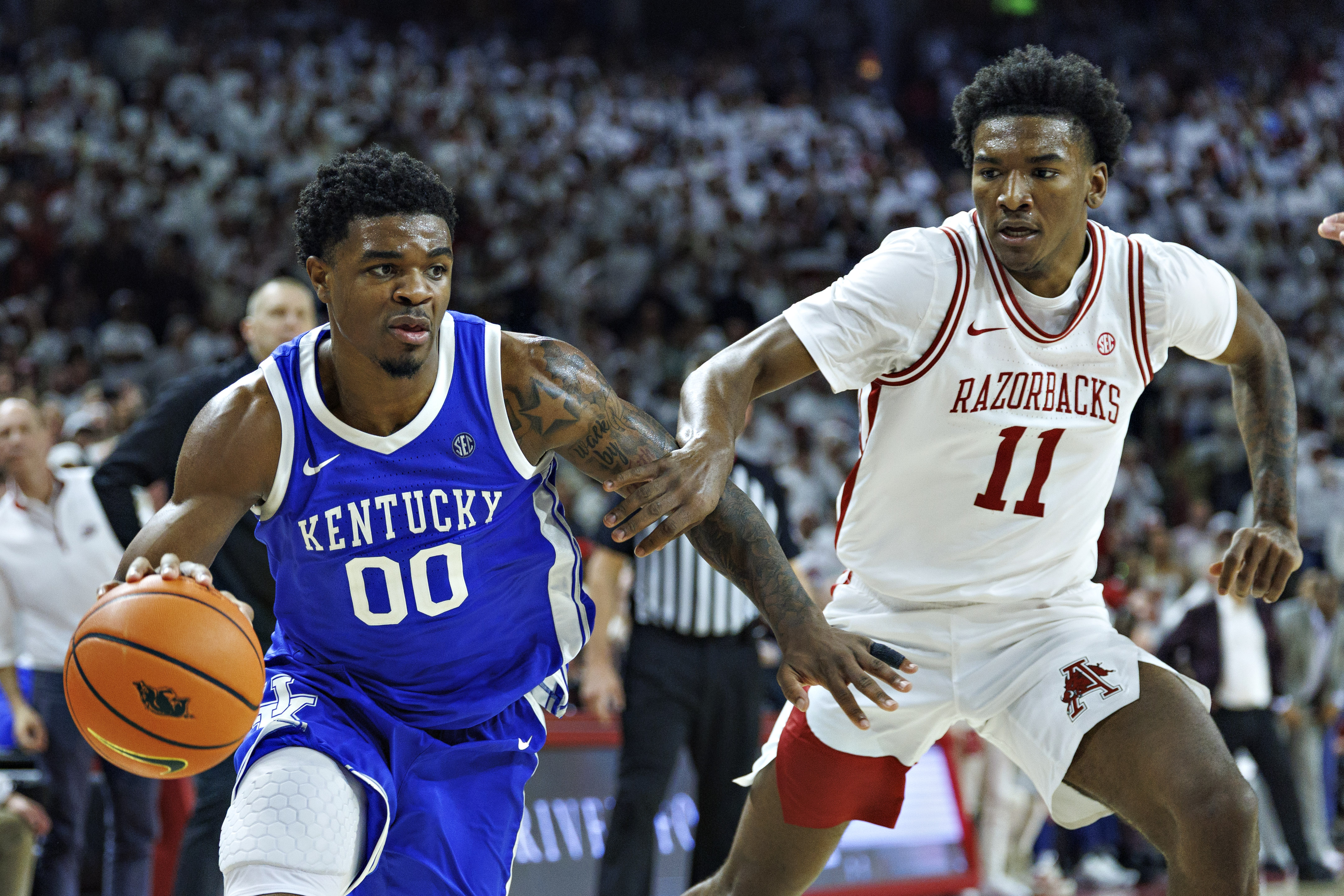
Seth: They are the drama queens of the sport. It is so college basketball that after they got embarrassed by 25 points at Vanderbilt, they went into Arkansas, controlled the game throughout and won 85-77. Don’t look now but Kentucky has won six of the last seven. They’ve hit their stride. So I’m going to say yes, Kentucky’s back.
One thing I’ve noticed is that Denzel Aberdeen is settling in, but I also like what I’m seeing from Otega Oweh. He played really well against Arkansas. He is not settling for the soft jumpers anymore. He seems to be attacking the rim, getting to the foul line more. He was the preseason SEC Player of the Year.
Jayden Quaintance’s knee is still not right. It might not ever be right, but yeah, I’m going to say Kentucky is back.
Andy: Yeah, but this is also the SEC right now. There isn’t a team that’s going to run away with it. On Sunday Florida smacked Alabama around, and Florida had just lost the week before. So for now, Kentucky’s back, but they could lose badly next week. This is who they are.
Is the new replay review system working? Do you think it has improved the game?
Andy: I do actually. We’re already seeing coaches look back to their staff. Everyone has an iPad now behind the bench. I’ve seen a number of times where the coach or the players on the court do the old symbol of twirling the finger, and then they’ll say, “No, no, no. Here’s what we saw. We shouldn’t.”
So for the most part, I think it’s working. I do think what happened at the end of the Indiana-UCLA game is going to occur. In that game, there was a challenge on an out of bounds play in the second overtime. To everyone that watched it, it clearly looked like it was off Indiana, but it wasn’t enough to overturn it according to the three officials. Indiana keeps the ball, they get fouled with three-tenths of a second left, and they win the game by one.
Coach Mick Cronin obviously had every right to be upset by that. It wasn’t why they lost because they put themselves in that position. But still, it’s not a perfect science. And there are gonna be mistakes. But for the most part, I think it is working.
Seth: I agree with you about the incorrect call in that game. I think what’s really working is that the end of the games have gotten much better. Unfortunately, we know what’s going to happen in the NCAA Tournament: You’re going to get a lot of people watching who haven’t been following the sport all year and they don’t understand that referees are not able to review out of bounds calls at any point in the game. So you’re going to have a situation late in the game, coach is out of challenges, and there’s going to be a bad out of bounds call and no one is going to be able to review and reverse it.
So there are some things to tweak. The whole appeal process is a disaster – we don’t need to get into it. But it has made the end of games better. And that’s a good thing.
Meet your guides