
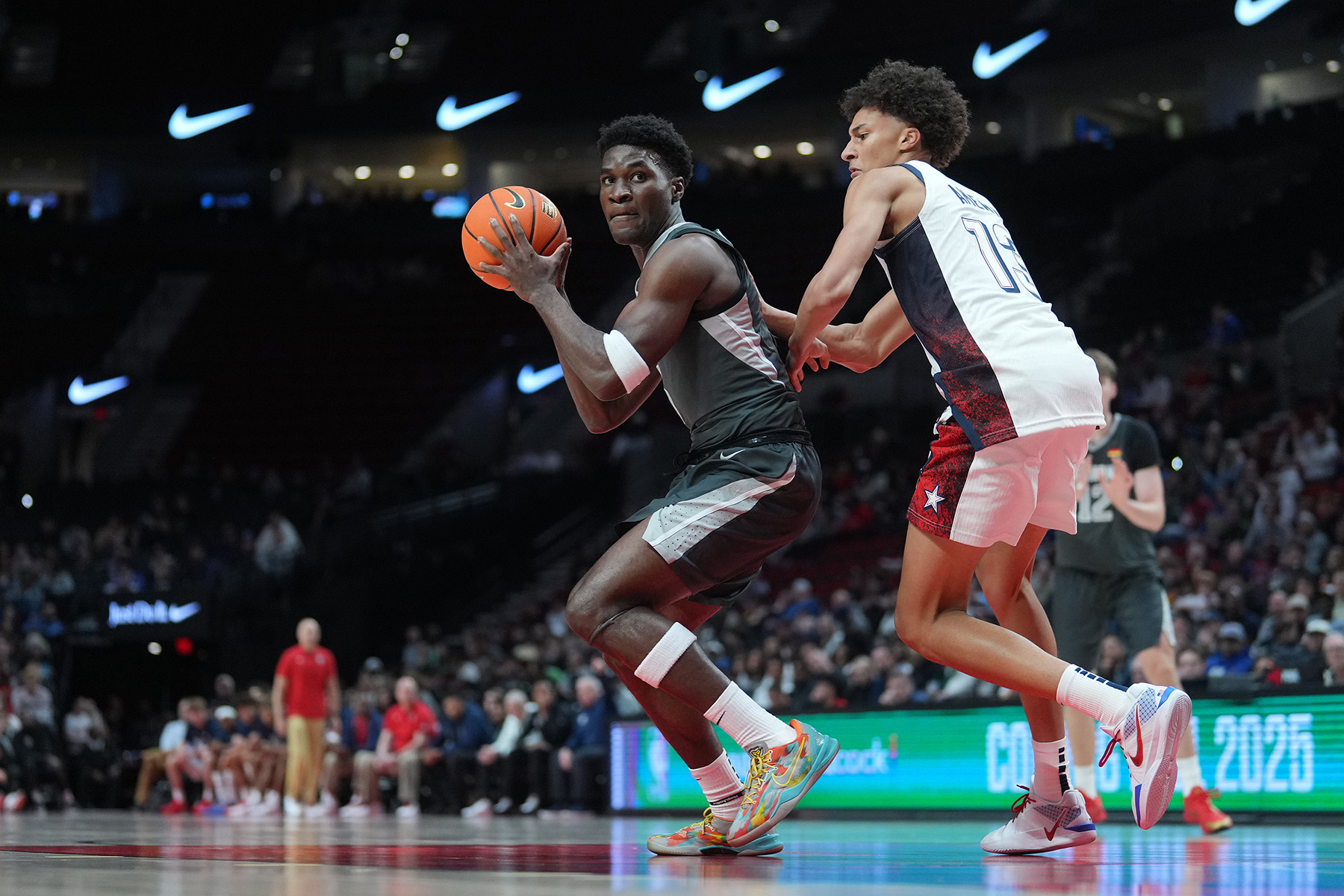
They packed into T-Mobile Arena in Las Vegas hoping to see a star freshman turn in an epic performance on Monday night, and they were not disappointed. He was only 18 years old, but you couldn’t tell by his chiseled frame and polished skills. He blew past smaller defenders, soared over bigger ones, dropped in feathery floaters and slammed home authoritative alley-oops. When the game was done, the numbers told the story: 30 points, 7 rebounds, 5 assists, 3 steals and 1 block in a 93-87 victory. It was just the second time in the history of the Big 12 that a freshman had gone for 30 in his very first game.
The plot was anticipated, but it came with a twist. That performance was turned in not by BYU forward A.J. Dybantsa but rather Arizona forward Koa Peat. Dybantsa has long been a household name even to casual fans, but Peat has heretofore been known mostly to the hard-core set. Not anymore. His incandescent debut — against defending champ and third-ranked Florida, no less — made Dybantsa’s 21-point, 6-rebound, 3-assist outing in the Cougars’ 71-66 victory over Villanova in the nightcap seem almost ho-hum by comparison.

It’s not often that a pair of freshmen turn in such dominant performances on opening night, but as the week rolled on, similar numbers poured in from freshmen like vote tallies on election night. Kansas guard Darryn Peterson: 21 points, 4 rebounds, 4 assists in a win over Green Bay. Houston forward Chris Cenac Jr.: 12 points, 10 rebounds in a win over Lehigh. Michigan guard Trey McKinney: 21 points, 4 assists in a win over Oakland. Baylor guard Tounde Yessoufou: 24 points, 7 rebounds in a win over UTRGV. Illinois forward David Mirkovic: 19 points, 14 rebounds, 4 assists in a win over Jackson State. Tennessee forward Nate Ament: 18 points, 9 rebounds in a win over Mercer. North Carolina forward Caleb Wilson: 22 points, 4 rebounds, 3 assists in a win over Central Arkansas. (Wilson added 24 points, 7 rebounds, 4 assists and 4 steals in Friday’s win over Kansas.) Duke forward Cameron Boozer: 15 points, 13 rebounds, 3 steals, 2 assists in a win over Texas. Washington forward Hannes Steinbach: 21 points, 7 rebounds, 6 assists in a win over Arkansas Pine Bluff. Syracuse guard Kiyan Anthony: 15 points, 3 assists in a win over Binghamton. Cincinnati forward Shon Abaev: 18 points, 2 rebounds in a win over Western Carolina. Arkansas got big debuts from two freshmen guards in its win over Southern: 22 points, 4 assists from Darius Acuff Jr., and 21 points, 6 rebounds, 7 assists from Meleek Thomas.
And to think, Cooper Flagg was supposed to be a freshman this season before he reclassified before his senior year of high school.
Granted, most of those numbers were put up against subpar competition, and those youngsters will have their struggles in the months ahead. But even in a world of too-early hot takes and instant overreactions, it’s reasonable to ask whether this freshman class isn’t just great, but historically great, and perhaps on the way to becoming the best in the history of the sport. “From my eye, it’s the deepest crop of freshmen that I can remember,” said ESPN analyst Jay Bilas, who has long been a staple of the network’s college basketball and NBA Draft coverage. “You’ve got star power at the top, but the depth of NBA caliber talent, I just can’t remember it going this far.”
If we’re using the NBA Draft as a barometer, the benchmark is 2017, when freshmen comprised the top seven picks and 10 of the first 11. A record 16 were chosen in the first round. Just six of those, however, have played in an all-star game, and the overall number one pick, Markelle Fultz, has been one of the most underperforming top picks this century.
How will the draft class of 2026 measure up? Hoops HQ NBA Draft expert Jonathan Wasserman projects that freshmen will comprise the top five picks and 10 of the first 11. He has 18 going in the first round.
So are we watching the best freshman class ever? The question is less compelling than the context in which it is being asked. For the last several years, the predominant narrative in college basketball has held that high school recruiting was on the verge of extinction. In its place emerged an ethos of get-old-and-stay-old, whereby coaches favored 23- and 24-year-old seniors who could be acquired via the transfer portal. The transfers might not have the same long-term NBA potential, the thinking went, but they had the physicality, maturity and guile to win right away.
NBA Draft Breakdown: Expert Analysis of all 30 Picks
Hoops HQ’s Draft insiders react to trades, mistakes and feuds on Night One of the NBA Draft. PLUS: Rivalry Watch. Did the Hawks grab the Knicks’ guy?
To be sure, this is an exceptional class. Next year will likely mark a regression as most recruiting and NBA draft experts believe the Class of 2026 to be among the weakest they’ve seen in years. But the resurgence of the freshman is likely to continue if only because there are scant few “Covid seniors” remaining in college basketball. Those are fifth-year seniors who were granted an extra year of eligibility due to the 2020 pandemic, but have now cycled out of the sport.
“The game has changed. The old guys are back to playing four years of college like they used to,” said Arizona coach Tommy Lloyd, who has seven freshmen and just one new transfer to his roster. “At some point, there has to be a regression to the mean in terms of opportunity. I think you’re seeing that right now.”
We’re also seeing once again that they don’t make freshmen like they used to. Today’s top prospects get identified when they are barely teenagers, and they spend their high school years crisscrossing the country — and in many cases, the globe — in search of top competition. They have also grown up in the Age of Instagram, so they are familiar with the scrutiny that comes with moving up a level. “These guys are way more prepared than freshman who came in in the eighties or nineties,” Bilas said. “Look at all the rookies that are doing really well in the NBA. These guys are ultra competitive, ultra prepared. Doesn’t mean they’re not going to have ups and downs, but it’s not like back in the day where it was a shock to the system to play in college.”
Another advantage in relying on high school recruiting is the chance it presents to build continuity. Lloyd’s freshman class includes several players, such as Bryce James, a 6-foot-4 guard from California and the younger son of LeBron James, who were brought in as multi-year projects. Ditto for Michigan coach Dusty May, who has five freshman on his roster (including two internationals) and four commitments thus far from the Class of 2026. “Obviously, if we lose some guys we’ll have to pivot, but right now the majority of our roster will be high school players and multiyear players,” May said. “I just feel confident that we can retain guys.”
Many of their peers, however, remain skeptical. Chief among them is UCLA’s Mick Cronin, who brought in five transfers last spring but does not have a single true freshman on his squad. UCLA is one of three finalists for Christian Collins, a five-star forward from southern California (USC and Kentucky are the others), but aside from that Cronin is not heavily involved with any high school seniors. “The way I look at freshmen is they’ve got to be able play as freshmen,” Cronin said. “Because if they don’t, they’re going to leave. I don’t see the point in bringing in a guy who’s going to leave. Because now you waste money and time coaching them.”
Given all the changes that have come to college sports, no one should assume this trend will continue unabated. “It’s going to be a year-by-year deal,” Lloyd said. “The question is always, where can we get the most value and the best players? For us this year, it was high school players. But just because we have some good freshmen this year doesn’t mean we’re going to assume we’ve solved the riddle.”
It will be a while before we know just how good this freshman class will turn out to be, so perhaps it’s best to set aside that question and savor what’s happening. These young kids came ready to play, and the show is just beginning.
Meet your guide