
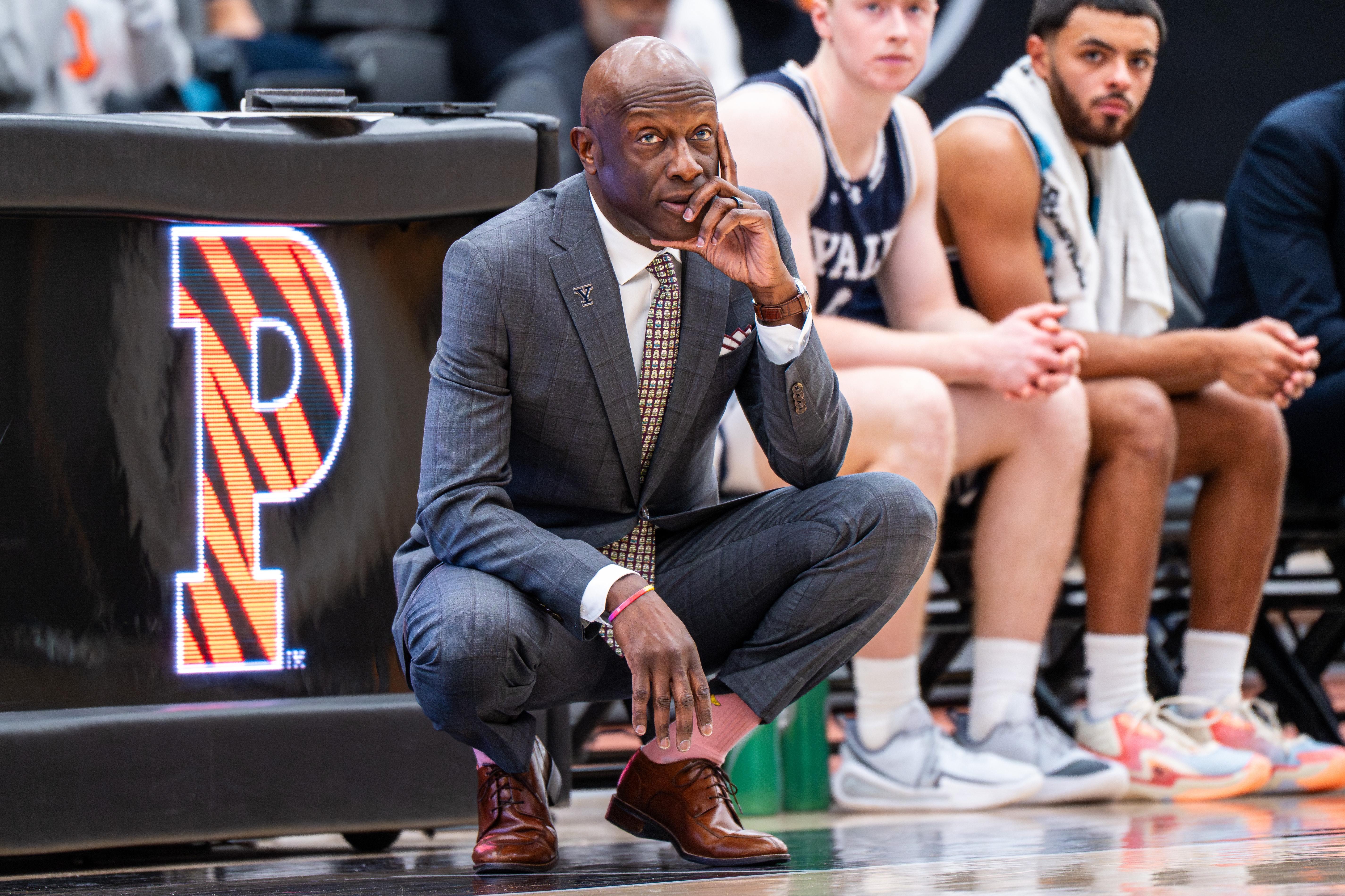
It may not have been the original intention of James Jones to enter into a lifetime of basketball coaching, but his passion for the sport — along with an overwhelming sense of boredom — forced him to alter his path in 1999.
Even early in his tenure as coach at Yale, it still seemed possible he might return to a career in business sales. After tying for first place in the Ivy League in his third season, the Bulldogs endured nine consecutive seasons without another significant breakthrough. That almost brought his dream to an end.
“I had no patience,” Jones tells Hoops HQ. “I was 36 years old and I wanted everything yesterday. I was full of piss and vinegar. I drove the team to a championship in our third year here and the reason why it wasn’t sustainable was because I was half out of my mind. I think that if I would have continued to coach that way, I might have had a heart attack by now.”
The waiting, as Tom Petty once noted in song, is the hardest part. Instead of that dreaded heart attack, Jones now has been accumulating championship teams while making history at college basketball’s mid-major level. It has become one of the great success stories in the sport.
Jones, who turns 62 in February, has become the architect of Ivy League domination the past decade at the school in New Haven, Conn. The Bulldogs have posted a 110-32 (.775) conference record over that span, winning six Ivy championships, four league tournament titles, and earning five NCAA Tournament bids. Yale now shares that rarified Ivy air previously identified with Princeton, Penn and Harvard.
Among active tenured Division-I NCAA coaches, only Oakland’s Greg Kampe (41 seasons) and Tom Izzo of Michigan State (31) have been around longer. Next in line, Jones is tied with Gonzaga’s Mark Few at 27 seasons each. For some perspective, the all-time leaders are Jim Phelan of Mount St. Mary’s and Phog Allen at Kansas, both with 49 years. Jim Boeheim (47 at Syracuse) and Duke’s Mike Krzyzewski (42) don’t land far behind.
Jones shows no sign of stopping.
“Every now and again I’ll be in the gym and I’ll look up at the championship banners we’ve won and kind of be in awe of what Yale has become,” he says. “But I don’t stay in that space very long, because I’m still in it. It’s not helpful to linger.”
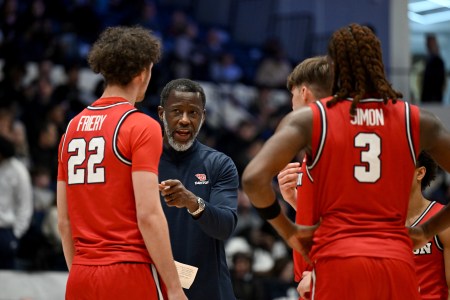
Following a 22-8 record in 2024-25 highlighted by a 13-1 Ivy League campaign, Yale has positioned itself for perhaps greater success this season. Led by 6-foot-7 senior forward Nick Townsend (17.0 points per game, 7.6 rebounds), a finalist for the Lou Henson Award given to the top mid-major player in Division I, Yale was the unanimous preseason choice to win the league again this season. Jones has surrounded Townsend with a solid and steady lineup of forward Isaac Celiscar (12.6 points) , center Samson Aletan, and guards Trevor Mullin and Casey Simmons. Sophomore forward Riley Fox (13.1 points) has been a huge contributor off the bench.
“It’s a matter of instilling in us the work ethic and dedication that is consistent in our program,” Townsend says. “Our three principles for the program are defend, rebound and share. Drilling that into us, and all the guys buying in, plays a massive role in how connected our team is and the success we’ve seen in the past few years.”
The Bulldogs, first in the nation in three-point accuracy (41.4 percent), began this season 11-1 overall, the best start in school history since 1945, and now stand 14-3 overall and 3-1 in Ivy play after consecutive home wins over Cornell and Columbia. The CollegeInsider Mid Major Top 25 currently ranks Yale at No. 6 behind Gonzaga, Miami (OH), Liberty, Murray State and Saint Mary’s. Yale’s only losses have come at home to Rhode Island and on the road against Alabama and Princeton.
“Nobody wins every game.” Jones said after a frustrating 76-60 loss at Princeton on Jan. 10.
Jones grew up on Long Island, the son of Herman Jones, a presser at a dry cleaner. After an undistinguished playing career at Albany, he worked as a sales executive for NCR Corporation before returning to the more familiar world of hoops. His role as an Albany assistant from 1990-1995 led to assistant spots at Yale and Ohio before he was promoted to the head job at Yale.
After Stops at Duke and Virginia, TJ Power Finds a Home at Penn
After starting his career at Duke and later Virginia, the sweet shooting 6-foot-9 junior has found a home at Penn
At Yale, the focus remains on the things the Bulldogs can control without looking too far ahead.
“I think that speaks to the sustained success our program has been able to have,” says Townsend, a psychology major with over a 3.9 grade point average who finished writing his thesis as Yale played at the Paradise Jam in the Virgin Islands in November. “We know we have a target on our backs. Using a loss like the Princeton loss is good for us. A lot of it comes down to our effort and attention to detail.”
Those are trademarks that have been perfected during Jones’ 27 seasons at the helm. He was hired to replace Dick Kuchen in April 1999, and with 432 victories he has become the winningest coach in school history, surpassing the legendary Joe Vancisin, who won three Ivy titles. He also ranks second in Ivy League victories, trailing only Hall of Fame coach Pete Carril of Princeton, who won 514 games in 29 years. Jones, a four-time Ivy League Coach of the Year, was inducted into the New England Basketball Hall of Fame in 2015.
Yale had last been to the NCAA Tournament in 1962 before stunning college hoops with a 79-75 upset of Baylor in 2016 and sending Bulldogs fans into pandemonium. Yale turned the trick again in 2024 with a first-round 78-76 rejection of Auburn. Now the Bulldogs are no longer a surprise on the national scene. Last season they threatened Texas A&M before falling 80-71 to the SEC foe.
Expectations have changed.
“We’ve gotten to the point where we go to the NCAA Tournament and lose to Texas A&M and our supporters are disappointed,” Jones says. “I mean, that’s the level that you’re at. What we want to do is try to get a Sweet Sixteen or Elite Eight. A Final Four. Now that’s really hard. The stars have got to be aligned.”
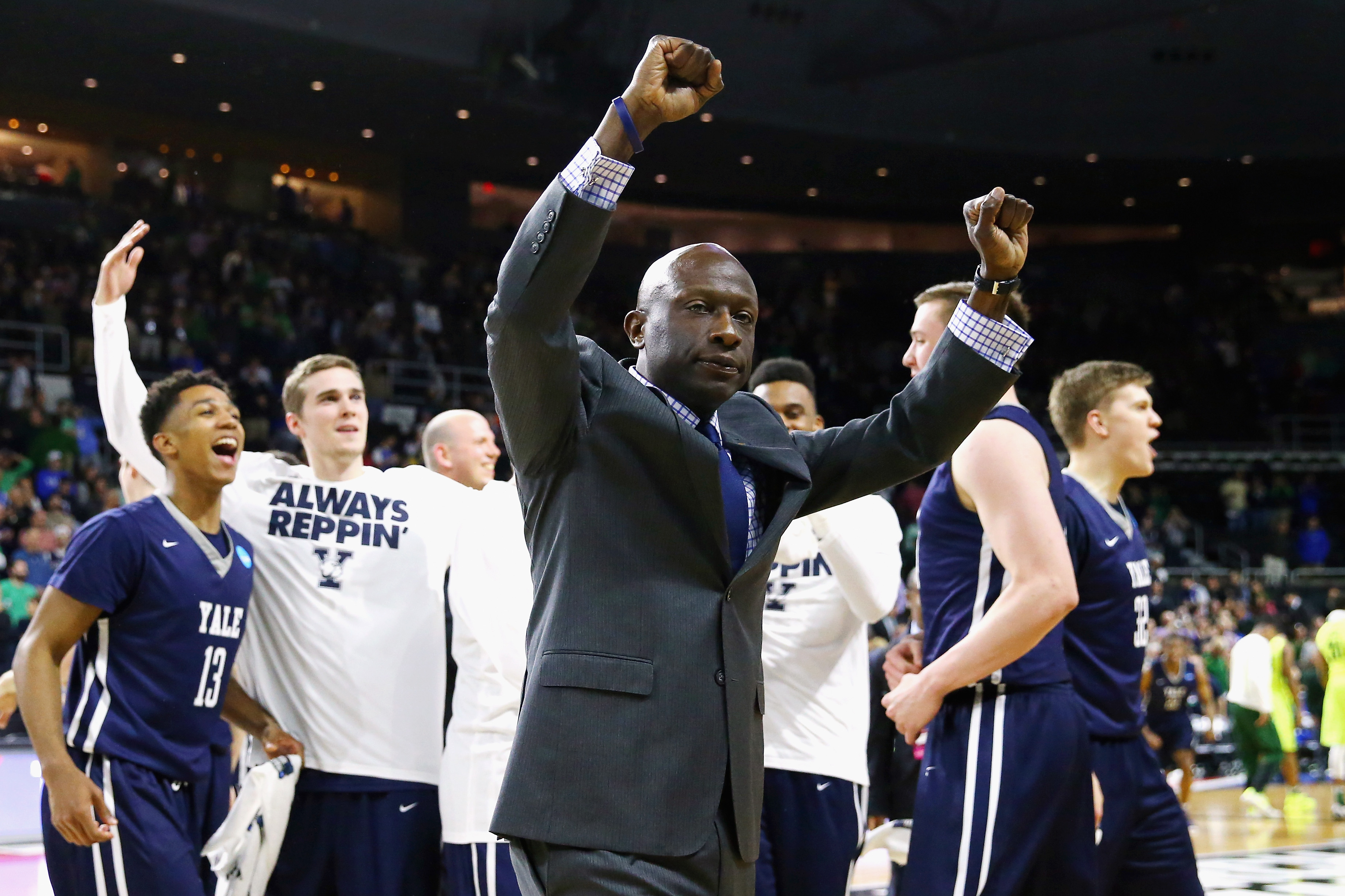
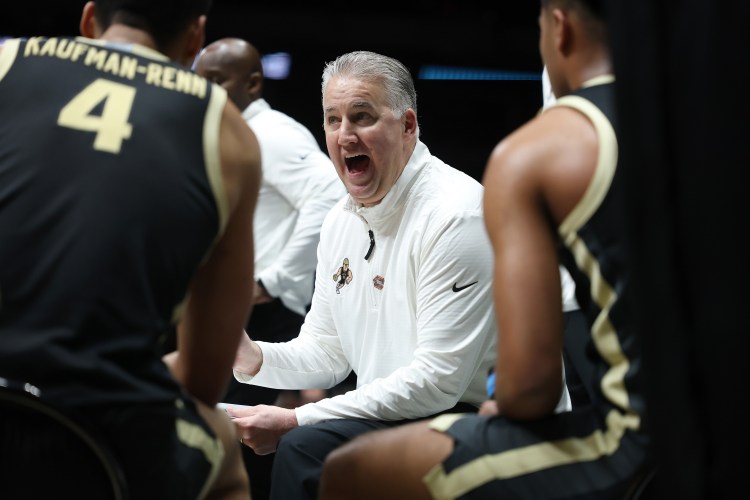
Winning the Ivy tournament and receiving the automatic bid to the NCAA field is the primary target for the league schools and their coaches. But crafting a nonconference schedule that builds off tougher competition has become a challenge for Jones and Yale because of the “curse of the mid-major.” Power programs refuse to visit New Haven because of the fear factor. Jones has turned to friends in the coaching profession — Matt Painter at Purdue, Bill Self at Kansas, Nate Oates at Alabama — to secure marquee road games or guarantee contracts. This season, Yale lost at then-No. 14 Alabama 102-78 on Dec. 29, coming off a 19-day break for exams and the holidays.
Perhaps the biggest disappointment for Yale is UConn’s refusal to schedule the Bulldogs.
The programs scheduled 14 games between 1987 and 2014. But the rivalry shut down in December 2014 after Jones took his team to Gampel Pavilion in Storrs and shocked Kevin Ollie’s defending national champions 45-44 on a buzzer-beater for Yale’s first-ever win over the Huskies.
“After we beat UConn, there wasn’t a team in the state that played us for five years,” Jones says. “I would love to play UConn. But if you go look at UConn, they play a very difficult nonconference schedule. I don’t blame (UConn coach) Danny Hurley because of the hard teams he plays. I wouldn’t want to play us either. But from my seat right now, it’s just hard.”
Jones credits his longtime staff of associate head coach Matt Kingsley, along with assistant coaches Tobe Carberry and Brandon Sherrod, for building the program’s culture and recruiting the unique players who can handle the academic and athletic rigors of Ivy life.
“It was built brick-by-brick.” Jones says. “If you ask anybody in the last decade, ‘What does Yale basketball mean to you?’ We defend, we rebound, and we share. I think that’s really changed our dynamic and helped us understand who we are. We go to practice every day and every game trying to play to those strengths.”
For Jones, outworking people is the start of it all. He says it has less to do with basketball and more to do with the people. That’s why he directs his staff to find players who will join Yale’s family atmosphere and build a unit that works together, wins together and shares everything. “We want to look for guys with a little snot in their nose, who aren’t afraid to get their uniform dirty,” he says. “That translates wherever you go to toughness. It’s not easy to stay up all night studying and then get up and have a good practice the next day.”
Townsend, just named Ivy League Player of the Week for the third time this season, is the latest to embody those qualities. After averaging 22.5 points with 16 rebounds against Cornell and Columbia, Townsend is just 21 points shy of 1,000 for his career.
“If we were to cut Nick Townsend open right now, and you found a metal skeleton, I wouldn’t be surprised,” Jones says. “He’s robotic in the sense that he rarely makes a mistake. If he makes a mistake, I’m confused. He’s the perfect teammate and the perfect player for a coach where all he wants to do is win.”
That’s the combination that keeps Jones reaching for the top. The next step is anyone’s guess.
“I’m one of the luckiest people you ever want to meet,” Jones says. “I didn’t set out to become a basketball coach, right? I wasn’t a high school kid thinking this is what I wanted to do for the rest of my life. I kind of lucked into it, so to speak. It’s just so fortunate.”
Meet your guide