One artery was clogged 100 percent. Another was 95 percent. A third in the 90-95 percent range.
Matthew Graves was dangerously close to having a catastrophic heart attack.
At age 50.
As a former Division-I men’s basketball player from Butler.
As a second-year head coach at Indiana State.
“I gotta say, there were a lot of people looking out for me during that week,’’ Graves told Hoops HQ of the Oct. 20 triple bypass surgery that saved his life.
“I’m just for the doctors at Union Health (Terre Haute, Ind.) that they were able to catch it,’’ Graves continued. “When you’re 50, having open-heart surgery is not something you’d expect.’’
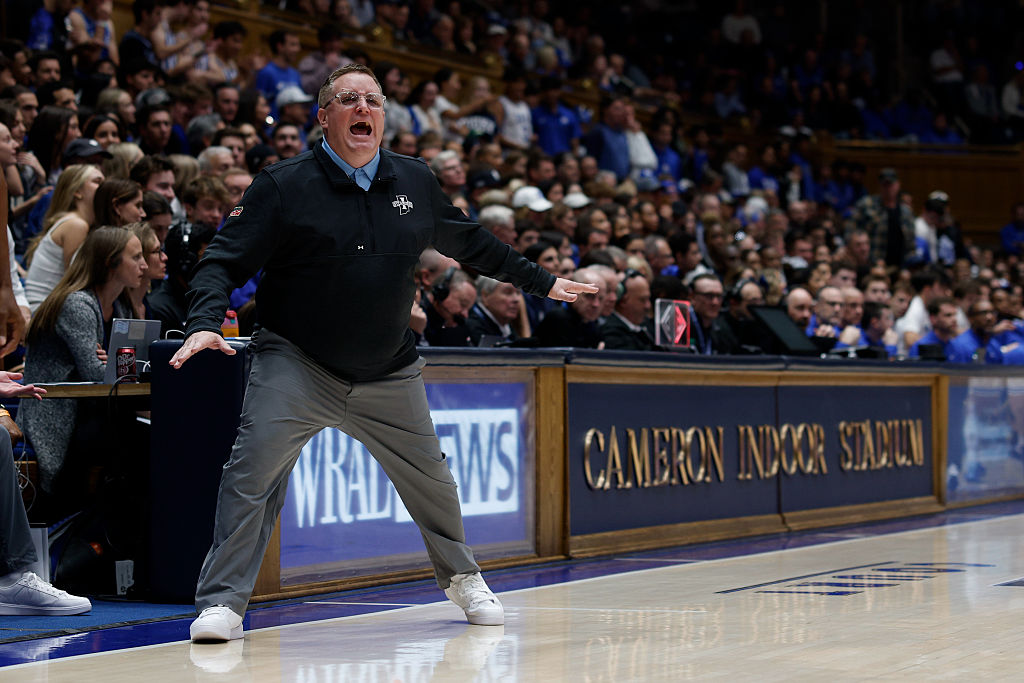
Graves, who turned 51 on Nov. 9, returned to the bench for the Sycamores Thursday night, though his duties were limited for the time being. He picked quite a game for his return, as the Sycamores fell in triple overtime to Bradley, 108-99. The game reached OT courtesy of a wild banked-in three-quarter shot by junior guard Jo Van Buggenhout.
Graves may not have been fully coaching the team as always, but he knows it’s a miracle he was on the bench to watch. It was easy to forget how close he came to not being there, or anywhere for that matter. He believes his warning signs can serve as red flags for everyone.
Read what your body is telling you. And Graves’ chest was screaming that something was wrong. His family went on a vacation in mid-August. He said he didn’t have a productive summer keeping his weight down and eating healthy.
“I was about 15 pounds heavier than I would normally be in the summer,’’ said Graves. “I had a goal to lose 25 pounds by Christmas, but as I began to work out, I would feel tightness in my chest a little bit and then it would go away. I was able to coach normally in practice and that continued for a couple of weeks.’’
Graves said he just chalked it up to being older and out of shape. But it didn’t subside. He went to see his doctor on a Thursday in mid October, and by Tuesday he had an echocardiogram. By Thursday the following week, he had met with a cardiologist to schedule a heart catheter test.
He said he was told that the worst-case scenario could be a stent or two.
“I thought, OK, I can handle that, no problem,’’ said Graves. “We were getting to play an exhibition against Butler and I was extremely excited to be back at Hinkle Fieldhouse. But when I woke up from the heart cath the doctor told me he had news. He said you’re not leaving the hospital.’’
He didn’t. He had the open-heart surgery the following Monday.
That Time When I Conquered My Anxiety
My days starting out in Fresno posed a mental health challenge, but I did discover Jerry Tarkanian’s odd sleeping habit
“When we heard that coach Graves was having a triple bypass it was a huge shock and pretty heavy,’’ said junior Camp Wagner. “We were just praying and hoping coach Graves was going to be OK. It all went from the news of the surgery to the shock to him letting us know that it was successful that he would be back in due time.’’
Wagner said the players knew that they would have to step up and fill some leadership voids as assistant Mark Slessinger took over on an interim basis.
As the team was grappling with Graves having major surgery, he was facing his own fears, thinking immediately about his family in the weekend before the procedure.
Graves said his wife and one of his daughters was with him and he spoke to his older daughter, who was away at school. He made sure to tell them he was going to be fine.
“That was one of the longest weekends I’ve ever experienced,’’ said Graves. “I wasn’t worried about making it through. It was more, are you going to be able to get back and be able to enjoy the things you do and be able to coach and do things with your family? That’s when it really hit me.’’
Graves said during his cardiac rehab he remained upbeat with fellow patients, most of whom were a decade or two older than him.
“The daily reminder is that I have a scar that runs down the middle of my chest,’’ said Graves. “That took a while for me to get used to and I’m just so thankful and appreciative of everyone who took care of me and outpouring of cards and texts and emails. I’ll never forget that and the support that I was given during that time.’’
He said the team aspect of the cardiac rehab was critical in his recovery. He said he could have just put on his headphones and done his work. Instead, he wanted to engage with all of the patients and share the experience they were all going through at the same time. There was a cathartic aspect of the rehab that has helped him recover.
While he did find a competitive streak, pushing the max number on the treadmill at times if he saw another patient moving faster, he said he was coachable and a good listener and patient.
And he’s been able to calmly watch the Sycamores at home, from the stands and behind the bench.
“Mark’s done a great job balancing it all,’’ said Graves. “I watched the Edwardsville and Duke games from my basement. That was hard for me. But then I’ve been at the home games lately and been able to go into the locker room and meet with the staff at halftime. And in the past few weeks I’ve been at practice. I’m not leading practice, but I’ve been able to do some tweaks and returning to some of the coaching protocols has been really good for me.’’
There is no timeline when he will resume his duties full-time.
The Sycamores, who had posted a 7-4 record through Dec. 17, will jump into Missouri Valley games against Bradley (Dec. 18) and at Illinois State (Dec. 21).
Graves will be watching, keeping calm and remembering how lucky he is to be around his family for Christmas.
“You’ve got to get things checked out if something doesn’t feel right,’’ said Graves. “It’s not worth it not to do that. You’ve got to think about your family. The scar reminds me of this every day. Hopefully after hearing my story, other people will get checked out and maybe it will save some people’s lives or extend their lives.’’
Meet your guide