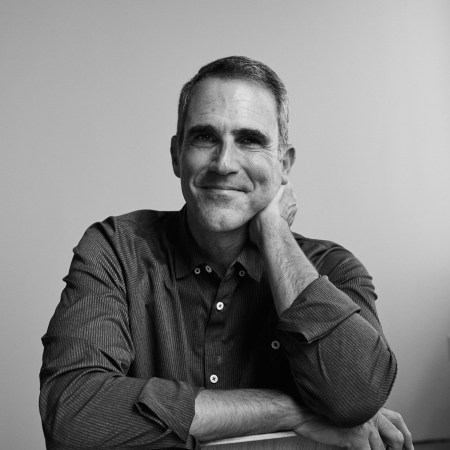

NCAA legend and St. John’s head coach Rick Pitino joined Seth Davis and Andy Katz on The Hoops HQ Show Tuesday morning to talk about bracketology, Gen Z, the Big East Tournament and more.
Stream full episodes of the podcast on Hoops HQ’s YouTube channel, @hhqsports, or live on the Fubo Sports Network.
Seth Davis: We are joined on Hoops HQ by the head coach of the Red Storm, Mr. Rick Pitino. Coach, thank you so much for spending your time with me and Andy. I want to start with your big-picture take on this team. There were a lot of expectations coming into the season: You were ranked fifth in the AP’s preseason poll. How does this team stack up heading into the postseason compared to where you thought you might be coming into the season?
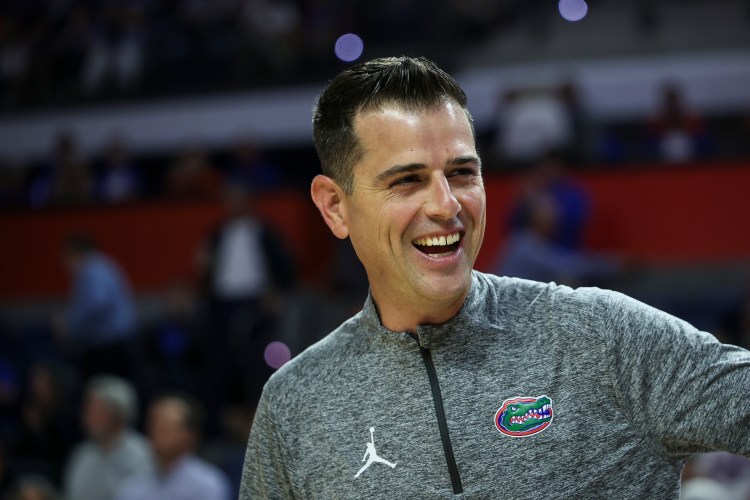
Rick Pitino: Yeah, I think it’s hard to be a prognosticator when you have eight new players, four new starters, and you just look at it and say, okay, this team’s going to be top anything. Because it does take a lot of time. I’ll give you an example of what I’m talking about: Florida right now, I think is one of the best teams in the nation. And their backcourt needed time to gel with the frontcourt.
This is my third-best team at St. John’s. I’ve been here three years and this is my third-best. And they’re good. They are good. I thought the first year’s team at the end of the year was outstanding. You had Dannis Jenkins and (Jordan) Dingle in the backcourt. You had (Joel) Soriano up front. You had (Chris) Ledlum at the power forward. But they really got good at the end of the year. And last year’s team was terrific. But this year’s team has taken much longer than the first two, primarily because I was taking longer to try and figure these guys out. But once we figured it out, I think they performed quite well.
Andy Katz: Rick, on senior night, it was understandable that you got very emotional introducing Zuby (Ejiofor). Can put in perspective what he has meant to you and to this program?
Pitino: Yeah, I think Zuby embodies everything I believe in. He came in, he was really a non-scorer, didn’t have great hands, really wasn’t a passer. He played very little at Kansas, obviously, because he was only a freshman. So he just worked so hard at player development, getting better and now he leads the team. He’s one of the top defensive players, leads the team in assists, rebounding, block shots and points.
So he embodies everything I believe in, from player development to leadership on a basketball team. And I am going to miss him terribly, because you don’t get three-year players anymore. The other guy I really like this senior class, but you just get to know them and you’re saying goodbye.
Seth: What’s the main thing you want to try to get better at heading into the Big East Tournament?
Pitino: Well, we need to get better at defensive rebounding, and we have. I just think every single team I notice, including the teams in the Big East, there’s a new thing now. Before, the charge-block was called about 50 percent of the time a charge, 50 percent of the time a block. Maybe even more, given the charges on defense. Now, every single team is bullying everybody to the basket, just pounding into the player, because unless you go vertical, you no longer get that call. The offense has a distinct advantage over the defense.
So we’ve got to get better at containing the basketball, getting in our gaps defensively and helping out those guys who are getting bullied to the basket.
Andy: Rick, I know that St. John’s does not control all the tickets at the Big East Tournament. But the atmosphere at the UConn home game a few weeks ago was unbelievable. I’ve been at a couple of your games this year at (Madison Square) Garden, and it’s been great. You’ve got a long history of coaching in the Garden: Knicks coach, college coach. What’s it like to get some of that back to where it really feels like it’s your home court?
Pitino: Well it’s funny you mentioned that — I got my team together this morning talking about the Big East Tournament, how spectacular it is. I said, guys you’re not going to fully appreciate this until you leave New York, but you guys just played 11 or 12 games as your home court in the World’s Greatest Arena. Whether it’s Michael Jordan or Kareem or LeBron, or you name any basketball player that’s had these legendary careers, like Kobe — the Garden is The Mecca. So you guys got to call that your home court. Now, it’s sellout crowds. So you’re always going to cherish that. You’re always going to remember that. I certainly still cherish it to this day.
Andy: But if I can follow up, what’s it like to coach there when it is rocking behind you?
Pitino: You know, for me, back when I signed my scholarship — they didn’t have letters of intent back then — I signed on the floor of Madison Square Garden, watching Julius Erving — he wasn’t Dr. J then — play against Marquette for Al McGuire, when Al McGuire turned down the (1970) NCAA Tournament to play in the NIT, because he had five starters from New York.
UMass lost by 30 points, but after the game I signed my scholarship papers on the floor of Madison Square Garden. So, from that point to becoming the Knick assistant, the Knick head coach, winning it back-to-back at Louisville and now at St. John’s, it’s very, very special to me.
Seth: You know, Rick, I thought I had heard every story that you had ever told, but I had never heard that one. That’s unbelievable. By the way, that’s my second favorite Rick Pitino story, second only to the fact that you interviewed with Jim Boeheim for a job on your wedding night, but that’s for another conversation.
Steering back to the St. John’s team, you had the big game at UConn on February the 25th. You lose by 32. Then you come home three days later, you play a pretty good Villanova team and you win by 32. How do you possibly explain that?
Pitino: Well, I told the guys, look, I lost to Notre Dame by, I think, 31 points, and we went to a Final Four. I lost to somebody else by 32 points, and we went to an Elite Eight when I was at Louisville. I said, it happens. Guys, you were well prepared, you practiced hard the day before, you had a great walkthrough, and it just happened. And then against Villanova, we had our worst walkthrough of the season, our worst practice the day before, we won by 32. So I’m never guessing how our walkthroughs will determine how we play.
But I will say this: Unless you felt your players didn’t work hard and didn’t give great effort — I looked at the game, I watched the film and I said, you know what? They played great. We did not shoot the ball well, at all, did not play well, but we gave effort. And I just said don’t worry about it, let’s get on with it, put the game behind you. I told the Notre Dame story about that Final Four, I told the story about the Elite Eight, so let’s get going to win against Villanova and forget Connecticut.
Seth: If I could follow up, what did you learn or what was exposed in the Connecticut game as an issue that you now have the chance to correct?
Pitino: You know, it was an overpowering crowd. They got an incredible run and they got to us a little bit. We wilted a little bit with that tough crowd. And sometimes when you coach young players and their offense is not clicking and they’re not doing well — and it was the whole team’s offense not doing well — your defense starts to go the other way and we did a little bit.
That was the lesson I tried to teach them. I said, look, you’re always going to have one or two games in the NCAA Tournament where your offense doesn’t go well and your defense needs to carry over. I actually showed them the clips leading up to the Wichita State game when we won the championship in 2013. I said, this team was the best defensive team in the nation, and I told my team at Louisville, if you’re not better than them defensively, you’re not getting to Michigan.
Purdue Legend: NIL and the Transfer Portal Are Depriving Today's Players
The former Boilermakers captain and current Big Ten Network analyst discusses program loyalty and life after college basketball
Andy: Rick, I covered you at Kentucky in the 90s, Louisville in the 2000s, now here at St. John’s. I still think you’re as intense as ever in terms of the way your players play their tails off, your assistants work their tails off. You’re intense, but you definitely have changed and evolved in a way that’s thoroughly enjoyable. Not that you weren’t before. How do you think you have changed over time and as a coach, now in your 70s?
Pitino: What’s funny, I heard Dylan Darling, I read him in the Steve Serby piece. He said, ‘Coach, when you lose, is a madman.’ And I am so different today. I would laugh if they ever got in a room with my Kentucky players, the Louisville players. I said, I’m like a teddy bear with these guys.
So, I just think you must adapt to the young people today. Not that they’re soft — I think it is a pampered generation. Obviously, the parents aren’t as tough on the kids anymore in this day and age. They give more love, which is not a bad thing. So I just try to give a little more love.
Not that I don’t believe in discipline. I do. But I tell my players all the time, if I’m not coaching and on you all the time, that means I don’t think you’re really good. They like me getting on them because, hey, he thinks I’m really good. So, you know, I don’t mind changing. I think change is good. I think when I was in my late 30s and early 40s, I invented the game. And then when I finally got into my 50s and humility struck me over the head with failing with the Boston Celtics — I think humility is really, really the biggest key of everything.
I couldn’t even tell you right now, if you ask me who the best coach is in the nation. I could probably name 30, 40 guys. When I was out of work, I used to go around and speak to some teams. And then when I was a pro coach, I’d go watch practices. The guys that I thought were phenomenal reputation-wise, I thought they ran decent practices, good practices. But then there were other guys that didn’t have these reputations as great teachers that I thought were phenomenal.
One was Skip Prosser from Wake Forest. I went to watch him practice and I thought his practice was great. So you really don’t know coaches until you watch them practice. And you guys, because of TV, have gotten a chance to watch walkthroughs and watch practices. And you can really tell who’s really tuned in. But more important, are the players focused on what the coach is saying? That’s the way I always look at it.
Seth: Well, I love the Skip Prosser reference. One of my favorite humans on the planet, gone too soon. To Andy’s point, Rick, you’re 73. We’ve seen coaches younger than you leave the game for various reasons. most notably that they don’t like the changes. Meaning players are getting paid. It’s more transactional. You referenced getting guys only for one year. Yet, I don’t get a sense that the changes happening in college basketball — I know you’re not thrilled with a lot of it — but I just don’t get a sense that that is chasing you away from the game. How are you processing those changes to still find that joy that you’ve always found in this job?
Pitino: Well, I think it’s more difficult coaching today than ever before because, like next year I’ll have probably four or five new starters. This year, I had four or five new starters. Trying to get a team to gel, and what the greatest hypocrisy with the NCAA is, here you have all these new teams and you’re paying them as professional athletes and they give you four hours a week in the summer. I think that’s absolutely absurd.
But as tough as it is, I think in the last two years, the product on the court, between the lines, is the best of the last 20 years. I think the players are much better, because all the Europeans — there’s a great player right now in the EuroLeague who’s going to pay the money back that the team’s paying him, and he’s going to get offered a large contract by this team, but he wants to go to college because he can make more in college than he can in the EuroLeague.
So you get the foreign influence of great players who are not playing over in Europe because they can make more money in college. And then you get guys like JT Toppin staying, because he can make a lot of money in college. So the product is much better because guys are staying in school. It’s tougher on the coaches, but the money part I don’t mind at all. For St. John’s, I think it’s a good thing because we don’t have football and we don’t have a ra-ra campus.
We have the Garden, we have the Big East, so pay to play is a good thing for us.
Andy: Rick, this season, two of my favorite moments involve you. One was the game at Xavier, you in the hallway with your grandson, with Richard, as a dad. I loved that moment. And then being on the court when you set the record, getting over 900 wins. And there were just some great moments that I remember this season, watching you as a dad and a grandfather and seeing you in that role — I loved it as a father myself. What have those moments been like for you at this point in your career and your life?
Rick: Well, it’s really exciting to have Richard back on the East Coast. He had a great run in New Mexico, loved it there, but he wanted to get closer to his family. We had to go three, four or five hours to see him play and he loves where he’s at now.
I’m not thoroughly enjoying playing against him in the same league. I just don’t like winning and he doesn’t like beating me as well. And this year we had an overtime game, and then at Xavier, we had to fight back from being down 15 to beat them. So he’s doing a phenomenal job. But I just don’t like it. If I had my druthers, I wish he was at Louisville or Duke or Carolina or some other place that wasn’t in our league. But it is what it is.
I also get a chance to see him. Like he’ll come in Tuesday. All the kids will go to dinner. And then I’ll be at his game on Wednesday, and then after the games we’ll go out together. We do handle winning and losing together very well. He knows if I lose to him, I’m going to be proud of him. It won’t bother me. And if I beat him, he’s the same way.

Seth: I think it bothers you a little bit when you lose, but if you got to lose, you got to lose to your son. Last thing: One of the reasons why I’ve really enjoyed talking to you over the years is, a lot of coaches are so locked in on their own team. They’re only focused on their own team or their next opponent. You watch a lot of basketball. I mean, you can talk about what’s going on around the country in college basketball as well as any media pundit — better than a lot of media pundits.
So let’s take St. John’s out of the mix. Who do you like? Are there any teams that are maybe a little bit under the radar, that are a bit better than some of us think and that we should keep our eye on?
Pitino: Well, I like Florida. I like Florida and Duke as the two best teams in the nation. I think if Michigan played Duke again, they may have the edge the next time they play them. I certainly like them a lot. I think everybody ranks the teams very well right now.
I do think UCLA could be a dark horse if you’re looking for one. But they’ve had so many highs and lows — if you watch the press conferences, sometimes you think you would have floated in the East River, but that being said, they’re playing good basketball right now and they’re coming on the right way. Illinois on any given night could beat anyone — they’re really, really good. The East Coast is not loaded, per se. I think Louisville, on a certain night, if you play fast, with that backcourt, they can beat anyone in the nation. Houston is going the other way a little bit right now. Why? I’m not sure of that. But they’ll get going come tournament time. Sometimes you have your lulls in the middle of the year and your dips at the end of the year, which they’re having, but they’ll come back. Adversity sometimes makes you stronger come tournament time.
Meet your guides