
Syracuse Legend Jim Boeheim joined Seth and Andy on The Hoops HQ Show Friday morning. Stream the full episode on YouTube, Spotify or Apple Podcasts.
Seth Davis: We are joined by a very familiar face in the world of college basketball, Naismith Hall of Famer himself, Jim Boeheim. Call him the former coach of Syracuse, but I think you’re pretty much the permanent fixture there for better and worse and everything in between.
Obviously tough transition time right now for Syracuse, it’s been a rough couple of years under Adrian Autry. What would be your diagnosis for the problems that the program had with Red as the coach and what’s your hope that things can be different now with Gerry McNamara?
Jim Boeheim: Well, basically we never adjusted at Syracuse to the price that had to be paid to get players and Adrian didn’t have enough money to get the players you have to have to win in the ACC. I mean, the prices have gone from $5 million to $10 to $15 now, might even be $20 in some cases in our league. And if somebody spends $15 or $17 and you’re spending $6, you’re not going to be competitive. That’s basically what happened here.
I think Gerry coming in, they realize what they have to do; there’s going to be more money provided for NIL. He’s done a really good coaching job at Siena. He had injuries, he had to change his defense, he had to change his lineup and still got to the NCAA Tournament and obviously gave Duke all they could handle. So he’s prepared.
But I think the money angle is something that, it’s just there. I mean, you might be able to sneak out a good team with $7 or $8 million, but you’re going to have to be lucky. And at $10 now, that might be enough, but it’s rapidly going to $15. There’s no end in sight because we have no cap, we have no contracts, you know, no real regulations.
How would you like to be, you know, Giannis, now a free agent. You can go to any team you want in the league with no compensation. He’d probably get about $200 or $300 million at least. So that’s what college basketball is and the price is going up. It’s radically gone up from what I’ve seen already this year from, you know, good players getting $2 or $3 and the really good players might get $5. So that’s where we are and you have to adjust to that.
Gerry’s got a great staff and he’s got a good start to recruiting. He’s got some fundamentally really sound players and I think he’ll finish up with a good class.
Andy Katz: So Jim, we don’t know what we didn’t know, because it’s hard to reject what would have happened had Gerry been in versus Red and all that. It just always seems that if it’s the coach after the coach who replaces the legend like yourself that coach is always in a better position because they learn the lessons, as you were just saying. In this case, it’s the money.
How much do you think it’s benefited Gerry that he was able to run his own program, to deal with all this adversity as the head coach, to get to the NCAA Tournament with a 16-1 and almost win it, to now being the head coach at his alma mater in a different stage of life and career than a few years ago?
Boeheim: Well, it’s definitely better for him. He’s got two years of coaching experience and making adjustments and turning the program completely around; it was at the bottom. We’re not where we want to be, but we’re certainly not at rock bottom. So I think that experience will help him and the money will make a difference. Those two factors are, I think, what you have to look at.
I think about the schedule last year, you never want to start out in a tournament where you lose three games, and that’s what we did. You don’t want to go out and play Kansas, Houston and Iowa State, three teams that were in the top five at one point or another, and almost beat Houston and Kansas. But, you know, it just was never enough. We didn’t have enough weapons. I think we’ve learned that lesson and I think we’ll be better for it.
Seth: I actually want to dig into that a little bit in terms of the money piece, because like you said, money is everything right now. It’s pretty amazing how, you know, a few years ago they had rules against how much cream cheese you could put on a bagel during a recruiting visit and now we see what’s happening.
But on Syracuse specifically and the ACC as a whole. Obviously the ACC the last few years has been a dramatic decline from what we traditionally know the ACC to be. My theory is that the schools in the ACC, and maybe Syracuse was a part of this I don’t know. When the whole NIL watershed was happening, it was almost like, “No, no, no, we’re above that. We’re not going to get our hands dirty doing that, we’re recruiting student-athletes.” You know, all these other leagues who, maybe were conducting business like this all along and now it’s just a difference of paperwork, were kind of ahead.
Do you feel like that is what happened to the ACC and maybe Syracuse in particular that it took some time to flip that switch and say, “We’re actually not above this, we actually need to raise this money and pay these guys?”
Boeheim: I don’t think anybody in the ACC thought they were above this. I don’t think that’s a good explanation for what’s happened. I think they vastly underestimated how much money it would take to be competitive, that’s what I think happened. And it changed a little bit this last year. Remember, we had four teams in the tournament two years ago, Carolina barely got in. This year we had eight. And why?
Well, Virginia bought a new coach, spent a lot of money. North Carolina State spent a lot of money. Clemson didn’t have to spend a lot, they had a lot of veterans and they were able to get there. Miami spent a lot of money and, you know, obviously Duke, Carolina, Louisville had been spending money. So we had eight teams in the tournament because the league made that adjustment.
From what I’m hearing, people in the ACC are spending real money this year. Duke has always spent money and they’ve also had more of a national brand where national brands will pay Cooper Flagg. Duke didn’t pay Cooper Flagg $8, $10 million — national brands did. So I think that is another part of it. But yeah, we were behind the Big 12, the SEC, Big Ten, and I don’t think we’re quite there yet, but we’re catching up.
You can win with a little less money. Indiana football didn’t have the money that some of those schools had in that league and they won the whole thing, so coaching still comes into play. You can also spend a lot of money like some schools have and not win. I mean, you still have to get the chemistry right, the scheme right. You have to do all that stuff, that’s all part of it.
Andy: Jim, I saw you courtside at the Final Four. What Michigan did, obviously not easy, where they did spend money, but they got guys that were willing to be more selfless, to not take all the shots and to not suck all the oxygen. And it all worked. There’s plenty of schools where we can point to examples where they went and got big time guys and it didn’t because everyone wanted the ball in their hands.

Hoops HQ Is a Webby Award Nominee. Please Vote for Us!
We are thrilled to announce that we’ve received a Webby nomination for Best Independent Publisher. We need your help to win the People’s Choice vote.
If you were coaching in today’s era, you know, how would you want to construct your roster to work in today’s times of this money?
Boeheim: Well, some of it is a little bit of good luck. Some of it’s research, making sure you’re getting guys that will buy it, that have played as good teammates where they’ve been before. You can look for that, you can see that example. And then, you know, it’s up to the coach to be able to get a team to play together. And back in the old days, you know, everybody was trying to score just like now. I mean, it’s no difference, players had to help sacrifice.And when they sacrifice what’s lost is they’re actually helping themselves and they’re helping their team.
Why? Because the team’s winning, people look at them more. If you average 18 points and your team’s horrible, you’re not getting many looks. If you average 14 and your team’s going to the Final Four, you’re going to get looks. People are going to look at that and respect that. Yeah, I mean, you have to have chemistry. Michigan, first of all, they had a tremendous level of talent.
I was not sitting too far away from them. They played horrible and won a national championship in the final game. I mean, I don’t know if they would want to admit to that, but they played, they didn’t play well. They didn’t play smart. They missed shots. They did a lot of things they don’t normally do and they still won against a good Connecticut team. I think if they play well as they did during the year, they’ll win by 30. That’s how good they were in size, physical size, strength, ball handling, shooting.
Andy: Well, they played like that Saturday night against Arizona.
Boeheim: Yeah. I mean, I had Arizona coming to the tournament kind of being the favorite and it was a no contest. Arizona didn’t even look like they had a chance. And so, yeah, I mean, but every team that gets to the Final Four, final eight, they play together, they try to help each other. There’s not selfish teams getting to the Sweet Sixteen in many, if any cases. You might not even get in the tournament if you got a really selfish team.
And sometimes teams just don’t fit together. It might not be that they’re selfish. You know, you get two guys that are scorers and that’s their mentality, they’re gonna try to score. And if you don’t have a balance to that, it can hurt your team.
But you know Michigan was the best team at the end of the day. But college basketball is in a great place. We have more good teams, more good players than we’ve ever had. You can hate the system, which it’s not a great system, but you end up keeping seniors longer, bringing in many more foreign players that were playing in Europe, making $500,000 or $200,000. Now they’re making $1 million.
So there’s probably going to be a hundred foreign players in the NBA that wouldn’t have been here in the NCAA and there’s going to be a hundred seniors that stay. That’s a huge talent level. You’re going to have better basketball. It’s kind of ugly off the court to get to that point, but it’s, it’s what it is.
You know, coaches have always adjusted. We adjusted the different things in the game, the shot clock, the three point line, all this stuff that comes up. This is the most dramatic adjustment that we’ve ever seen in terms of money. And if you spend enough money, you’re going to have a pretty good team for sure. You may not have a great team. You may not put together a great team, but it’s hard to put together a great team without money.
Seth Davis: For sure. So, I want to ask you about a situation that happened this past season at Syracuse and that was Kiyan Anthony, Carmelo’s son. And Carmelo being there, in a world of social media where things get out that wouldn’t have otherwise gotten out. I just wanted your take and your insight into that situation, partly because of course you coached Carmelo and you know him quite well, his name is on the practice facility. So he’s been very good to you and Syracuse and college basketball in general.
But also you coached your sons at Syracuse, Jimmy and Buddy. So you know what it’s like to be a dad in that dynamic. So I’m curious, first of all, if you had any conversations with Carmelo through all that and basically, you know, what’s the best way to manage that. And we should add, by the way, that kind of said he’s coming back as a sophomore. Obviously Carmelo played with Gmac, so it’s all well and good, but it’s been kind of an interesting situation. What’s your take?
Boeheim: Well, here’s, I gotta give you a little background. When Jimmy was at Cornell, his freshman, sophomore year, he wasn’t playing a lot. And I liked their coach, he’s a really great coach, I think he’s moved on down to William & Mary, Brian Earl. I think he’ll get to a higher level, but I didn’t agree with what he was doing. I’m a father. I said, “Jimmy’s better than that guy.” And I might’ve been right or wrong, but you know, the father is always going to think his son’s going to play. Trust me.
But Melo was good about it. I think he, you know, was disappointed.
Kiyan Anthony, my evaluation, is a guy we used to get, play a little bit, and by his junior year, he’s really good, senior year, really good. That’s what most players are. In today’s world, that doesn’t work because when that freshman goes out there, he’s playing against seniors and you can’t win when you do that. So he needs to get stronger, he needs to improve his shot. He’s a good offensive player. He needs to shoot the ball better and defensively, he’s got to get better. You know, my son’s in the G League and he couldn’t get the NBA and he was struggling in the G League because his defense was bad.
He got better his second year, third year, he’s had two really good years in the G League. You know, Kiyan has to improve defensively. He’s a really good offensive player. He gets in the lane, makes plays, he’s got to be able to make his three consistently. He shot 56 percent from the foul line. I think Red was in a position where he really had to play. They didn’t have a lot of guys. I think Gerry’s going to have a lot more guys looking at what the recruiting looks like.
So he’s going to have to improve and I think Carmelo will look at that. But, you know, he’s a father. If I did something to Buddy or Jimmy that my wife didn’t like, their mother didn’t like, you know, I’d hear about it. That’s just the way it works. But I’m hoping it works out. He can be a really good offensive player.
You look at a kid that left Syracuse, Quadir Copeland. He struggled here. I played him, but he was turnover prone. Then he went to McNeese State, almost got booted there, but he got going. He had a decent year, but this year, his senior year, he’s a top two-three team player in the league. Because some guys just take a little longer. Chris Bell had a really good year at Cal this year. He struggled for a couple years to get to that point. That’s just the way it is with some guys.
There’s very few freshmen in today’s world. Freshmen used to come in and play against other freshmen. Now freshmen come in and they’re playing against juniors and seniors or fifth year players. That’s a lot to ask. I mean, the top 10 or 20 freshmen can do it, but it’s hard for just normally pretty good freshmen coming in to be able to step in right away. How much you improve between your freshman, sophomore year, now that’s up to the player. Get stronger, get your shot better. You take care of those things and you’ll be fine.
Andy: I gotta go back a little history here with Jim here. I said this on the air during the tournament, I referenced ‘85 Big East and that time, you know, cause I grew up in the BC area. My dad was a professor there, so I lived it. I was in high school then, the Big East in the mid 80s.
But Jim, you lived it, you coached it. Educate our youth.
How good was the ‘85 Big East at ‘85 to ‘87?
Boeheim: Well, it was good because everybody had juniors and seniors because we all had veteran teams. That’s not the case today. It’s a different veteran team. They’re not guys that play together, but they’re veterans. In those days, these guys played together for three or four years. We had Patrick Ewing for years, we had Derrick Coleman, Rony Seikaly, Sherman Douglas, you know, Stevie Thompson together for four years. So it was just different. It was really good basketball.
The top teams were better than the bottom teams for the most part. And there was a clear distinction between the top teams in the country and the rest. In today’s world, there’s not that clear distinction between the top teams, maybe in Michigan or in Arizona. But those years, you know, were great years. The SEC hadn’t gotten going. The Big Ten was okay, but it was the Big East and the ACC. And we, you know, we got ahead of them.
They had, I think three teams in the term of one year and we had 11. So those teams adjusted, they got better to catch up. And then the money factor came in and schools that had a lot were able to use that money. Those SEC schools always had money they put into buildings, I mean they had $100 million facilities there. Now they took that $100 million and they’re just putting into their teams in most cases and that’s the difference today. But it was a special time, we were worried every day of winning a game in that league, trust me.
Seth Davis: So I want to ask you your all-time Syracuse starting five. My version of that is your top five all-time players. Andy’s version is to create the best team of pieces that fit together. So which would you prefer to answer? What’s gonna get you in less trouble?
Boeheim: You know that commercial when the guy’s talking to his wife and she says, if you could have “A” me or he goes “B,” you know how he does that? Well, with you two guys, I’m going to go “C.” I don’t like either one of your versions. So I never pick the best version, you guys do that. It’s like my family, I have four kids. You think I’m going to rate them?
If I pick two, my wife would kill me. And if I pick five here and don’t put Derek Coleman in, he’ll kill me. I was lucky, I had a lot of really, really good players and I mean, I could pick 10 guys that were just great players. That’s why I coached for 47 years. I’m not that much smarter than anybody else is. You know, you get players and you try to get them to play together, but it takes talent to win, that’s as simple as it can be.
I mean Pearl Washington, the most exciting player I ever coached and probably the most exciting player I ever watched play. Maybe Calvin Murphy was in the same area, but just for true pure excitement. I was just happy I got to coach him, if we had a lead, I’d just sit and watch him some nights, but I was lucky.
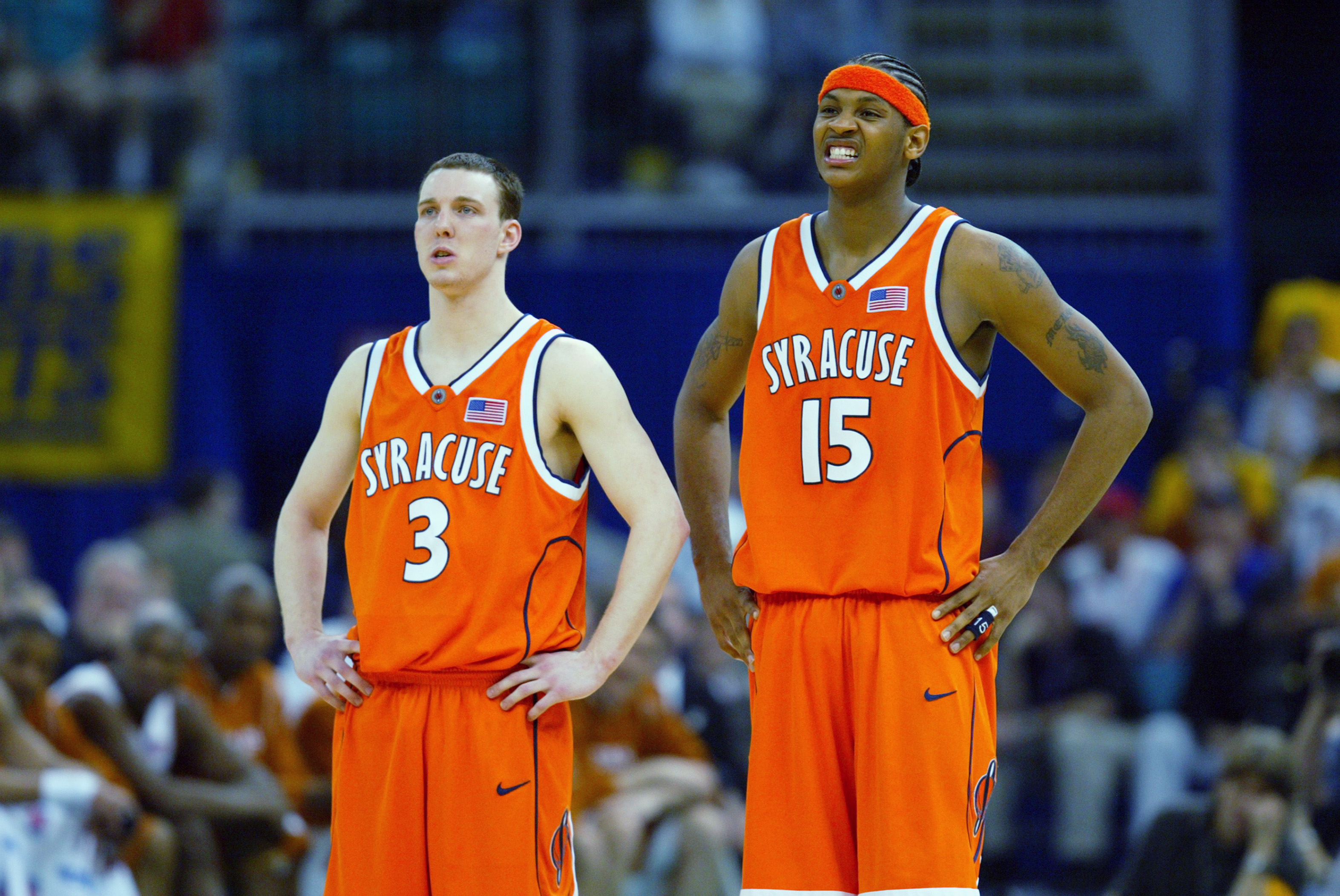
Carmelo won the whole thing for us, so he’s always going to be there, in a special place for me and he’s given back to our school. I’m praying that his son really steps it up and plays well. That’s what I’m hoping for.
Seth: All right, well the easy answer is your favorite two are Jimmy and Buddy, so we’ll let you off the hook.
Andy: Well, but, I’m curious Jim, not for you but just in general.
Which one do you like better? Picking a team or picking five all-stars?
Boeheim: I think if I had to pick five, I would try to pick a team. I would try to pick positions, two forwards, two guards and a center. That’s what I would pick.
The problem is I have Roosevelt Bouie and Rony Seikaly at center. And at forward I got Billy Owens, Derrick Coleman. You know, I got John Wallace, I got Carmelo Anthony. At guard I got Pearl Washington, Sherman Douglas, I got Lawrence Moten, Gerry McNamara. That’s ten, I mean, I didn’t even think about it. And the better one of all of them was Dave Bing. So, I mean, he was better than all those.
Andy: There you go.
Seth: That’s right. I’ll tell a story on your behalf, Jim, because I quote this a lot. Jim was in a chapter in my book on coaching and he told the story about his mom where he goes to Syracuse and the first year you get on the court and there’s this guy who no matter how hard you work and no matter how hard you try, you’ll never be remotely as good as him.
And you call mom, you call mom and you say, “I’m not remotely as good as him. I’ll never be as good as him. I don’t know what to do.” And instead of mom saying, “Of course you’re as good as him,” you know this, she says, “Well, what about those other guys?’ And you said, “Well, none of those other guys are as good as him either.” And she said, “Well, I guess you’ll just have to be better than those other guys.” So that’s a good statement on your life, right?
Boeheim: That’s what happened. My mother was 100-percent right. I got better than those other guys and so I got to play. But yeah, I mean, I’ve only been here for 64 years. I don’t know. I mean, I’m probably getting used to being up here by now. I don’t know. Has anybody ever stayed at a school for 64 years? I don’t think so. Not consecutively.
Seth: Right, probably not. Then of course, the other famous quote, Andy, was when he went to Maui for the Maui Invitational. And you said, “How’d you like Maui?” He goes, you know, “It’s like Syracuse in July.”
Boeheim: Ha ha ha. I had a couple of those.
Seth: Jim Boeheim’s Greatest Hits. Well, thanks for joining us on the Hoops HQ Show. Always great to catch up with you. Look, I see you on TV. You’re in the media now, so we’ll be calling you plenty and getting your insights. You haven’t lost a game in quite some time, so thanks for taking the time to join us.
Andy: Thank you, Jim.
Boeheim: Thanks guys, appreciate it. A lot of fun being here.
Meet your guides