
NIL agent and Weave CEO Dan Poneman joined Seth and Andy on The Hoops HQ Show Tuesday morning. Stream the full episode on YouTube, Spotify or Apple Podcasts.
Seth Davis: We are now joined by Dan Poneman. Dan is the founder and CEO of Weave, which is an agency that represents all kinds of men’s and women’s basketball players, including well over 150 players in the portal.
Dan founded his agency about four years ago. He was one of the really early guys — agents, I should say, getting into the space of representing college players and helping them navigate all of the options, especially with respect to NIL on the transfer portal.
So he has not only seen this space change so much, but he helped to create it. So Dan, thanks for being on the show. We want to have a big picture conversation on what’s happening out there in the marketplace with the transfer portal, especially since it opened up the day after the Final Four ended.
How would you compare how the market is working right now compared to in the past?
Dan Poneman: Well. Now, every year since this thing has started, it’s changed drastically. Year to year, you know. Last year, the big conversation was around the switch to the House settlement, right? A lot of schools trying to front payments to beat that shift from a world of collectives to a world of just revenue sharing.
There were key changes in previous years before that. Like you said, I was the first agent in basketball doing this. Initially you couldn’t really use NIL as an inducement. So it was a totally different landscape of having to tiptoe around that.
The big conversation this year is above the cap on NIL. You have your revenue sharing payments, and then at Power Four schools, your revenue sharing cap has to be split across all sports. A Big East school can spend $10 million on revenue sharing. A Power Four school only has 20.5 million to split across all sports. So they might only have $3 million for revenue sharing. So the big conversation is, hey, if the school offers a player $3 million and 750 is rev share, how are you getting that money above the cap? How are you making real NIL payments to justify this? Like that’s the big conversation and no one really knows how this thing’s gonna pan out. We saw it in the football portal and now that’s the conversation happening in the basketball portal right now.
Andy Katz: All right, so Dan, educate me here. In talking to a lot of different college coaches, they basically say they have no leverage. We saw this a lot last season, this past season, where players, whether they’re injured or not, kind of shut it down. And now they’re back in the transfer portal. Why can’t we get to a point where a contract has clauses, has incentives?
You want X amount of dollars, you play X amount of games. You wanna have your revenue increase, you stay a second year. You play X minutes — the kind of contracts that have incentives that we see in the professional space, and we’re obviously entering a professional world.
Why are current contracts largely devoid of clauses and incentives?
Poneman: Well, we could do an hour just on that question right now. And for me, one of the ways that me and my company have gotten ahead in this space is by being creative and thinking innovatively in those ways, doing multi-year contracts when other people weren’t.
But a lot of schools are still stuck in the past and they’re afraid to be innovative. And additionally, there are limiting rules within the current infrastructure that prevent it. So for instance, I have a player right now who redshirted last year with a pretty bad injury. I’m negotiating a deal with his school for the upcoming year and they’re afraid that — what if he doesn’t play all the games? What if he gets hurt again? So I wanted to do a deal of, hey, if he plays 60% of games, he gets this amount. If he plays 80%, he gets this amount. Structuring the deal based on how much he plays.
And they’re saying, well, our administration won’t let us do that. They don’t think it’s within the rules: it’s not supposed to be pay for play, this is supposed to be marketing money, right? Similarly, I propose many schools do multi-year deals with mutual buyouts after each year. Some schools do that, which I think is great: Hey, let’s do a two-year deal and if he outperforms it, he has to buy his way out of the contract, and if he underperforms it, you have to pay to get rid of him.
Some schools are doing that. I think it’s advantageous for them and other schools just can’t wrap their head around it. They’re doing these year-to-year deals but ultimately, we have to get to a point where we have collective bargaining, where athletes are employees, where we have a union, where we’re able to negotiate between the schools and the players.
Everyone’s complaining about the system’s broken, it’s chaos, but no one will do — who’s supposed to do something about it? I’m not gonna accept the NCAA making rules on behalf of my players. The NCAA represents their member institutions. They don’t represent my clients, right?
So until we have a union that’s representing our clients, and we can go against the NCAA and collectively come to an agreement on how this thing will work, it’s gonna be making up rules left and right and arguing them out in court, which is not healthy for anybody.
Seth: So I think the follow-up question there, Dan, is there’s nothing — correct me if I’m wrong — there’s nothing in the rules that says schools can’t do this. You see this on social media all the time: They should be allowed to do multi-year deals. They’re allowed to do multi-year deals. They’re allowed to have buyouts. Okay, you want to transfer? Then you have to pay us new money or the school that wants to take you has to pay that buyout.

Hoops HQ Is a Webby Award Nominee. Please Vote for Us!
We are thrilled to announce that we’ve received a Webby nomination for Best Independent Publisher. We need your help to win the People’s Choice vote.
There are no rules against multi-year deals, buyout clauses and the like, am I correct?
Poneman: I’m working on a deal right now for a player who’s an unproven young player who’s going to a Power Five school and the structure that I’m proposing is $100,000 for the first year, $300,000 for the second year, okay? If he performs really, really well and he wants to move on, he has to pay $100,000 to get out, but he’s gonna go make a million somewhere, so it’s fine. And if he doesn’t perform well, they have to pay him $100,000 to get out of that $300,000 guarantee. That’s how it works at the pro level.
Good GMs understand the economics of this and can think multiple steps ahead. In pro sports, like overseas you have FIBA and in the NBA you have the NBPA that can work out these disputes if they come.
Now I’ve seen situations where players have buyouts and they basically say screw you, they go to the next school and say screw you, sue me. Like we saw with the quarterback at Tennessee — I don’t work in football, but where they basically said all right you’re gonna have to sue me in court.
Now, do we really want to see schools sue between players? That’s where it gets complicated. There is no governing body that can actually have jurisdiction over these disputes. So it’s not a perfect system, but that’s why an agent like me comes in. I come from a background of having worked in the sport for 20 years. Yes, I work on behalf of the players. My job is to get my players paid and protect them, but I also care about the stability of the sport. I care about the integrity of the sport and I care about the coaches who I have to work with year after year.
So if I have a player shut it down when they’re not really that hurt — I had that situation this year. Client came to me, getting paid $50,000 somewhere. He’s like, I’m not playing enough. I’m kind of hurt. I’d rather shut it down right now and get my redshirt year. I said, all right, you can do that. You’ve got to give him back the $50,000. I’m not letting you keep that $50,000 they’re paying you to play, and if that role is nine minutes that’s their choice.
There’s so much chaos and there’s so many agents that are only thinking on behalf of their players and not the health of the overall sport itself. That’s where we get into some of these problems.
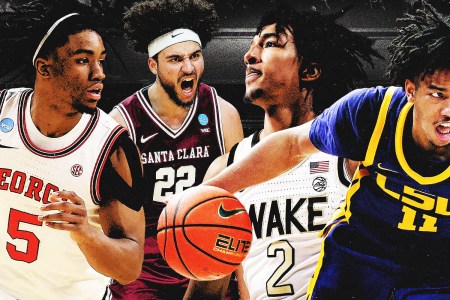
UPDATED: Ranking the Top 50 Players in the NCAA Men’s Transfer Portal
May 3 update: Over 2,000 players have declared their intent to change schools. We rank the top 50.
Andy: I still wonder if we ever get to a collective bargaining agreement, who is doing it? There isn’t a union. Can there be a union? It’s been shot down before in terms of whether the players can unionize. The schools don’t want them to be employed.
So who’s negotiating for the players? Who’s negotiating on the other side?
Because it would have to be for all sports. So was it Charlie Baker? Is it the commissioners? Is there someone just for basketball and someone just for football? All these kinds of things. We still don’t know who actually would be doing the talking, the negotiating. And that’s a problem.
Poneman: First off, I think it cannot be for all sports. Football is very different than basketball. Basketball is very different than non-revenue sports, right? You don’t have the NBA, the NFL, the MLB all having one collective bargaining agreement. It’s different. There’s different economics in each sport.
Second off, I’ve seen athletes.org and this group and that group and they’re all trying to claim to be the new union for players. Well, I represent most of the players. I represent more players in college basketball than anybody else by multiples. And no one from athletes.org consulted me on their agreement. I think what it has to be is me and some of the other elite agents in the space.
There’s me and eight other guys who represent half the good players. If we’re all aligned and we want what’s best for our clients, we can nominate someone to lead our group, just like they do in the pros. The players themselves vote and there’s player representatives and they come together. Now the last challenge I’ll say there is: In the NBA you have guys who could be in the NBA 10, 15 years. Every year we lose 25 percent of our union members theoretically and a new group of freshmen come in that have no idea what’s going on. So really the agents, the elite agents in the space are the stable forces that need to come together, and I’ve been working to bring a lot of those guys together.
Shout out to Corey Markham and Austin Walton and some of these other guys who have done a great job in this space who have the best interests of their clients in mind. Hopefully we can come together and support our clients in finding a fair way to negotiate with the NCAA to come to a good resolution.
Seth: We’ve talked about it on social media and elsewhere. The feasibility and legality of a players union in college to me is so far-fetched. I’m glad you’re trying. It’s certainly a fantastic idea, but it is interesting to get your perspective on this and how this is evolving.
Poneman: We’re very far away, we’re very far away, you’re right, it is very far away from having a players union. We’re very far away from them being employees, but it’s inevitable. Is it in five years, is it in 10 years, is it in 15? It’s inevitable. They are employees, they’re earning millions of dollars from these institutions that are earning billions of dollars. They are employees, just not called that. It’s inevitable, but it’s very far away, and until we get to that point it is going to be absolute chaos.
And you know what? I’m going to exploit that chaos to put money in my clients’ pockets because it’s better in their pockets than the pockets of the universities, the administrators and the coaches.
Seth: Amen. And by the way, I’m all for the capitalism, money chasing, all this. I’m glad these players are getting paid. I’m glad guys like you are helping them get paid. Everyone says, this is awful. The players are asking for X million dollars. Well, don’t pay them. Obviously the market is warranting them paying. It’s a super busy time for you. Thanks for joining us on the Hoops HQ show. Best of luck.
Meet your guides