
A bipartisan bill aimed at bringing stability to the chaotic world of college sports is set to be released.
On Friday, Senator Ted Cruz (R-Texas), the chair of the Senate Commerce Committee and co-author of the bill, joined The Hoops HQ Show to discuss the groundbreaking development.
Cruz and Senator Maria Cantwell (D-Wash.), the ranking member of the Senate Commerce Committee, announced the new legislation earlier this week, as leaders across the NCAA have continued to call for Congressional help to tackle the many issues impacting college athletics in the NIL era.
“This is a big deal that we now have bipartisan legislation,” Cruz told Hoops HQ. “We introduced it because college sports are in crisis.”
If ratified, the bill — named the Protect College Sports Act — would limit undergraduate athletes to one “free” transfer, establish a five-year eligibility window that excludes professional athletes, institute a hard cap on direct payments from schools to athletes, and prevent coaches from taking new jobs in the middle of a season. It proposes a narrow antitrust exemption related to transfers and eligibility, protecting the NCAA from legal challenges in those areas.
While none of the college sports bills introduced in Congress over the past six years have advanced, there is optimism that the Protect College Sports Act could break the trend. The Republican-backed SCORE Act, a separate bill that has been widely debated in recent months, has garnered little support among Democrats in part because it designates athletes as non-employees. The Protect College Sports Act avoids such a definitive declaration.
In this exclusive interview with Hoops HQ’s Seth Davis and Andy Katz, Cruz breaks down the bill, addresses some of its criticisms and explains why he believes it will ultimately be passed into law.
Seth Davis: Senator, thanks so much for taking the time. Thank you for your work — you and Senator Cantwell — to get to this point. I know we have a long way to go, but a lot of us, myself included, didn’t think we could even get this far. So you’re to be congratulated and thanked for that.
It’s called the Protect College Sports Act. The main criticism out of the gate is that this has tilted too far in favor of the schools. You’re proposing ways to limit athlete compensation and their ability to transfer, plus their eligibility. So the main question to start, Senator, is why shouldn’t athletes have the same opportunities offered by the free market that coaches and athletic directors have?
Sen. Ted Cruz: Seth and Andy, thank you for having me. It’s good to be with you. This bill was introduced, and this week is a big deal that we now have bipartisan legislation. We introduced it because college sports are in crisis. And the biggest losers, if Congress doesn’t act, are going to be the athletes. What we’re seeing right now, number one, the transfer portal that I think is out of control. You’ve got kids transferring three, four, five times. You’ve got no eligibility standards — six, seven years. You’ve got people playing who are 27, 28 years old. You’ve got pros going back to college athletics. None of that is good. And then on top of that, you’ve got an out of control spending spiral that is causing — every week we’re seeing a different school canceling women’s sports, canceling track and field, canceling Olympic sports, canceling tennis. That’s going to keep going.
If Congress doesn’t act, I believe within three to five years, we will see a total of somewhere between 30 and 50 schools that have football teams that are competitive nationally. And I think everyone else basically goes away. Everyone else basically becomes a high school team and is no longer competitive in any meaningful way. That would be devastating.
And for the athletes, if you look across the country, there are more than 500,000 college athletes right now competing in the United States. My approach in drafting this bill, along with Democratic Senator Maria Cantwell, was: I’m less worried about the superstars. I’m less worried about the Michael Jordans or the Arch Mannings. They’re going to be fine. They’re going to do great. They’re going to make millions of dollars. They’re just fine. I’m worried about the 99 percent of college athletes who will never play in the NFL or will never play in the NBA, but college sports has been their avenue to go to school, to get an education, to get a degree and to learn all the skills that you learn through competitive athletics — to learn teamwork and discipline and hard work and sportsmanship, all of which, even if you’re never going to be a professional athlete, set you up for success to provide for your family for the rest of your life.
I think if we don’t act, those 500,000 kids playing college athletics, in three to five years that drops in half. And you’re talking about over years, millions of young men and women who have been able to go to school because of college sports, if Congress doesn’t act, those kids don’t get that opportunity. That’s why I think we need to act.
ACC Preseason Power Rankings for the 2026-27 Season
The Blue Devils are once again the team to beat in the ACC. Check out where Duke’s rivals land in the conference’s preseason power rankings
Andy Katz: There’s no question, Senator, that schools have made those choices in cutting sports. I’m curious, politicians and athletic departments have dealt with this donor class; but at some point there ends up being, whether it’s in politics or sports, donor fatigue. At some point, the market takes over because it’s not a bottomless pit of money. What do you think the chances are without this legislation that the donor class at some point says, you know what, I’ve had enough or I can’t give as much so that those numbers do end up coming down?
Sen. Cruz: Well, I think what happens is, you’re getting a bigger and bigger divide between the haves and the have-nots. Let’s take Texas. And by the way, in terms of college athletics, the monstrous college football generates the overwhelming majority of the revenue. College basketball generates a little bit, and then essentially nothing else generates revenue. That’s the entire field. When it comes to college football, in Texas, if we do nothing, the two programs that I am certain survive are the University of Texas and Texas A&M. They’re big enough, they have a big enough donor pool that no matter what happens, UT and AM are going to be there and they’re going to be just fine. I am not at all confident that any other program survives in Texas. And if we’re three to five years from now and we see no Baylor, no TCU, no SMU, no Texas Tech, no University of Houston, no Rice — that’s a terrible thing. That’s a terrible thing for the players that would have had the opportunity to play. That’s a terrible thing for football fans. It’s a terrible thing for this state and for the game nationally. So I think it is critical that we act now to prevent that separation. Basically what you would have is a mini NFL. And that’s not good.
What we’re seeing is the really wealthy institutions, they’ve got the resources to keep ramping up and ramping up and ramping up, and all the other schools are desperately trying to keep up. Almost every athletic program in the country right now is losing millions and, in many instances, tens of millions of dollars in an unsustainable way, which is why they’re canceling sports one after the other.
This bill attempts to strike a balance. First of all, it protects the rights of athletes to be compensated. I think the old system, where athletes couldn’t be compensated, was wildly unfair. Everyone was getting rich on sports except for the athletes. That was wrong. And as a conservative, I think you ought to be able to reap the fruits of your labor. If you’ve developed a great skill that generates a lot of value, you ought to enjoy the rewards that come from that. And so this bill protects real NIL opportunities. If you’re a quarterback and you’re selling sneakers, you should be able to make as much money as you can doing that because that’s real NIL. It also protects revenue sharing — that schools can share a significant chunk of the revenue that they’re getting with the athletes. But what it does is it goes after the fake NIL. It goes after the booster with a bag of cash who just meets in a back alley and says, “I want this player at my school.”
Going back to the athletes for a minute, let’s take a kid who hopes to play in the NBA. But just about every college player hopes to play in the NBA, and we know about 1 percent of them are going to. If a kid goes to three or four schools in four or five years, that kid is very unlikely to get a good education. If you’re just hopping from school to school to school, you’re not in a major, you’re not studying, you’re not developing skills. And when your college time is done, you don’t have the benefits you would have had if you went to a school.
So let’s take the transfer portal. We wrote in the bill: Every athlete is entitled to one free transfer. You can transfer anywhere you want once. A second time you can transfer if, A, your coach leaves, B, your program is canceled, or C, you’re the victim of sexual assault or sexual harassment.
Other than those exceptions, if you transfer a second time, you can do it but you have to redshirt a year. I think that’s a much better system for athletes and for programs and also for fans. Fans get really tired of seeing their team and then at the end of the year, the whole team goes away because richer schools go and poach all their good talent. It doesn’t let coaches and programs develop talent and grow them up into being stars within the school, which is a big part of college athletics.
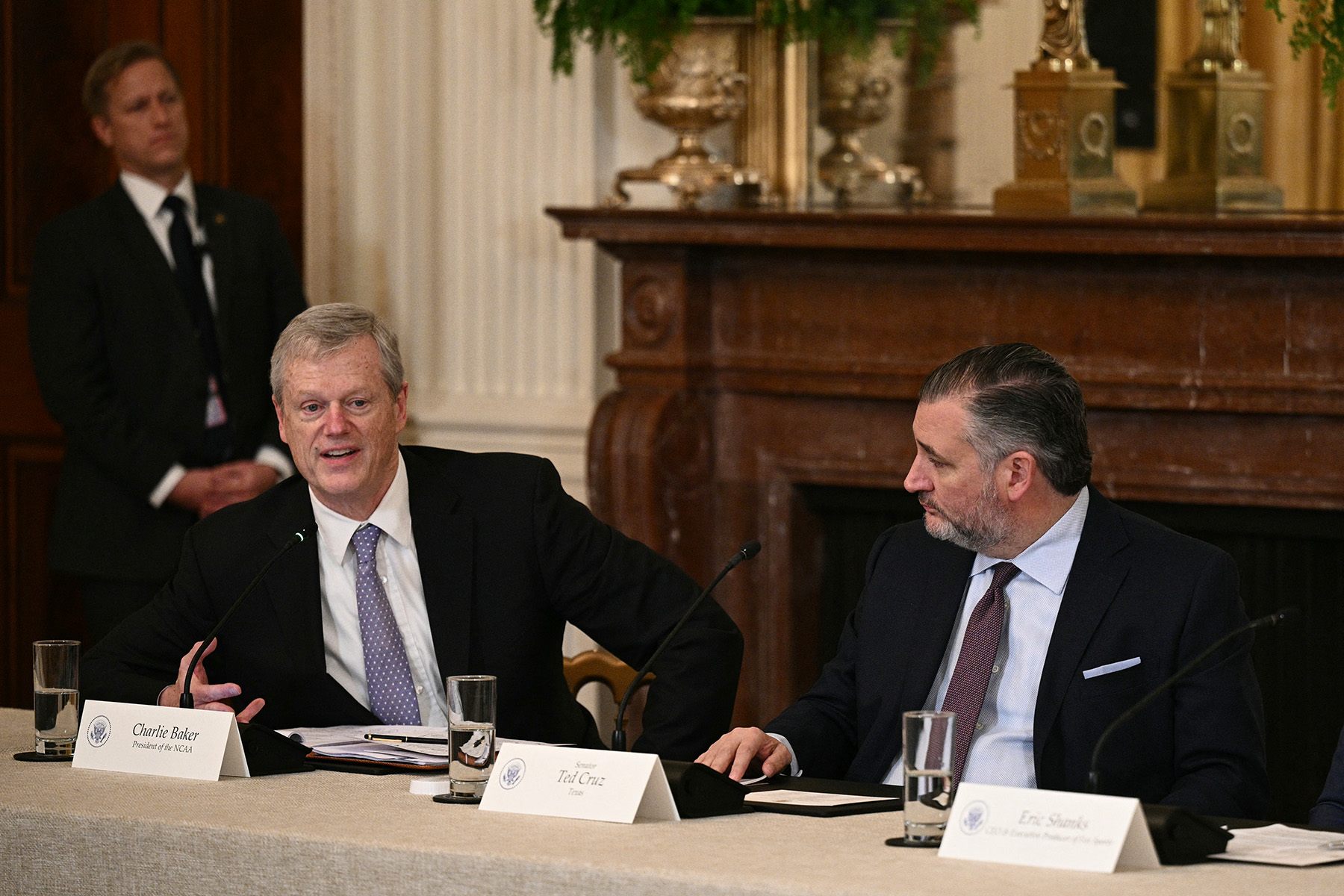
Davis: Senator, the politics of all this is so fascinating to me. We’re used to hearing folks like you on your side of the aisle make the case for the free market. Small-c conservative, small government intervention or non-intervention. We have a settlement in the House case, and you all are basically saying, all right, we’re going to force schools to follow the rules that they agreed to in the settlement. And then on the other side, you have folks on the left who are saying, well, let the free market work for the laborers. So why in this situation would you maybe depart from your traditional non-government intervention position?
Sen. Cruz: I am a big free-market person, but in this case, it is Congress ultimately that has screwed this problem up. Because it used to be that you could have rules. The NCAA had rules on eligibility, on transfer, and they could enforce them. And what happened in recent years is the courts applied the federal antitrust laws, which Congress wrote, to basically strike down all the rules. It created the chaos. So now anytime the NCAA tries to enforce a rule, it gets struck down in court. The system is broken down.
Let’s think about the NBA. All of us love the NBA. The NBA has a salary cap. They don’t have unlimited bidding. If a team wants to acquire a player, you have to work within the salary cap, and it makes the whole system work. For a league to work, you have to have rules that apply so you have some modicum of parity. In college sports, we’ve lost the ability to have those rules to make it operate. And this is allowing the system to work.
As I think of the problem, there are two aspects. One, cost. You’ve got to stop the out-of-control, spiraling cost, at least slow down the increase so that colleges can keep up and maintain the programs they have. But number two, on the revenue side and an important part of this bill, we allow college sports to pool their media rights together and negotiate jointly. I believe that will generate substantially more revenue for college sports across the board. And as a price of schools being able to do that, we require that they maintain all of their roster slots and scholarship slots for women’s sports, for track and field, for Olympic sports, for the non-revenue sports. That’s a lot easier to do if you’re growing the pie so there’s a whole lot more resources for everyone. So we’re trying to solve this from both sides so that we don’t destroy the incredible thing that is college sports in America.
Katz: Senator, as a legal scholar, help me out here. You mentioned at the top how they’ve constantly lost cases. They’ve sued and been sued. What we saw most recently with the eligibility issue is schools, notably in the South, look for a friendly judge who is an alum to get a court injunction, and then ultimately potentially lose on appeal, but allow that athlete to play for X amount of time during that injunction. What gives you confidence that if this bill were passed into law it would withstand legal challenges?
Sen. Cruz: That is a very serious problem, and you’re right. If you’re the local judge, particularly an elected judge in the hometown of the school, no elected judge is going to want to root against the star point guard or the star quarterback going to the team. In this bill, we write the rules very clearly. So for example, on eligibility, we say that every athlete has five years eligibility and a hard cap of age 24. So you’ve aged out of college sports at the end of your 24th year. It’s not fair for guys who are 27, 28 years old to be competing against 18-year-olds. There’s a real difference between a 28-year-old man versus an 18-year-old kid. We also put in place a clear prohibition on pros playing college sports. And I was joking with Charlie Baker, the head of the NCAA, I said, “I for one am really looking forward to seeing LeBron James’s college career.”
And the crazy thing is, LeBron has used no eligibility. He could go under the current system. Can you imagine being a 17-year-old kid, a freshman, and you’re told, Okay, you’re guarding LeBron? You’re like, What the hell do I do with that?
Davis: I’m guessing there’s an argument to be made that LeBron may have gotten above the actual and necessary expenses, but it’s a point very well taken and clearly a concern.
All right, let’s talk about the politics of this. Tell me if I have the lay of the land correct. First of all, the SCORE Act was killed in the House by the Congressional Black Caucus, which is not happy with what’s going on, particularly in the South and the SEC schools with regards to redistricting. This bill has to get out of your committee. It has to get a 60 vote threshold in the Senate to get over the filibuster. And then if it’s passed in the Senate, passed in the House, reconciled, maybe signed by the President, all before Aug. 1, which is the congressional recess — because then when you all come back, you have the November midterms happening and it’s hard to get anything done leading up to the November midterms. It seems like a pretty high hurdle. Can we overcome that?
Sen. Cruz: It is a high hurdle, but I believe we’ll get it done. I’ve spent the last three years — I put literally thousands of hours into trying to bring Republicans and Democrats together. And there are structural differences between the House and the Senate. The House can operate on a simple majority, and so the majority can ram through their priorities, and that’s by design. The Senate, as you noted, with the filibuster rule, requires 60 votes, and so that forces the Senate to work together in a way the House doesn’t have that same necessity.
In order to get 60 votes, we have right now 53 Republicans. That means we need a minimum of seven Democrats. So for the last three years, I have been negotiating with multiple Democrats, and for the past several months, most significantly with Maria Cantwell. I am the chairman of the Senate Commerce Committee. The Senate Commerce Committee has jurisdiction over about 40 percent of the U.S. economy, including all of sports, both college sports and pro sports, Olympic sports — all of that falls within the Commerce Committee. Maria Cantwell, Democrat from Washington state, is the ranking member, so she is the senior Democrat on the Commerce Committee. For the last month, the two of us have literally sat in a room six to eight hours a day negotiating provision by provision. It’s been painstaking and painful on both sides.
Almost no observer believed we could get this done. And the way we got this done is that both of us made concessions. Both of us said, okay, we can’t demand a partisan bill that is far right or far left. We need to find common ground that actually solves this problem. And each of us gave a lot to find common ground. This is a very different bill than the SCORE Act. I respect the folks that worked hard on the SCORE Act, but we needed to get Democrats to sign on to this.
When we introduced it, we introduced it with two Republicans, two Democrats. So we already have two Democrats. And Maria Cantwell and Chris Coons are both very senior Democrats, very respected by their colleagues. I’m having a lot of conversations with other Democrats. It’s interesting — we introduced the bill several days ago, and as far as I’ve seen, there has only been one senator who’s publicly criticized this bill so far: Chris Murphy, who’s a very liberal Democrat from Connecticut.
Our criticism is coming from two sides. One, the very, very far left, that basically wants chaos in college sports, that wants unlimited lawsuits, everybody being sued — every school, every conference, the NCAA constantly being sued — and hopes ultimately to turn every student athlete into an employee, to unionize them, have them pay union dues. I think all of that would be really bad for college sports. You would see a lot of programs shutting down. The historically Black colleges and universities have said they would shut down their athletic programs if that happened. That would be terrible to lose the HBCU sports programs.
The other opposition comes from big money. In particular, on the revenue side, the SEC and the Big Ten generate more than two-thirds of all of the revenue in college sports. Those are the powerhouses, those are where the eyeballs are, that’s where the money is. And they have expressed concerns, resistance to the provision in the bill that allows for the pooling of media rights. We also provide explicitly that a super league is banned because the SEC and Big Ten have talked about combining, and the bill explicitly says that’s banned because that’s terrible. If that happens, the rest of the country gets left behind. So our opposition, ironically, is from the far left and from big money. But I think we found a sweet spot.
My objective is not to get just 60 votes in the Senate. I’d like to get a lot more. I’d like to get this out of the Senate with a big bipartisan vote. I think there’s a real chance of that. And if that happens, it goes into the House with real momentum, and I think that’s how we get it passed and signed into law.
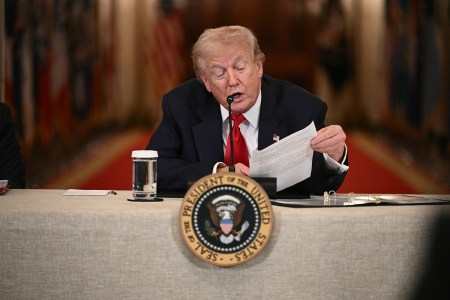
After President Trump’s “Saving College Sports” Roundtable, A Lot of Questions Remain
Hosted by President Donald Trump on Friday afternoon, the summit included leaders from across the sports industry, but no college athletes were invited to participate
Katz: Senator, there are a couple of things in there that actually once were NCAA rules. The transfer issue, you used to have to sit out and used to not be able to transfer within a league. There’s no question that it’d be great if agents were capped at 5 percent. They may not like hearing me say that, but they’ve been taking advantage of players at 20, 30 percent in the last couple of years. The pooling media rights, I think that’ll be interesting to see how that gets negotiated or if that gets through. The one that really jumped out, and I’m curious to hear your point on this, is the “Lane Kiffin Rule” about when you can leave. I’m trying to think of another example where you would be prevented from changing jobs in a profession at any point in a calendar year. So how would that withstand a legal challenge if someone wanted to change jobs in this particular profession before the end of a season?
Sen. Cruz: So the prohibition is actually not on the coach; it’s on the institution. So an institution is prohibited from recruiting or hiring another coach or an offensive coordinator or defensive coordinator or senior coaching official during the season or during the playoffs.
And you asked, is there another area where that’s done? Well, the NFL does that. That is the NFL’s rule. And we basically copied the NFL’s rule. Look, there’s no shortage of poaching coaches in the NFL, but you have to do it during the offseason. Because what happened to the kids at Ole Miss with Lane Kiffin was just wrong. It is wrong for a coach in the middle of the season, as you’re heading into the playoffs, to suddenly be picked off by another school and leave those athletes high and dry going into the playoffs. And so this allows for full mobility of coaches, but it just sets a time frame and says you got to do it during the offseason. You can’t do it right in the middle, when the kids are playing and they’re counting on their coach.
Davis: Well, any law that takes a shot at Lane Kiffin is bound to be politically popular outside the state of Louisiana. So I commend you on the politics of that.
Sen. Cruz: Look, LSU was following the rules that existed then. I love LSU. But I think it’s not good for the system for that to happen repeatedly. That leaves a lot of athletes high and dry. And it’s also lousy for the fans. I was at a Rockets game recently and I turned to the guy I was with and said, “It’s weird that there’s more continuity in pro sports now than there is in college.” You can have your whole team and it disappears.
And by the way, one of the bad things about this constantly escalating cost — you guys both love hoops. I love hoops. I play twice a week. I was a mediocre high school basketball player, and I will say at age 55, I’m still a mediocre high school basketball player. So I haven’t gotten better, but I haven’t gotten materially worse. You look a few years ago, a school like Baylor could win March Madness. Today that’s almost impossible. If Baylor develops a star, the richer programs go and pick him off. A year ago, the Final Four was all the No. 1 seeds. That’s really boring. The fun part of March Madness is the Cinderella story. I remember when I was a freshman in college in 1989 and Princeton was the No. 16 seed. We were playing Georgetown, the No. 1 seed, and we came within one point of being the first No. 16 seed to beat a No. 1 seed. They had Alonzo Mourning on the team. Our center was a guy named Kit Miller, who was only 6-foot-5. In that game, Kit outplayed Alonzo Mourning. And we had the ball, three seconds to go, down one point. They pass it into Kit, he takes a shot at the elbow, Mourning fouls the living crap out of him, they don’t call it and we lose by point. Not that I’m bitter about it or anything.
Davis: Actually you sound like a coach, so if this politics thing doesn’t work out for you, then I’m sure we could find you a job as a college basketball coach.
Sen. Cruz: I’m not nearly cool enough to be a coach. I just enjoy their work.
Davis: Well, listen, Senator Cruz, we appreciate the time that you’ve put in — not only in crafting this legislation, but getting out there and talking to folks like us, and more importantly our audience, to explain it. I know you’ve got an uphill climb, but as we say in sports, at least you’re in the game. We appreciate your time and best of luck with all of your endeavors.
Sen. Cruz: Thank you, gentlemen. Appreciate it.
Meet your guides