
CHICAGO — From his office window, Chris Holtmann can see across Sheffield Avenue to the corner where DePaul’s $42 million practice facility will soon stand. For a long time, that was merely a discussion, a pipe dream for a once-proud program that had fallen into irrelevance. Now, it’s actually happening.
Last season, Holtmann’s second in Lincoln Park, did a lot to change the conversation on every front. With agents. With players. With boosters. And with students. The Blue Demons doubled their Big East win total from four to eight, finished in the top 100 of KenPom, swept archrival Marquette for the first time since 1999 and set records for single-game and full-season student attendance at Wintrust Arena, a 30-minute L ride from campus on the other side of the loop, where DePaul has played since 2017.
After the Marquette win at home in January, Holtmann tweeted that he was buying a round for students at a bar on campus, a price for success he was happy to pay. He’ll drink to that.
“Look at what can happen here when there is a degree of success,” Holtmann told Hoops HQ on Monday. “Look at how it affects the student body. I think that was tangible for us as a DePaul community.”
At a school that too often settles for past glory — of which there is plenty — attention has been newly refocused on the present. The practice facility is finally moving forward, the Blue Demons moved quickly in the transfer portal to lock down six of their original seven targets, a class ranked 17th by On3 and 34th by 24/7, and Holtmann has at least some proof of concept that his approach can work at DePaul, which last made the NCAA Tournament in 2004.
The Blue Demons have to replace leading scorer C.J. Gunn and dependable big man N.J. Benson, but return starting combo guard Layden Blocker as well as emergent stretch-four Theo Pierre-Justin and rising sophomore Kruz McClure — Holtmann’s first big recruit at DePaul — as key rotation players. Their portal additions focused on two-way players to maintain the defensive focus that brought the Blue Demons success last season — they were 32nd nationally in defensive efficiency and held Georgetown to 1-for-23 shooting in the second half of a comeback home win in January — while also adding a new offensive edge, especially from long range.
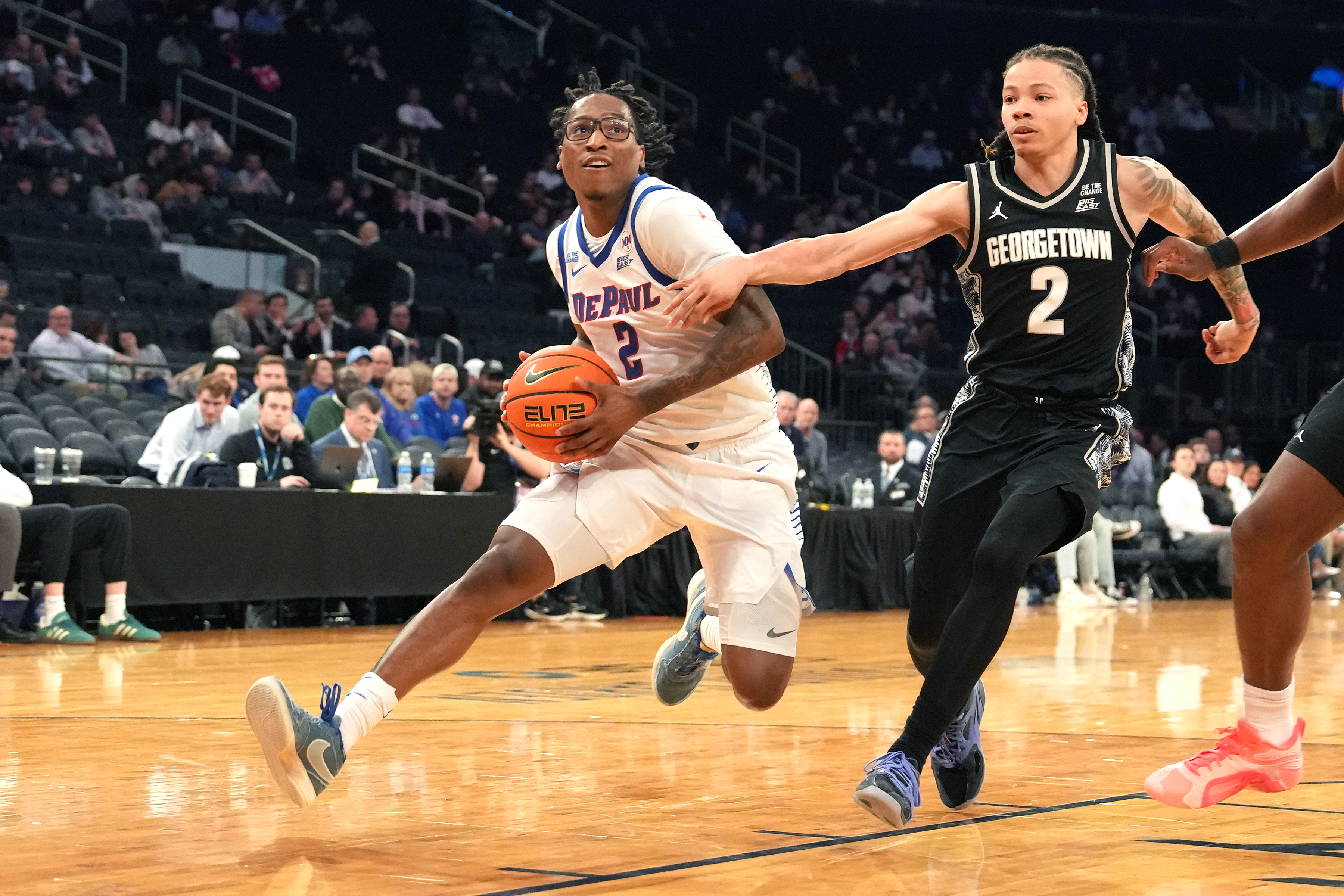
Magoon Gwath, the Mountain West Defensive Player of the Year at San Diego State in 2025, is the centerpiece of the class coming off injuries that limited him to 16 starts, but there’s another 7-footer in Wilson Jacques (Fresno State), a high-volume three-point shooter in Ade Popoola (Tulsa) and backcourt depth in Koree Cotton (Texas-Rio Grand Valley), Kahmare Holmes (Wofford) and Noah Meeusen (Arizona State).
Popoola and Cotton and Meeusen are all 6-foot-5 or taller while Holmes is 6-foot-3, giving DePaul the kind of positional versatility and length Holtmann realized he needed when the Blue Demons started switching more often off the ball in the middle of last season and had success with it.
There’s a lot to sort out with all the newcomers, and a hard-working identity that will have to be rebuilt from scratch, but there’s also raw material Holtmann didn’t have in his first two years at DePaul, because the team’s improvement has opened doors that weren’t open before. Meanwhile, DePaul has also invested to keep Holtmann’s entire staff intact. There’s real momentum that the Blue Demons haven’t had in a long time.
“Listen, this program has been beat up perception-wise for two decades,” Holtmann said. “Players, it’s a little more granular for them when you go into those numbers. They maybe saw some of the wins. They saw the Marquette win, saw the social-media hit of me buying beers. Saw some of the competitiveness in the bigger games. But agents? They were like, yes, this is a real competitive program now. If we had not shown real progress we would not be in some of those conversations.”
Still, Holtmann is the first to admit that the hard part of the job is just starting. There was a lot of low-hanging fruit for a new coaching staff to collect, but getting to 99th in KenPom and sixth in the Big East from where DePaul started was probably a lot easier than getting into the NCAA Tournament and winning double-digit games in the Big East will be now.
“I told him, now the real work begins,” athletic director DeWayne Peevy told Hoops HQ. “But the alternative is much worse. Not having enough resources. Not even being done (in the portal). The fact that they’re finished, in this environment, it wasn’t like they were rushing through it, they were just very prepared, very structured. We had the resources to make it happen. We even did some fundraising in the middle of the portal season to finalize our roster. But that’s what it’s supposed to look like.”
Top 20 Mid-Major Transfers for the 2026-27 Season
Memphis leads the pack in our look at the top men’s transfers heading to mid-major teams for the 2026-27 campaign
So there’s money, for the practice facility and for revenue-sharing, where DePaul is still near the bottom of the league but with a much smaller gap to the top. And there’s support, not only from students and fans and boosters but the highest levels of the university, where athletics has become a priority, basketball in particular.
Go-ahead for the new basketball facility — the centerpiece of a $60 million upgrade to on-campus athletic facilities — was obtained over some community objections about the demolition of historic apartment buildings now used for student housing and campus concern over the loss of that university-owned housing in one of Chicago’s most expensive neighborhoods. But the facility was deemed essential not only to DePaul basketball but the university itself, which landmarked other buildings on campus and modified the plans to make the street level more publicly approachable to alleviate those concerns.
That new investment in athletics does not come in a vacuum. As the parochial prep pipeline that once delivered generations of students to urban Catholic institutions like DePaul withers, the university has to find new ways to reassert itself in the higher-education market. The nationally recognized performing arts program is a pillar; basketball was once another, and president Rob Manuel, who arrived in 2022, is counting on it to be again.
“We’re going to be undefeated all summer,” Peevy said. “I’m not going to hype this up any more than it needs to be, but we also need to go out there and get in front of people.”
That’s why Peevy just re-upped through 2031: He’s finally seeing the vision he and Holtmann share for the basketball program start to materialize in both wins and concrete. And for the first time in a long time, the conversation at DePaul isn’t about what happened in the past, or what might happen in some uncertain future. It’s squarely on the present, and what will happen next.
Meet your guide