
Saylor Poffenbarger knows about hardship. And not the kind that goes away, but the kind that lingers, working its way into the fabric of everyday life.
Poffenbarger is a journeywoman basketball player, who started at UConn, then made her way to Arkansas and now is in her final season of a two-year stint at Maryland.
She grew up going to Maryland games with her family and dreaming of playing for the Terrapins. But now that her childhood wish is a reality, the Terrapins are in a precarious position. They started the season 14-0, before injuries decimated their roster. Now, Maryland is sliding in the rankings after losing four games in a row.
But Poffenbarger knows true hardship. This is nothing. Which is why the senior is exactly the leader Maryland needs right now.
The Poffenbarger residence was every child’s dream. Out on their 20 acres of land in Middletown, Maryland, Saylor and her siblings could be whatever they wanted. They were athletes and adventurers, splitting their time between battling on the family basketball court and throwing a football, to running around the extensive property and going on fourwheeler excursions.
Saylor’s mom Amy was a basketball player at Missouri in the early nineties, and later transitioned to coaching. But leading a team was easy next to the challenge of wrangling four kids under six. Reese was the oldest, then Saylor, Fordham and Brittin. The youngest Poffenbarger, Higgins, was born much later.
“I was a walking form of push-and-pull,” Amy says with a laugh. “There was so much going on.”
Saylor appointed herself as Amy’s assistant. She was bossy, but in a good way. Saylor spoke with confidence and authority, so her younger siblings listened when she told them what to do.
“She was a little mother hen,” Amy said. “If I wasn’t in the room, she was very much in control.”
Fordham was just two years younger than Saylor, so they were glued together. Everything Saylor did, Fordham did, too. Saylor wouldn’t so much as paint her nails without also treating Fordham to a manicure.

“He was her baby,” Amy says.
But in March of 2010, a horrible tragedy became reality for the Poffenbargers. They were on one of their adventures when the ground beneath Fordham’s ATV gave way. Saylor watched helplessly as her baby brother drowned in the creek below.
It’s the kind of grief that can’t be explained. You only know it if you’ve felt it. And if you’ve felt it, you will always feel it.
“It still bothers me,” Saylor says. “But I’m at the point in my grief where I’m not accepting of it, but I’m more understanding of the fact that it happened. I’ve lived 15 years without him. I know more about life without him than with him.”
Often, Amy says, grief pulls families apart. But she was determined to keep hers together. So no matter how much it hurt, they never stopped talking about Fordham.
“I never said we couldn’t talk about it. If they had questions, we were going to answer them,” Amy said. “I never shut them down. I never said, ‘I can’t do this right now.’ I might be crying while I talk about it, but I wanted them to see that emotion and be able to have conversations about Fordham. I wanted them to know that, “Hey, this is life. And it’s never going away.’ ”
Saylor had always loved basketball, but after Fordham’s death she took it to a new level. Once, during a visit to her parents’ house in Georgia, Amy remembers looking out the window to see Saylor dribbling two basketballs around the parking lot. Saylor did lap after lap around the quartermile loop that circled the building.
It was easy to get lost in the sport. Amy was a basketball coach and the Poffenbargers had a court at home. Plus, College Park was just an hour down the road, so Saylor spent her childhood watching Terrapins’ games and going to Maryland basketball camps.
“Basketball was definitely my escape,” Saylor said.
Maryland offered Saylor a scholarship in seventh grade. At the time, it was her perfect school. But that changed by the time she got to high school. She loved Maya Moore, so when Geno Auriemma and UConn came calling, Saylor stopped thinking about other programs.
Saylor was set to be a part of the 2021 recruiting class, but after COVID hit during her junior season, eventually cancelling her senior campaign, she opted to enroll early at UConn.
It was supposed to be the start of Saylor’s dream. But once she got to UConn, grief punched Saylor in the gut, and she couldn’t catch her breath. She could no longer escape into basketball. Now that she was away from home, Saylor felt Fordham’s absence for the first time. No one at UConn knew him. No one understood her grief. And Saylor realized she didn’t understand it either.
“We were so young when it happened,” she said. “I realized I didn’t remember much about Fordham.”
That hurt almost as much as losing him.
“She had nothing to think about, so the only thing on her mind was reckoning with death,” Amy said. “Like, ‘Why did this happen to my little brother?’ ‘Why does it happen to anyone?’ ”
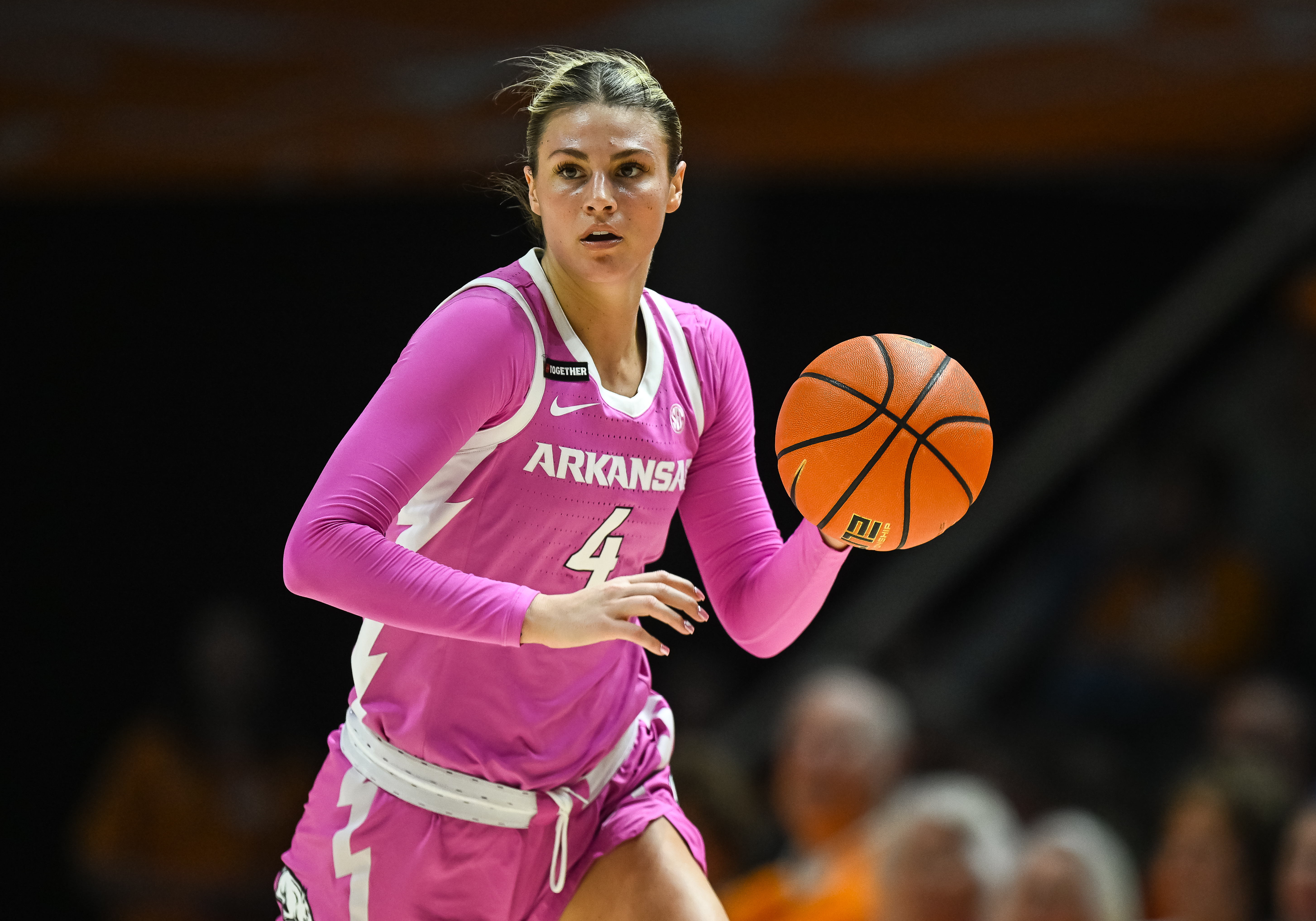
Saylor left UConn halfway through the season and opted to enroll at Arkansas. Her god sister, Lacey Goldwire was an assistant coach for the Razorbacks, so Saylor was able to reconnect with someone who understood what she had been through. It also allowed her to renew her confidence. After struggling at UConn, Saylor loved the free-flowing style of play that then-coach Mike Neighbors implemented.
But at UConn, Saylor learned that basketball could no longer serve as a distraction. She needed to come to terms with Fordham’s death. She needed to grow with it and find a way to embrace the tragedy as part of her story.
Saylor grew up going to church with her family, but as she processed her grief, she reconnected with religion on her own. It’s what helped her make sense of an otherwise senseless world.
“Grief has its ups and downs,” she said. “One thing that helped was getting stronger in my faith. I learned to stop questioning everything and to understand that God had a bigger plan. He needed Fordham for something greater.”
Saylor wore No. 4 at both UConn and Arkansas – the age Fordham was when he died – and now, at Maryland, she wears No.6 to honor his birth month.
She never expected to leave UConn or that she would play at three different schools. Saylor didn’t even expect to end up at Maryland. But after two years at Arkansas, she felt home calling her back. Being a Terrapin allows her to have much-needed balance between being a basketball player and just being Saylor.
“When I look at my brothers, they don’t look at me as an athlete, they look at me as a sister,” she said. “It helped me realize my purpose. Being able to go home and just hang out with them, it sounds corny, but it takes you outside of the basketball world.”
Through her three-school journey, Saylor learned to find purpose in the unexpected. Coming home to finish her basketball career at Maryland means Saylor can have her team over for dinner at her childhood home. It means she can watch Higgins play basketball. It means family can come to every Maryland game. And it means she can call on her mother hen persona once more.
“She’s got the biggest heart,” Maryland coach Brenda Frese said. “She serves as that older sister to everyone on the team. And she’s going to help anyone that she can.”
Saylor believes that everything happens for a reason. She has to. Otherwise how do you make sense of a four-year-old’s death?
Now, every problem seems small. When she left UConn, Saylor endured online hate. Sometimes, disgruntled fans still come at her on social media. It means nothing to her. Wanting to transfer for a second time was simple. Battling injuries throughout her career has been met with maturity and acceptance.
“There are always highs and lows,” Amy says. “It’s all about how you attack it. Are you using experiences as a lesson, or are you feeling sorry for yourself?”
Maryland is facing difficult challenges. Guards Bri McDaniel, Kaylene Smikle, Lea Bartelme and Ava McKennie all endured season-ending injuries. The Terrapins’ roster is thin, and it’s starting to show. The team has lost six of its last nine games, including four-straight to UCLA, Iowa, Washington and Oregon.
The Terps are now tenth in the Big Ten and things don’t get easier from here. Three top-15 opponents remain on their schedule: Michigan State, Ohio State and Michigan. Then comes the gauntlet that is the Big Ten Tournament. It’s all quite daunting. But this challenge can become an opportunity. And the low point can turn back into a high. It’s all a matter of perspective.
“Everything shapes you,” Saylor says. “Every time you handle another problem, you realize how much stronger you are.
“If I can handle losing a brother, I can kind of handle anything.”
🏀 SUBSCRIBE TO THE HOOPS HQ SHOW ON YOUTUBE.
Meet your guide