
Rienk Mast understood the risks clearly. The surgery was rare among high-level athletes, so there wasn’t much data on it. Doctors were unwilling to give him a percent chance that it would work, but they were optimistic.
It was the 2024 offseason and Mast was dealing with osteochondritis dissecans (OCD) — a joint condition in which a piece of bone and its overlying cartilage either loosen or detach from the rest of the bone — in his left knee. To repair the lesion, surgeons would have to use a bit of cartilage from a cadaver. “I know enough about biology that I know that there’s a risk in that,” says Mast, a senior who already has a degree in physics and is currently pursuing a master’s in applied science. “If it doesn’t take, then the problem’s not fixed, and there’s no guarantee of me coming back to play.”
A 6-foot-10 forward, Mast had just wrapped up a stellar 2023-24 season with Nebraska. Playing through significant pain in his knee, he averaged 12.3 points, 7.5 rebounds and 3.0 assists to help lead the Cornhuskers to their first NCAA Tournament in a decade. His six double-doubles were the most by a Nebraska player since 2007-08.
Even if it went smoothly, Mast’s surgery would sideline him for the entire 2024-25 campaign. If it didn’t, he could be out for far longer, perhaps even done for his career. He had the option of a less invasive procedure, which would have him back on the court in 4-6 months. But there was no guarantee that such an operation would be a long-term solution. Most likely, Mast would have to undergo the bigger surgery a few years down the road. “Obviously from an emotional side, you want to continue that momentum of the NCAA Tournament season,” says Mast. “But from a rational standpoint and looking (at my) long-term playing career (and) also my after-playing career — I don’t want to be in a wheelchair after I’m done with basketball, I want to be able to run around and play with my kids — it just made more sense to do the big fix.”
Mast had successful surgery in May 2024. The ensuing year would test his patience, discipline and commitment in profound ways. He had suffered a torn ACL in the past, so he was accustomed to the rehab process. But this was different. Slower. More meticulous. More fragile.
Mast’s highly anticipated comeback has been remarkable thus far: Through eight games, the big man is averaging 17.9 points, 6.3 rebounds and 3.4 assists while shooting 55.4 percent from the field and 43.2 percent from three. The Cornhuskers are a perfect 8-0, their best start to a season since the 1977-78 season.
“He had to be extremely diligent in the rehab process — if he wasn’t, then his career probably would have been over,” Nebraska coach Fred Hoiberg says. “We don’t have a more disciplined player on our team than Rienk. If anybody could handle it and go through it, it was him.”
The pain started midway through December 2023.
After beating Michigan State at home, Nebraska had a week to prepare for a clash with Kansas State in Manhattan. Mast was held out of practice every day, struggling to run or jump at all. A piece of cartilage had broken loose in his knee and was floating around, causing considerable discomfort. Since the Cornhuskers would have a lengthy break for the holidays following the K-State game, the plan was for Mast to play through the injury and then have minor clean-up surgery. He loaded up on pain meds and somehow put up 19 points and 12 rebounds against the Wildcats, leading Nebraska to a 62-46 win.
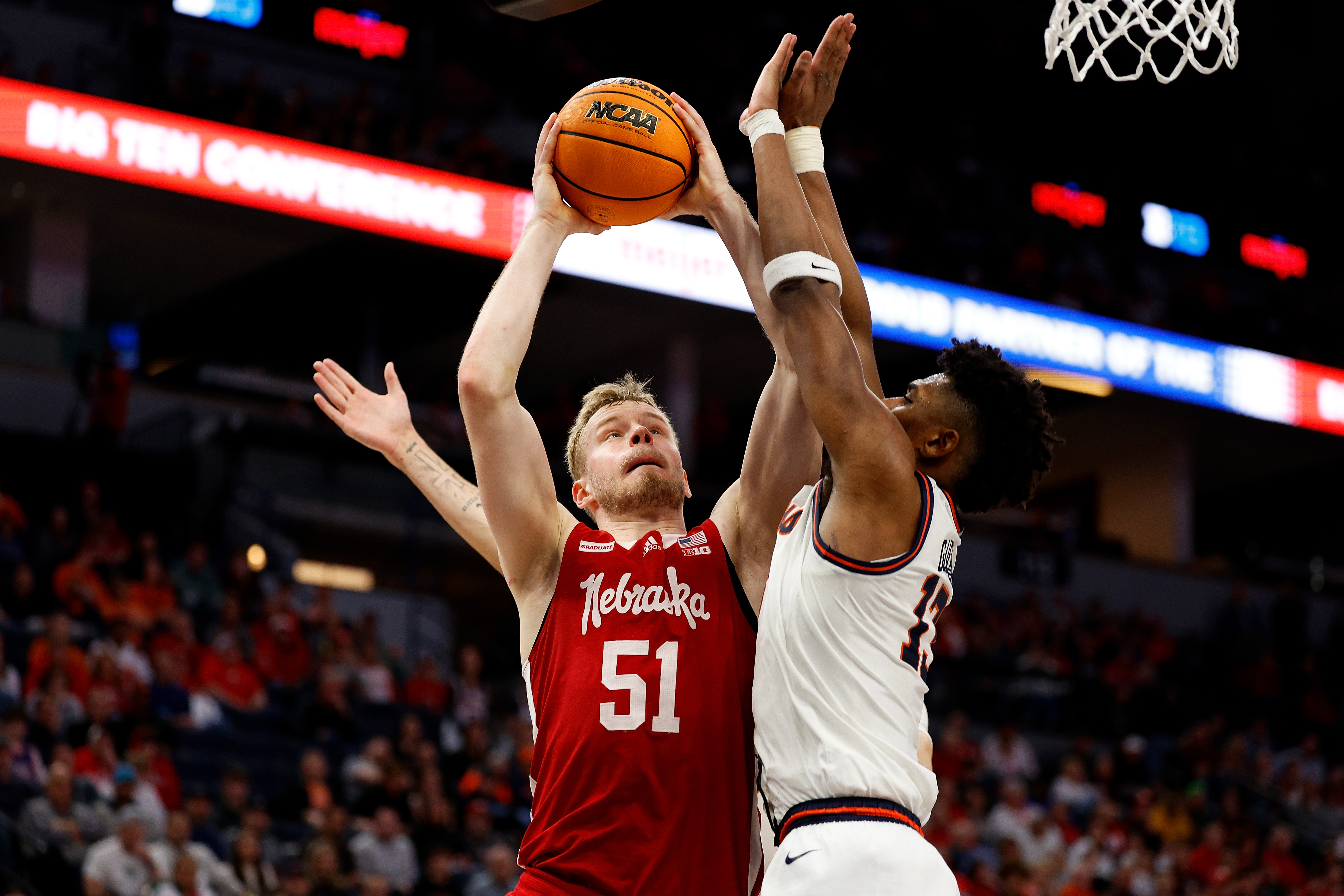
When doctors went in to clean up the knee soon after, they realized that Mast’s condition was far worse than they thought. In the near future, he would require a more extensive surgery. The small procedure alleviated his pain for a couple of weeks, but it wasn’t long before it returned. Mast used a combination of pain meds and cortisol injections to help him get through the next three months. He often sat out practices to keep his legs fresh for games. “He was going through a great deal of pain at the time,” says Kurt Joseph, Nebraska’s director of strength and conditioning. “Some days it felt like soft tissue pain. Some days it was like spasmic type pain. Sometimes it was radiating. It was interspersed with small pain and large pain depending on the day. And he was very, very resilient through that process.”
“Rienk was a warrior that season,” adds Hoiberg. “He was playing on one leg at the end of that year.”
Mast averaged 11.7 points, 6.7 rebounds and 3.1 assists in conference play, earning All-Big Ten honors. Nebraska came in third in the league — its highest finish ever — and received a No. 8 seed in the NCAA Tournament, where it fell in the first round to No. 9 Texas A&M. The program would have been well-positioned to go dancing again in 2025, but Mast’s knee needed to be taken care of.
Following the larger procedure in May, he faced an incredible uphill battle. He was on crutches for the first 2-3 months, unable to put any weight on his leg. The area had to heal before rehab could begin, and there was still the threat that Mast’s body would react poorly to the cadaver cartilage.
Never-Too-Early Preseason Top 25 Update: A New Big East Champion?
May 31: Seth Davis’ rankings see changes to the top 10 as big-time players drop out of the NBA Draft and head back to school
Once Mast cleared the initial recovery phase, his work with Joseph commenced. That process was, according to Joseph, an 11-month marathon of “implementing Wolff’s Law,” the idea that bone adapts in response to the mechanical stresses placed upon it. “The (amount of) stress basically equates to the amount of results you get from a situation,” Joseph says. “And you have to slowly progress it over time.”
Over the next four months, as summer wound down and training camp got underway, Mast’s rehab focused on strength-building. Along with Joseph, he followed a strict regiment of push-pull workouts. The two challenged and pushed each other, calling themselves the “Bicep Bros.”
Mast wasn’t yet able to do any strenuous athletic movement, which weighed on him mentally. It was hard to stay patient and consider the bigger picture. In the back of his mind, there was always a little fear that his knee wasn’t healing as it should. “Some of those days, especially in the first six months, when you have a little bit of pain or it just doesn’t feel right, you start overthinking: Did the piece of cartilage break loose? Is there something wrong in there? Am I still on the right track? Was it worth all of this trouble?” Mast says.
Through the dark and frustrating days, Mast stayed the course. As Joseph explains, athletes in rehab often “exacerbate their symptoms because they’re down on themselves or they’re having an identity crisis,” which adds to their levels of stress. Not Mast. The 24-year-old attacked the long journey with a very level head. “He was very mentally strong and very hardworking,” adds Joseph. “This injury was the closest (thing) to Mount Everest. And he approached it with the utmost professionalism.”
At the six-month mark, Mast received a critical update: Doctors confirmed that his body had accepted the new piece of cartilage. Mast had the green light to ramp up his training, incorporating more movement. His full rehab plan — designed by Joseph, athletic trainer Andrew McCabe, director of Olympic Sports rehabilitation Rob Rodriguez and others — utilized all of Nebraska’s resources, from the state-of-the-art equipment to the sports performance lab to the nutrition experts. There was tremendous synergy among the staff to ensure Mast progressed according to schedule.
His workout routine was broken into five-week intervals. During week one, he would learn and familiarize himself with a new set of exercises. Then he would gradually increase the intensity of each, aiming to reach maximum power and strength by week four. Mast would deload in week five before initiating another cycle.
Workouts ran approximately 2-3 hours, lasting all of practice. Mast would be off to the side or in the weightroom while his teammates were on the floor. Sometimes they would hear him grunting or yelling in the background. “He was Rocky Balboa,” says Joseph. “He would be like, ‘Come on, I want more!’ Some of the other players on the team would be drinking water during timeouts, looking at Rienk, like, ‘Yo, this dude is insane.’”
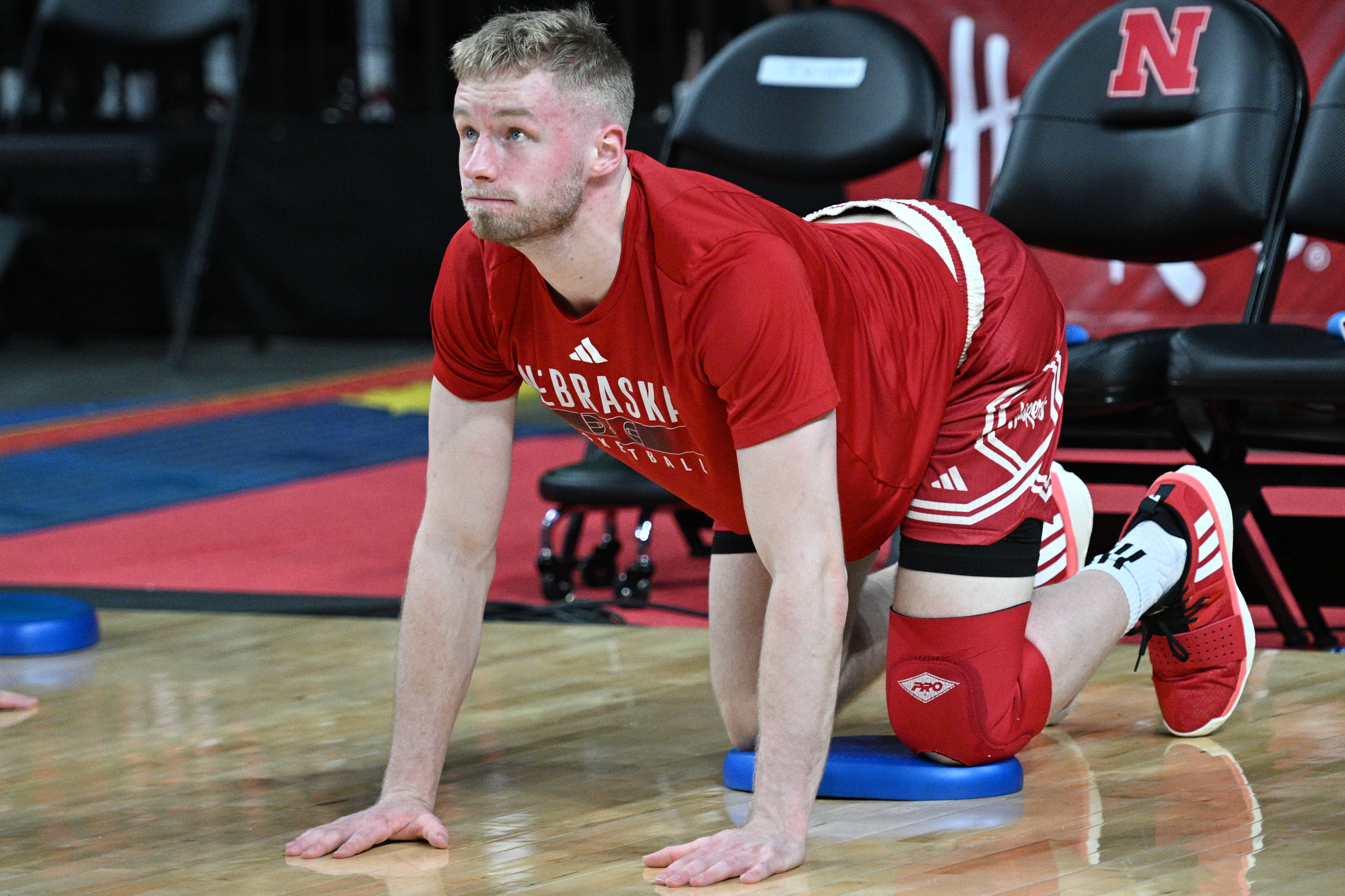
The small wins kept Mast going. His first jump. When he moved from the AlterG machine (anti-gravity) to a normal treadmill. The first time he shot a basketball in over a year. He was able to set personal records in practically every lift, including increasing his squat by a whopping 150 pounds.
Throughout the 2024-25 season, Mast maintained his role as a leader — Hoiberg calls him “one of the best leaders I’ve ever coached at any level” — but it wasn’t quite the same when not in uniform. On the floor, Nebraska was missing its top rebounder and the heartbeat of its offense. Mast led the Cornhuskers in assists and scored at least 15 points in 10 outings in 2023-24. “He does everything for us on the offensive end, and then he’s a really good pick-and-roll defender and he’s a smart, veteran player,” says Hoiberg. “He just provides everything for this team.” Without Mast, Nebraska went 21-14 and plummeted to 12th in the Big Ten, missing the NCAA Tournament.
Any concerns about Mast’s ability to bounce back were dispelled right away. In his first game in 575 days — a preseason exhibition against nationally-ranked BYU on Oct. 18, 2025— Mast erupted for 31 points, burying seven three-pointers to lead the Cornhuskers to a 90-89 win.
Joseph believes fans are seeing a “new and improved” Mast this season, given all that the senior has been through and the work that he’s done to return. The injury allowed him to “restart” his athletic career, as Joseph puts it, reexamining every detail that could possibly enhance his performance, from his balance to his breathwork to his movement efficiency. Mast is stronger — both physically and mentally — and benefitted from studying the game from a different angle while sidelined. After everything the Nebraska staff has done to help save his career, Mast is even more motivated to guide the program back to the Big Dance.
In the second game of the regular season, Mast made history, becoming just the third Nebraska player ever to record a triple-double. He finished with 18 points, 12 rebounds and 10 assists in a dominant 96-66 victory over Florida International. When he dished out his tenth assist, sealing the deal with 7:29 remaining, Pinnacle Bank Arena erupted in cheers. Mast checked out 30 seconds later to a standing ovation. Teammates swarmed him, as his stern “Rocky Balboa” game-face was replaced by a bright smile.
“It just makes that whole year worth it,” says Mast. “All the sh*t that you’ve been through, all the tough days that you’ve had, a night like that makes you see that it was worth it.”
Meet your guide