
Since 2021, instability has defined college sports. An overheated compensation market, expanded eligibility flexibility, and the NCAA’s inability to enforce transfer restrictions fueled unprecedented roster churn.
However, according to the NCAA, FBS entries into the college football transfer portal are down roughly 18 percent year over year. If that trend holds for hoops, it may be the first real sign that the era of annual roster upheaval in college sports is cooling, at least a little bit. We’ll start to find out when the portal opens on April 7.
Here are three reasons why the reduced transfer numbers could be the start of a new trend:
1) The Impact of House v. NCAA Is Finally Kicking In
The landmark settlement officially took effect on July 1, 2025. In practice, however, its most meaningful impact on roster construction likely won’t be fully felt until the 2026–27 season. In the months leading up to July 1, high-major programs rushed to front-load player compensation. Lump-sum payments flowed aggressively before the NIL clearinghouse and auditing apparatus became operational. Schools in power conferences layered institutional revenue-sharing on top of up-front payments to have unfettered spending power.
The result this season was a distorted, overheated market. The spending frenzy of the past transfer portal cycle was, in part, a final opportunity to operate without meaningful guardrails. Now those guardrails exist. If auditing mechanisms and cap space become more than a theoretical limit, the ability to outspend inefficiency will evaporate.
Schools in the Big East Conference appear to have the most favorable road ahead, as basketball operates without the gravitational pull of football. At most Power Four institutions, 70 to 80 percent of revenue-sharing cap space is earmarked for football. Internal politics, program prestige, and revenue-generating potential of each sport dictate the exact division of funds.
Big East programs face no such internal allocation war. Every dollar of available cap space can be deployed toward basketball without negotiation. This leads to a virtually unlimited cap for basketball-only schools with deep pockets, which is a huge advantage.
Spending alone has never guaranteed success in the NIL era. But it has often been the prerequisite to serious contention. As the cap firms and circumvention is regulated, structural advantages will become more visible.
2) Multiyear Deals and Buyouts
NCAA guidance following the implementation of the House v. NCAA settlement formalized the practice of inking athletes to multi-year contracts. While many coaches and players remain hesitant to enter long-term commitments, several top schools have begun to leverage these contracts as a way to hedge against roster volatility.
We have seen some high-profile instances recently of football players trying to break their contracts without consequences. That maneuver hasn’t turned out well. Washington quarterback Demond Williams briefly tested the transfer portal despite being on a multi-year deal, but ultimately remained with the program amid complications and the perceived enforceability of a buyout reported at roughly $4 million. Duke quarterback Darian Mensah went further, ultimately reaching a confidential settlement to exit his agreement with the Blue Devils before transferring to Miami for the upcoming season.
Buyouts are a critical component of reducing the number of players in the portal. According to NCAA guidance, any buyout paid by a school that brings in a transfer currently under contract will count toward that school’s rev-share cap. That cap-hit comes on top of whatever rev-share compensation the school pays them for that season. Effectively, this is a poaching penalty that disincentivizes schools from going after players under contract. In a future with a firmer cap and no front loading, this matters much more.
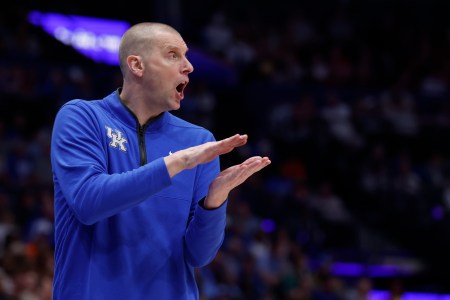
$22 Million? Mark Pope on Kentucky's NIL Budget, Pressure
The Wildcat coach talks Big Blue Nation, Malachi Moreno and rumors of a massive NIL budget. PLUS: Pope takes on the Shot Clock Challenge.
3) The Value of Retention
In a world where spending efficiency is key, a preference towards returning athletes is likely to follow. Coaches and GMs have quickly realized that keeping players around can be the secret sauce to winning. Returning players will often stay at their programs for a relative discount to what they could command in the open market. This is something long understood by NBA front offices, who largely agree that free agents are often overpriced by roughly a 20% premium due to bidding markets.
Returning players project more reliably when they stay within the same ecosystem. NBA front offices account for this in their models, often shading projections downward in the short run when a player changes teams.
Agents advising players should consider that jumping from a mid-major to a high-major for a one-year increase in pay can be a risky long-term move. The speed and physicality at the high-major level are noticeably different — especially for on-ball guards — and not everyone can make that adjustment. Averaging 15 a night in the MAC is often more valuable to a European club than serving as the seventh man in the rotation at a Big Ten school.
Caps create tradeoffs. Buyouts create friction. Retention creates value. What felt like unchecked annual free agency is likely giving way to something more disciplined.
Needless to say, it’s dangerous in this current environment to make long-term predictions, but these trends are in line with what the designers of the House settlement envisioned. We’ll know in a month whether we are in the midst of an aberration, or whether this is truly the start of something new.
Meet your guide