As the events in Ann Arbor last weekend showed, the relationship between a sport and replay reviews can get awfully complicated. That is especially true when it comes to the idea of coach’s challenges. The idea was first hatched by the NFL in 1999 and proved popular enough that it was subsequently added in Major League Baseball (2014), the NHL (2015) and the NBA (2019).
College basketball joined the fun last season, allowing a limited number of challenges and situations. They were granted one challenge per game, and only as long as there was a timeout available.
That was a good start, but it didn’t go far enough.
College basketball’s relationship with replay began with a Texas A&M–Texas Tech game in January of 2000, when an official used a TV monitor even though the rules didn’t permit replay yet. He was suspended for doing so. Two days later, Miami beat Villanova on a disputed buzzer-beater and the NCAA responded by authorizing officials to use courtside video for one exceedingly narrow purpose: determining whether a shot at the end of regulation or overtime beat the horn.
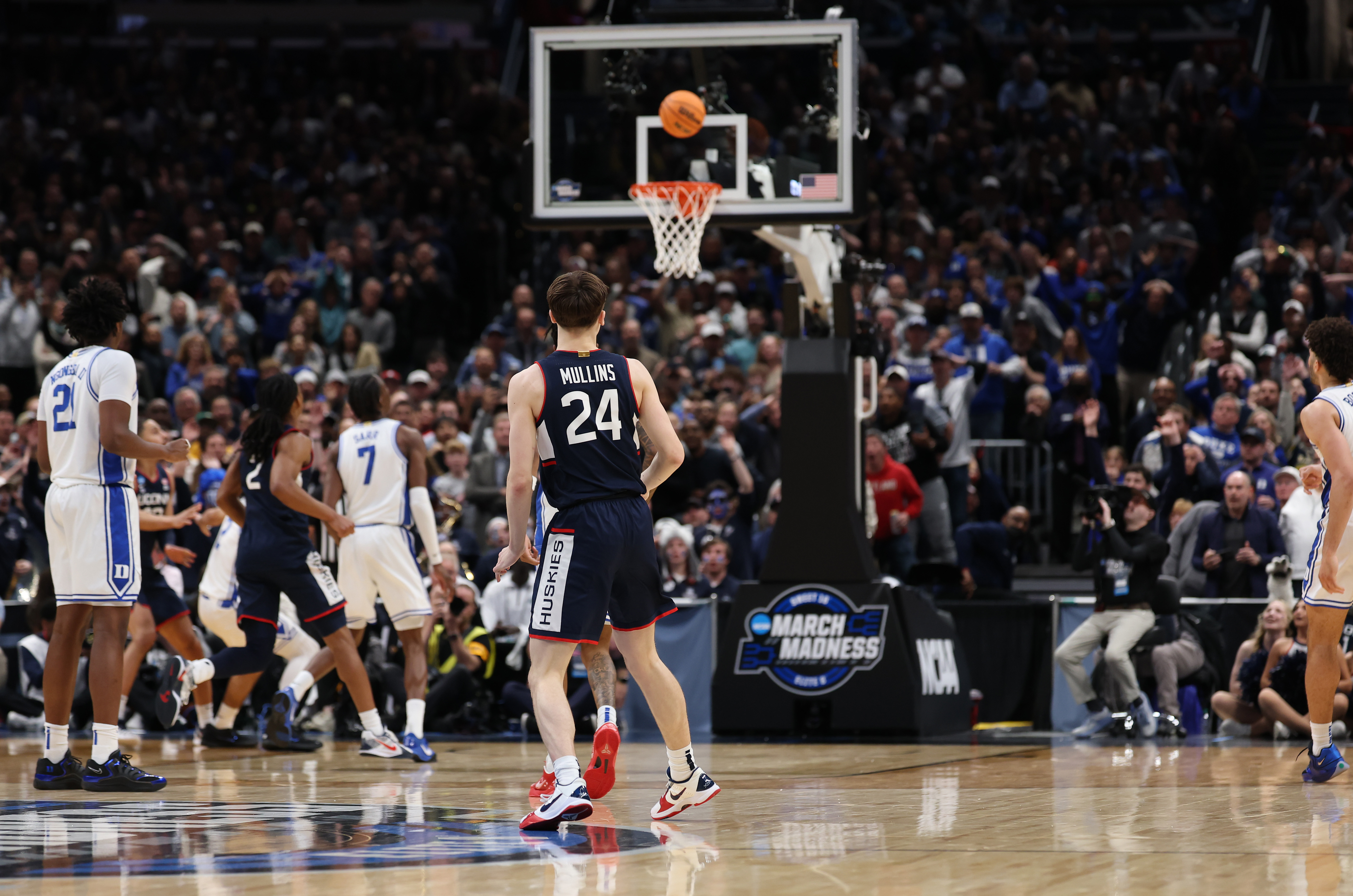
Over the next 25 years, that narrow exception steadily grew into an increasingly complicated collection of reviewable situations, that went from a nice to have, to a crutch, into ultimately becoming an albatross hanging around the neck of the sport, slowly sucking the life out of it.
So, when the NCAA introduced the coach’s challenge last season, ostensibly shifting some of the responsibility for replay from the officials to the coaches, it had an opportunity to do something bigger than simply add another way to initiate a review: It could have reconsidered the basic philosophy of replay – who should initiate it, what should be reviewable and how much control coaches should have over correcting an officiating mistake. It was the right idea. Now it’s time to take the next step.
Instead of simplifying things, the setup layered the challenge onto the existing replay structure and made it less intuitive. The result is a sport that now has coach’s challenges, coach’s appeals and official-initiated reviews, each governed by different rules, different timelines and different lists of what can be reviewed. The coach’s challenge shouldn’t merely have become another type of replay; it should have become the organizing principle for replay.
As things currently stand in college basketball, there are three means to initiate an official’s trip to the monitor. The first is the coach’s challenge, implemented last year, that allows a coach to challenge only three types of rulings: out of bounds, a called goaltending/basket interference violation, and whether a secondary defender was inside or outside the restricted arc. The coach must have a timeout and must act immediately; if the first challenge is successful, the team earns one additional — and final — challenge. One caveat to the challenge is that officials regain replay authority over the restricted area and goaltending rulings under 2:00 in the second half — but not out of bounds, which remains exclusively coach-controlled.
A coach’s appeal, which predates the challenge, allows coaches to ask officials to correct a separate list of specified errors involving things like clocks, scoring, free throws and potential flagrant fouls. Appeals are unlimited and don’t require a timeout to initiate, but if the team has already exhausted its timeouts, the result is an administrative technical foul for an excessive timeout.
Finally, an official-initiated review is used when officials decide — or are required — to go to the monitor, without a coach initiating anything. These include various timing, scoring, flagrant-foul and end-of-period situations, along with certain calls that become official-reviewable during the final two minutes.
This absurd architecture – three pathways to the same monitor, governed by three different sets of rules about who can initiate the trip, when they can initiate it and what they’re allowed to look at once they get there – creates a system that is unnecessarily difficult for fans in the arena or watching at home to follow. There are even interpretations in the rulebook explaining what happens when a coach makes an appeal and a challenge on the same play. For example, the rulebook contemplates a coach simultaneously challenging an out-of-bounds call and appealing for a flagrant foul on the very same play. That’s almost parody. A rule designed partly to improve game flow has created a replay framework that, again, requires considerable explanation.

“You Have to Be Strategic”: 11 College Basketball Head Coaches on the New Replay Challenge Rule
Matt Painter, Bill Self, Penny Hardaway, Dusty May and more break down the replay challenge rule and college basketball’s newest strategic dimension
The enthusiasm behind introducing a coach’s challenge to college basketball largely centered on the potential to reduce the number of times officials would go to the monitor, particularly at the ends of games. The challenge was largely effective last year in rectifying these delays.
The conception and application of the coach’s challenge erred, however, in three primary areas.
The first “error” was in failing to simply mimic the broad authority coaches in the NBA are given under its challenge rule. The NCAA’s coach’s challenge not only fails to put all of the burden of stopping a game to correct an officiating mistake under one umbrella category, but it failed to broaden its scope to cover more potentially significant mistakes. In other words, some of the most consequential calls remain largely beyond the challenge. Suppose there’s a massive block/charge call with 40 seconds left in a game. A coach might have two timeouts and an unused challenge and cannot simply say, “I think that foul call was wrong; look at it.” We allow microscopic video examination of whose fingernail touched a ball last, but not necessarily the judgment call that fouls out a team’s best player.
The point, ultimately, of going to the monitor should be to get the call right. The NBA has implemented this principle in its challenge rule. College basketball has not.
“If we’re going to have a challenge, let’s get the call right,” Baylor coach Scott Drew said. “If I challenge an out-of-bounds call, and the review shows that the ball did go off of my player, but it went out because my player was hacked across the arms, officials should be able to retroactively call that a foul. Like in the NBA. I shouldn’t lose that challenge even though the ball went off my player.”
Failing to account for these types of scenarios are strange omissions, particularly in light of how successful these types of challenges have been in the NBA. But these omissions are not out of the ordinary for how the Men’s College Basketball Rules Committee governs. Men’s college basketball is still the only version of basketball employing two halves, for example, versus four quarters. The rules committee has shown, for years, an aversion to aligning with the rest of the basketball-playing world, with its coach’s challenge being yet one more instance. As Mike Leach, the college football coaching legend, once said, “We’re so smart, we’re the only ones who do it this way.”
The second way in which the sport erred was in limiting the number of challenges if a coach continues to win their challenges.
“Why can’t I keep challenging until I lose?” East Tennessee State head coach Brooks Savage said. “If officials keep messing up and I keep correcting them, why do I run out of challenges? The problem with that is I had to let some calls go early in the game that I believed in my heart were wrong, but I needed to save my challenges for later in the game. Even if I was right in the first half, I would have only had one challenge left.”
A third way in which the challenge rule erred is in its two-minute caveat for certain restricted-area and goaltending calls, which undermines the logic of “coach control.” At 2:01, questions related to these two calls require a challenge. But at 1:59, officials regain the ability to initiate those reviews themselves. Out-of-bounds calls, however, remain the same: Officials can’t initiate that review; a coach must challenge it. Why? Even though the restricted-area and goaltending reviews are less common than out-of-bounds calls, if the philosophical move is toward coach-controlled replay, commit to it. The onus should be on coaches to challenge a call they believe to be an error for the full forty minutes of a game.
That’s not to say there should never be official-initiated reviews. But those instances should be reserved only for truly administrative matters — clock malfunctions, scoring errors, whether a shot beat the horn. These are things coaches should not be responsible for policing, nor should they have to spend a challenge to correct.
The idea of replay and its expansion, in all sports, is often argued to be in pursuit of “getting the call right.” This pursuit is a noble cause. It loses its nobility, however, when the ends no longer justify the means. College basketball didn’t arrive at its replay problem because any individual expansion was unreasonable. It got here because, for 25 years, it kept adding exceptions without ever deciding what replay was supposed to be. College basketball’s challenge system was a giant missed opportunity, particularly given the NBA’s example, to finally answer that question.
Meet your guide