
You are reading “Special Report: Pros in College?” for free. For complete access to Hoops HQ, SUBSCRIBE HERE. 🏀 New members score 25% off. 🏀
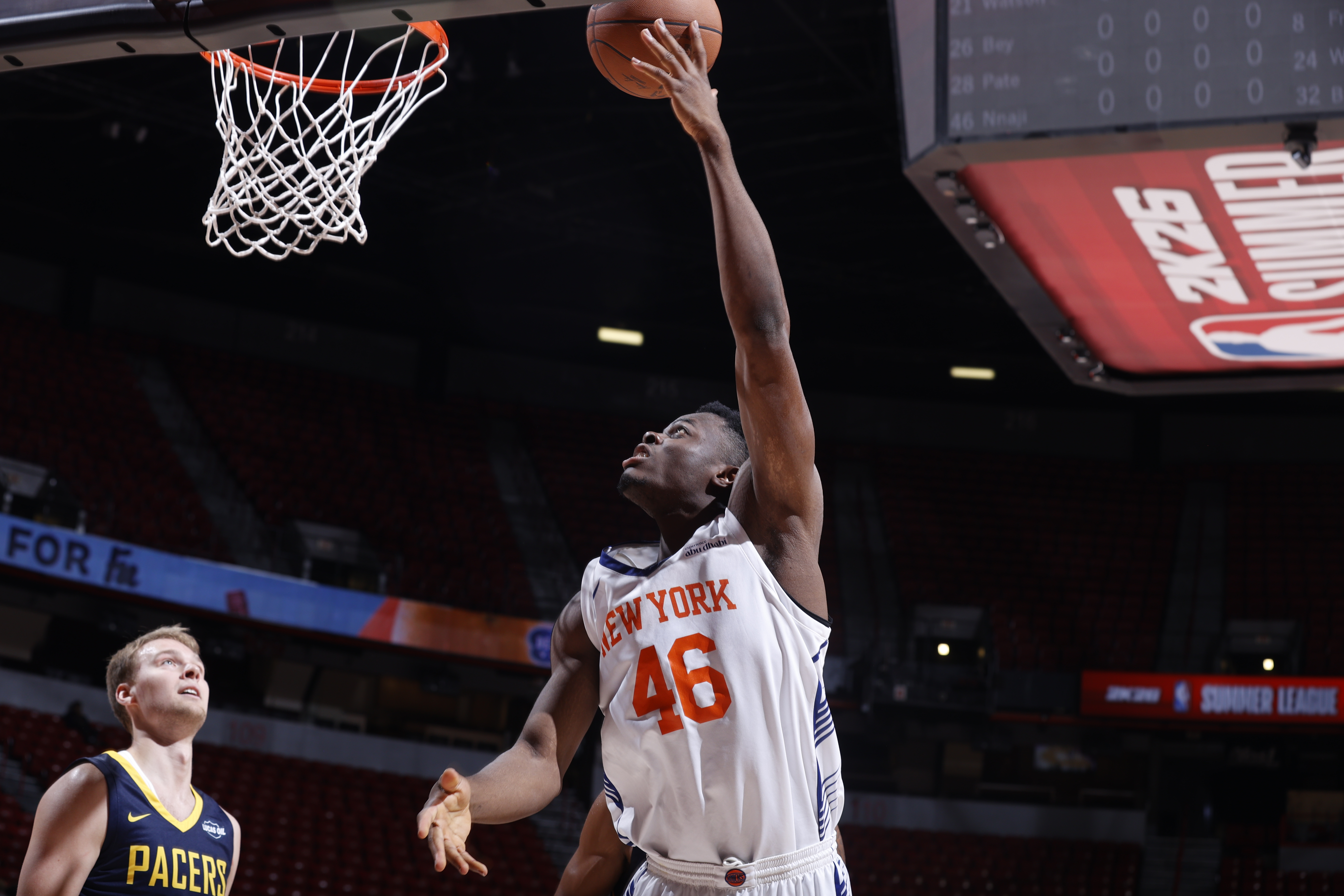
There have been so many unintended consequences unleashed by the massive disruptions in college athletics that it has been hard to keep track of them all. But there was no missing the thunderbolt that struck on Christmas Eve, when Baylor announced that it had signed James Nnaji, a 6-foot-11 forward from Nigeria who played professionally in Spain the last four years, as a midseason transfer. Nnaji, who is classified as a freshman even though he is 21 years old, made his debut for the Bears on Saturday, going for five points and four rebounds in 16 minutes during Baylor’s 69-63 loss at TCU.
In many respects, the Nnaji signing was business as usual. Midseason transfers are relatively common, the influx of international players has been growing for years, and several former professionals, including players from the NBA G League, have recently been declared eligible by the NCAA. But Nnaji’s case came with a major wrinkle: He was selected by the Detroit Pistons with the 31st pick in the 2023 NBA Draft. Nnaji never played in the NBA nor signed an NBA contract, but he did play 11 games over two years in the NBA’s Summer League and has already been traded twice, including as part of the three-team deal that sent Karl-Anthony Towns to the Knicks in 2024. The Knicks still own Nnaji’s rights.
The hue and cry was loud and clear, and it came from all quarters, most notably from two of the sport’s biggest coaching stars, Tom Izzo and John Calpari. Yet, much of the criticism has been rooted in a basic misunderstanding of NCAA rules. In an effort to clear up the confusion, I have put together a primer for our Hoops HQ readers to explain what’s happening, why it’s happening, and what might happen next. Herewith:
How can James Nnaji be allowed to play in college if he was drafted by an NBA team? Doesn’t declaring for the draft make you ineligible?
I thought so, too. Turns out, that’s not what the rulebook says. Specifically, NCAA Bylaw 12.2.2.2.1 which reads:
Before initial full-time collegiate enrollment, an individual may compete on a professional team (per Bylaw 12.02.4), provided the individual does not receive more than actual and necessary expenses to participate on the team.
The operative phrase here is “(b)efore initial full-time collegiate enrollment.” If a player has never been in college, he can put his name into the NBA draft and even get picked yet remain eligible for college. In fact, several international players who are currently playing in college also put their names into the NBA Draft. Several more are 22 or older and are thus automatically draft eligible even if they don’t specifically declare it. The only difference is, none of them tried to play in college after being drafted.
Bylaw 12.2.2.2.1 was passed in 2013, so it has nothing to do with NIL and revenue sharing. And contrary to conventional wisdom, Nnaji’s case is not unprecedented. Last summer, Kansas State announced that it had signed Belgian forward Nastja Claessens, who was selected by the Washington Mystics with the 30th pick in the 2024 WNBA Draft. Since Claessens had not previously played in college, she was eligible to sign with Kansas State over the summer. Somehow, that announcement provoked neither hue nor cry.
Calipari is correct that many NCAA rules are confusing and inconsistently applied, and we’ll get to that in a minute. But the Nnaji case is a layup. According to Bylaw 12.2.2.2.1, he is clearly eligible to play college basketball.
So if the rule wasn’t changed for Claessens and Nnaji, how come this hasn’t happened before?
Because it wasn’t until the last few years — and especially since the approval of the settlement in the landmark House v. NCAA case last summer — that college basketball players could be paid like professionals. The rules didn’t change, the incentives did.
From a financial perspective, it used to make sense to play in the NBA G League or overseas. Now, it makes more sense to play in college. And college basketball has benefited immensely from that, not only by luring talented international players but also by giving Americans who might have been first- or second-round draft picks a reason to return to school.
The rule you cite also mentions “actual and necessary expenses.” How does the NCAA define that?
This is the real sticky wick. That phrase, which was conceived 1997, was vaguely written in order to afford the NCAA staff some discretion. The principle behind the phrase is sound. If a player is getting paid purely to play, he or she is a professional, and therefore should be ineligible for college. But if that same player is only receiving living expenses, then they should still be able come to college, especially given that there is no equivalent overseas to American high school basketball.
This standard has by necessity evolved as a result of the transition to pay-for-play. The NCAA understands that it no longer makes sense to ban international players who are making mid-five-figure salaries. There is an extensive process involved in deciding whether someone is under the actual-and-necessary threshold, and needless to say there is a lot of gray area. But that is where things are changing the most.
Nnaji’s case to gain eligibility was helped greatly by the NCAA’s recent decisions to clear two players with NBA G League experience — Thierry Darlan, who is currently playing for Santa Clara, and London Johnson, who has signed with Louisville and will play next season for the Cardinals. Darlan received around $40,000 in compensation, but Johnson, who competed for the G League’s now-defunct Ignite program, signed a two-year deal worth $1.1 million. That shows just how far the NCAA is willing to extend the “actual and necessary expenses” threshold.
The question of where to draw this line is not easily answered, especially since there is plenty of incentive for players and agents to fudge the numbers. There’s a lot of conversation within the NCAA as to how to apply it moving forward, but for the most part the standard has held up. We’ll see how long that lasts in the face of the inevitable legal challenges to come.
Do the rules treat American and international players differently?
Absolutely not, despite what Calipari said during his viral rant. Johnson, for example, is from Georgia, and the NCAA granted him eligibility by the same rules it used for Nnaji. Regrettably, this falsehood has been propagated not only by other coaches but many in the media, and Calipari has yet to retract it.
If any of the international players currently competing in college leave their names in the NBA Draft next spring past the NCAA’s deadline to withdraw, they will forfeit their college eligibility. And any American who goes to the G League or overseas instead of college can enter the draft and then enroll, provided they haven’t crossed the “actual and necessary expenses” Rubicon. Geography has nothing to do with it.
Nnaji is one of several midseason enrollees who will be playing right away. Surely that’s a new rule, right?
Nope! Again, this has always been allowed, but for all the same reasons listed above, the instances have been rare.
Midseason transfers in general are not all that unusual. In fact, Baylor’s leading scorer, 6-foot-5 junior guard Cameron Carr, transferred from Tennessee in December 2024. Carr did not play in the second semester because the NCAA does not allow players to compete for two different schools in the same season. (Thank goodness for that. Can you imagine the chaos if that were allowed?)
But Nnaji and other international transfers who just arrived at Oklahoma, Dayton, Washington, BYU and Illinois have not played for a college this season and are therefore allowed to compete right away — if the coach wants them to, that is. Baylor coach Scott Drew definitely wants Nnaji to play because his starting center, 6-foot-11 junior Juslin Bodo Bodo, suffered a season-ending arm injury. The two projected backups are also on the shelf. From a basketball standpoint, it was an easy decision for Drew to bring Nnaji in.
An even more unusual case happened at USC, which added 6-foot-2 senior point guard Kam Woods to the roster. Woods played for Robert Morris last season and entered the transfer portal in the spring. He returned to Robert Morris, but when it became clear that he wasn’t going to be in the rotation, he sat out in order to preserve his ability to make precisely this change. I highly doubt Woods had any idea that he would end up at a high-major program and log legitimate minutes, but the move became necessary for USC when it lost its starting point guard Rodney Rice to a season-ending shoulder injury. So now Woods is a Trojan, just like Nnaji is a Bear. Unusual, but not unprecedented, and well within the rules as written.
“I Don’t Look the Same As Everybody”: How Jason Benetti Overcame Cerebral Palsy to Become a Top Sportscaster
Jason Benetti has taken a laborious path to the top of sports broadcasting. He couldn’t have done it without a tuba, his Nintendo and a whole lot of grit.
NCAA president Charlie Baker released a statement saying that players who have signed an NBA contract (including two-way deals) and played in NBA games are ineligible. Why did he make that change?
Again, this was not really a change so much as an updated interpretation, made necessary by all the confusion and misinformation unleashed by the Nnaji signing.
The NCAA is drawing the line at NBA contracts because it believes it goes above the “actual and necessary expenses” threshold. Given that the minimum NBA annual salary is over $1 million, it would be hard to dispute that. People (especially lawyers) will no doubt try to make the argument that it is unfair for the NCAA to deny eligibility to NBA players and not international pros, but again, the NCAA is only allowing international players to come if they haven’t made too much money. If an international player is making more than $1 million, you can be sure he won’t be playing in college anytime soon. Then again, many NBA players on two-way or Exhibit 10 contracts get paid under the league minimum. It’s probably a matter of time before a player in that situation attempts to thread the actual-and-necessary needle.
Moreover, there are quite a few college athletes who currently are making well over $1 million. They are basically professionals. So why deny the same opportunity to other pros? Also, why is the standard being triggered by two-way contracts if the player never played in an NBA game? Those questions will no doubt be addressed in a court of law near you. The answers will have enormous ramifications for the future of college sports.
Everyone agrees that the rampant transferring is killing college sports. Why don’t they go back to allowing players to transfer one time without having to sit out a year, but then make them sit out for each additional transfer?
This was another of Calipari’s suggestions, and it’s one I agree with wholeheartedly. There’s only one tiny problem: It would violate a federal court order.
The NCAA didn’t want to change this rule. It was forced to do so in late 2023 by then-West Virginia Attorney General Patrick Morrisey, who challenged the NCAA’s transfer policy on antitrust grounds after it denied a waiver to RaeQuan Battle, a basketball player who was making his second transfer to West Virginia. A federal judge in the Northern District of West Virginia (think he was a Mountaineers fan?) issued a Temporary Restraining Order and then a preliminary injunction that allowed Battle to play for the Mountaineers that season.
That action underscores why the NCAA is so vulnerable. If the case were heard by a different judge in a different jurisdiction, he or she might have issued a completely different ruling. And by the way, judges don’t actually have to “rule” on the question at hand. They can just slap an injunction and wait for things to play out, by which time the player’s season will be over.
When 11 additional states plus the U.S. Department of Justice signed onto the West Virginia case, the NCAA had no choice but to rewrite the rule so that players would be allowed to transfer as often as they want without having to sit out. So when Calipari and others prod the NCAA to change the rule back, they are encouraging the NCAA to violate a federal court order, which could lead to a criminal attempt charge. In some cases, that carries a prison sentence.
You think Baker is willing to serve time over this issue?
It’s a shame, because the change to the transfer rule has proven to be disastrous. Not only has it led to massive roster instability, but it has made it far more difficult for players to graduate because most of the time, all their academic credits usually don’t transfer with them. But it maximizes their opportunity to monetize their talents, which is why more than 4,000 football players have entered the transfer portal since it opened last week.
People love to blame “the NCAA” for these problems, but let’s not forget, schools like West Virginia are the NCAA. When legal challenges are brought, they almost always have the support of the very same coaches who are complaining about systemic instability. When coaches decry a lack of leadership, perhaps they should direct their ire not at the nameless, faceless “NCAA” but at the leaders on their own campuses.
Everyone also seems to agree that we need a players union and a Collective Bargaining Agreement (CBA) like there are in pro sports. When is that going to happen?
To paraphrase the guys from “Wayne’s World,” right after monkeys fly out of my butt.
There aren’t many things we can say for sure these days, but it’s a near certainty that a players union is not going to happen. For starters, that requries certification from the National Labor Relations Board (NLRB), which made clear in 2015 that it does not support this idea.
That opinion was issued in response to a petition filed by football players at Northwestern. The five-person NLRB didn’t even bother to rule on the petition. Rather, it declined to assert jurisdiction because doing so “would not serve to promote stability in labor relations.” Among the many complications was the fact that establishing a union would mean conjoining millions of athletes across thousands of universities in 50 different states, all of which have different laws governing what the NCAA is allowed to do. Moreover, the wide diversity among the membership is a huge impediment. Some schools are public, some are private; there are three different divisions inside the NCAA; and even among Division I (where the money is), there is a wide range of budgets, resources and ability to generate revenue. Creating a single union out of that huge morass is simply not feasible.
Of course, much has changed since 2015, so it’s not inconceivable that the NLRB would come to different conclusions now. It’s also possible that a change in the makeup of the Board, and in leadership in Washington, D.C., could lead to a reversal. But that is highly unlikely.
But let’s say for the moment that there was a legal path available. Why would college athletes even want to unionize? They’re making a killing off the current system. A CBA would mean giving the schools the chance to implement a hard salary cap and limits to the players’ abillity to sell their services on the open market. Not to mention all the potential revenue sharing involved. Would football players in the power conferences really want to hand over some of their hard-earned cash to non-revenue athletes at midmajor schools?
Lost in this conversation is that the settlement agreement from the House v. NCAA case is already serving as a de facto CBA. When you factor in scholarships and other expenses, it outlines a 50/50 split between labor (players) and management (schools). That puts it in line with CBAs in the pro leagues.
The judge who presided over the House case, Claudia Wilken, is the same jurist who ruled against the NCAA in the O’Bannon and Alston antitrust cases. No other human has done more to deliver a wrecking ball to the NCAA’s shamateurism house of cards. Would Judge Wilken really work for so many years just to end up certifying a settlement that still violated antitrust laws? It seems unlikely, but there will be many lawyers working many billable hours to make that argument.

So what are you saying, that there’s no answer here? How will things ever get better?
Don’t worry, folks. There is one organization that has the power to swoop in and save the day: the United States Congress.
Makes you feel so much better, right?
If there’s one entity that’s more dysfunctional than the NCAA right now, it’s Congress. But it’s the only entity that has the ability to restore a semblance of order. That will need to come in some version of antitrust exemption — and that, alas, is proving to be difficult. Major League Baseball is the only pro sports league that has one. The railroad industry does too. And that’s about it, although some elements of the agricultural, telecommunications and other industries have carve-outs. Everyone else is pretty much beholden to the Sherman Antitrust Act, which has somehow remained the ironclad law of the land despite being passed way back in 1890.
The NCAA and leaders around college sports are trying their damndest to craft something that can not only pass a House of Representatives that is evenly (and bitterly) divided between pro-labor Democrats and anti-union Republicans, but also clear a 60-vote hurdle in the Senate, not to mention win a final signature from the President. It also doesn’t help that the players associations from the major pro sports leagues have come out against Congress granting the NCAA an antitrust exemption. But Congress actually made some progress last year, to the point where a vote was scheduled for Dec. 3 in the House on the SCORE act. The vote was scuttled when it became clear it wouldn’t pass (it was viewed by opponents as being too pro-NCAA), but the fact that it was scheduled in the first place is an indication that there is interest in Congress to get something done.
For that to happen, the NCAA is going to have to drastically pare down the scope of its requests. Clearly it needs some form of antitrust protection to be able to enforce basic rules regarding eligibility and enrollment. Beyond that, everyone will have to live by the terms of the House v. NCAA settlement. Getting that through Congress won’t be easy, but it is doable.
The bottom line is that it’s going to take several years for all of this to be sorted out. Which is a shame, because it didn’t have to be this way. For far too long, the NCAA operated in a way that was illegal, immoral and unsustainable. Rather than acknowledge reality and adapt accordingly, the powers that be tried to hold up the system for as long as they could. Now it has all come crashing down, and it’s up to the folks who remain to figure a way out of the mess.
Thank goodness the games are so good.
🏀 GET IN THE GAME! A 1-year subscription to HOOPS HQ is now 25% off. 🏀
Meet your guide