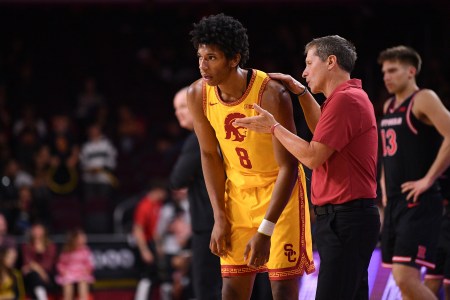

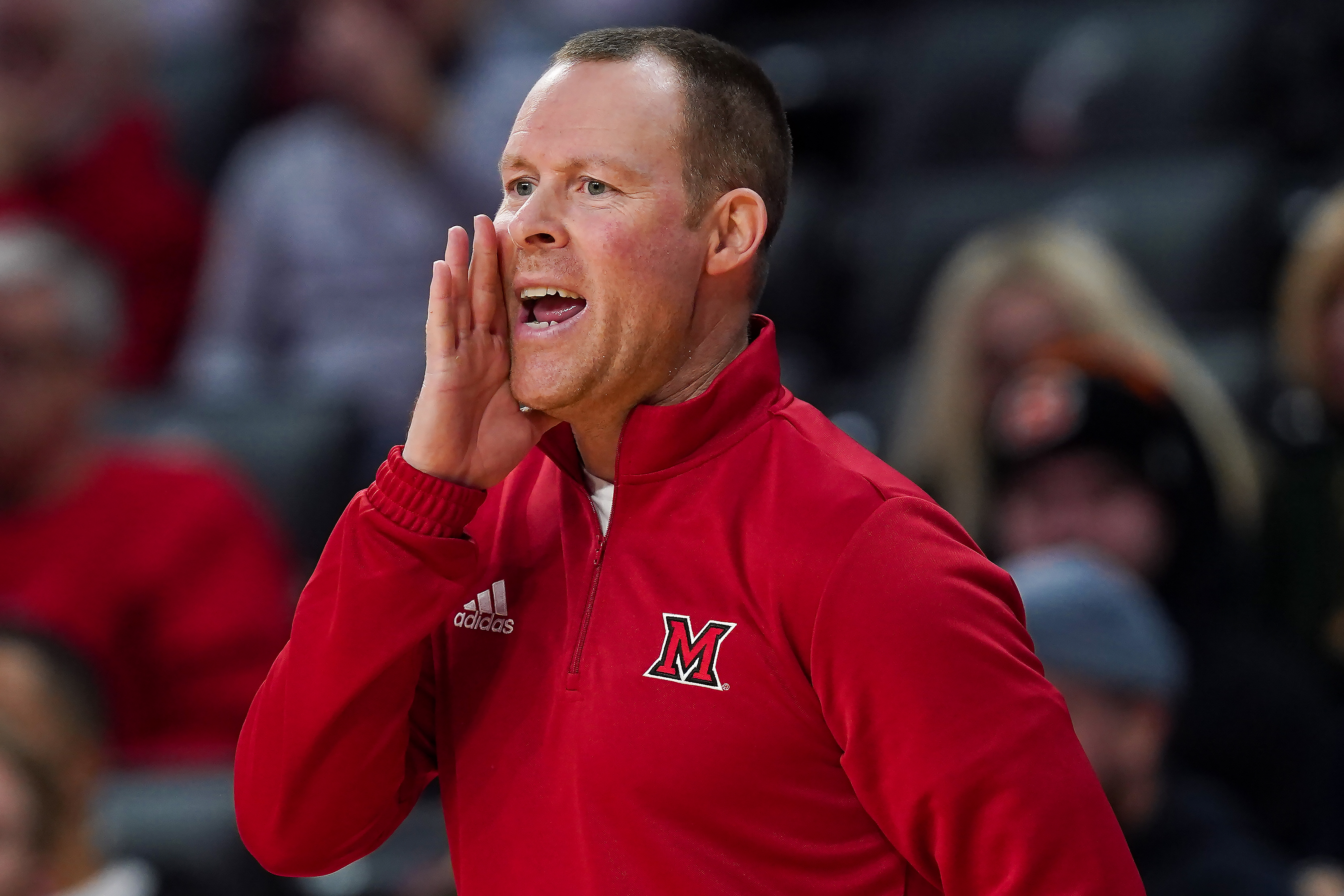
Miami (OH) Travis Steele joined Seth Davis and Andy Katz on The Hoops HQ Show Tuesday morning to talk about his RedHawks unbeaten run to start the season, getting fired by Xavier, strength of schedule and more.
Stream full episodes of the podcast on Hoops HQ’s YouTube channel, @hhqsports, or live on the Fubo Sports Network.
SETH DAVIS: We are joined by America’s coach Travis Steele, head coach of the undefeated Miami (OH) RedHawks. Travis, this is your fourth year there, you had 12 wins in year one, 15 in year two, 25 last year and already 27-0 this year. At what point did it start to dawn on you that you might have something special here?
TRAVIS STEELE: I think it started last year. We won 25 games, set a single-season record in Miami’s history for wins in a season. We lost a heartbreaker to Akron, to my brother (John Groce) in the championship game. We led for, shoot probably 39 minutes and 56 seconds. It was a hard way to lose, but those hard moments kind of reveal who you are. And two days later, I had player meetings.
As you know, with the transfer portal, things move very quickly, so I had to figure out who was on the ship and who was not on the ship anymore. And we didn’t keep everybody, but we did get a lot of retention from a really good team last year. So that’s when I was like, man, we got a chance to be really, really, really good. And I looked at our roster and we only had to add one guy from the transfer portal.
I thought we had the best spring that I’ve ever been around in all my years of college basketball, man, just how hungry our guys were, how motivated, how much better they were getting, the development. That’s right, I knew we had a chance to be really good because our guys responded the right way to a tough moment in the MAC championship game.
ANDY KATZ: I covered you when you were at Xavier. You get one of the power five jobs and for whatever reason it doesn’t work out. And then two weeks later, you’re at Miami, and you’re having great success. When did you figure out that you didn’t have to be at one of those jobs to feel accomplishment, to feel success, to feel a challenge and contentment in your coaching and professional life?
Steele: I always go back to like, you know, why did I want to coach? Right? Number one, it doesn’t feel like I ever work. I’m one of the most blessed guys in America, man. I get to coach hoops and be around young people. That’s what my mission, my whole mission, has been. How can we help young people become very successful both on the court, help them reach all their goals, but then also reach all their goals off the court. And I felt like Miami was a great fit for me at the time.
All things are all about timing. A lot of times, a lot of things are in life. I was unemployed for about two weeks and I was sitting there. It was the first time I had not been a part of a team literally since I was probably three or four years old, right? You’re playing in all these little league teams and then you kind of feel weird not being a part of one. And then David Sayler called — the athletic director here at Miami — and asked if I’d have interest in the job. And I told him, yeah, I love the brand and I thought there was a ton of upside. I was right. Miami is a special place and I’m fortunate to be here.
Seth: I tend to reach out to coaches in the spring after they get fired because I know how much you guys put into the job. I know how hard it is in that moment. How low were you when Xavier fired you and what would you say to other coaches who, in a few weeks, are gonna be going through that same experience?
Steele: Yeah, it hurt. I mean, it really hurt. I loved Xavier, right? We had poured 15 or 14 years, not just as the head coach, but I was the director of operations, was assistant coach, associate head coach, then became the head coach. The relationships that you have, the players that you’ve coached, you feel like you’ve let down a lot of people. It’s difficult, you know?
But I would also tell people that go through it, listen, it can make you better. It’s like I said, the hard moments reveal who you are and you have to respond the right way. Sometimes, and I hate using the word failure because listen, we didn’t fail. We were close. We were like one game away, three of my four years, from meeting the expectation there, the standard. But listen, I was below the standard and I totally understand the decision that they made. But those moments make you who you are and you have to self-reflect and get better, right?
Don’t deflect and say, hey, well, it was because of injuries or was because of this or because of that — like what are the things that you can control to make you better? But again, sometimes that failure or not meeting the standard is part of success, is part of your journey. And that’s what makes your story really cool and really neat to people, is everybody’s journeys are different. So that’s what I would tell the people that are gonna go through it.
Andy: When we had our mock (bracket selection exercise) last week in Indianapolis, the point was made that you cannot devalue road wins, just how important they are, how hard they are. You guys are currently 11-0 on the road. Three of your final four games are on the road. What is it about this group that has allowed them to thrive and be so successful on the road?
Steele: Well, I think a couple of things. I think number one’s our connectivity, Andy. Our group is super, super connected off the court, on the court. And I think that shows in those moments when you go on the road. For those that have either played in great environments or coached or been around it, it’s a you versus the world mentality, right? And our guys are super, super tight.
I think the other thing is our guys love playing the villain. They do, they love silencing the crowd. We lean right into it. We thrive on it. I would argue that we play better on the road than we do at home. And we have like a 30-game home win streak going on right now, which is incredible. But we love big crowds and we love it to be loud and we love silencing it. And that’s the players that we have. We have guys that have this huge, huge chip on their shoulder. Man, like all of our guys do. And they love to prove people wrong constantly.
Purdue Legend: NIL and the Transfer Portal Are Depriving Today's Players
The former Boilermakers captain and current Big Ten Network analyst discusses program loyalty and life after college basketball
Seth: All right, let’s post up a little bit here because you know, this is going to be a conversation. Hopefully it’s not relevant because hopefully you win the MAC Tournament and there’s no conversation about whether you’re going to be in the NCAA Tournament. As of now, most of the brackets have you guys as an automatic qualifier, pegged at about an 11 seed, right on the bubble. And that’s being undefeated.
So the question becomes, if you lose one or two games, what do we do with Miami? Right now, your overall strength of schedule in the NET is ranked 350th. That’s out of 365 teams. Your nonconference strength of schedule, the schedule that I won’t say that you control, but certainly have an impact over is 363. Those two numbers are going to hurt you bad.
So if someone says they didn’t play a hard enough schedule, therefore we shouldn’t put them in, give us a window into how and why you put together this schedule and what defense you might have for it.
Steele: Yeah, I would say number one, look at our schedules in previous years. We’re not afraid to play anybody, anywhere. We played at Michigan, at Ohio State, at Indiana, at Georgia. We’ll play anybody anywhere. Honestly, I have it slotted in our deal to play at two high majors every year. I knew we were in trouble with that though when June was hitting. And usually there was a line from Oxford, Ohio all the way to Cincinnati, Ohio, my first few years to play us.
Well, all of sudden, everybody’s saying, no, can’t do it. The numbers tell us not to play. Everybody’s using these analytical sites, not just to help in the portal, but also with scheduling. Like, do we play? What’s going to put us in the best position to get an at-large bid? Which I totally understand. I was at Xavier for years and the way the equation says now, you’re supposed to play Quad 1 games and Quad 4 games. Stay away from Quad 2s and Quad 3s.
I totally get it. But it was hard, man. I thought we had one, and I’m not gonna mention the school, and they kind of ditched us last second. And that was in late July. I did not complete our schedule all the way until mid-October. But we had no choice. We had to play somebody. We had to play 31 games.
We held out for as long as we could to try to find somebody. But the P5, P6, whatever you want to call it, wasn’t happening. And even like the really good P5, P6s, because there’s levels to this thing, as we know. They said no, all of them. So we didn’t have those opportunities.
Andy: Let’s take it down to another level. So Mount West, for example, you played Air Force, which is at the bottom. I’m just curious what were the opportunities within your neighborhood — the Wyomings, the Murrays, the Belmonts, schools like that that are toward the top of the Valley, A10 — which you could have played. Where did that next tier factor into your scheduling?
Steele: So we thought we had one A-10 done. We were supposed to meet in Detroit. They told us about the event. We agreed to do it. And then they said no. And it’s like, man, it’s like we kept on getting the rug pulled out from underneath us. I mean, it probably happened, man — 15, 20 times. We either had to sign a contract and we never got it back.
As far as other really good mid-majors, there was one, I’m not gonna mention schools’ names specifically, but one school said they would play us and then the date didn’t work, unfortunately. But we need to play like-minded, like schools.
Andy, I think to your point, I’ll be honest, we have to invest into scheduling, too, as far as what neutral-site events we can play in, right? So that’s part of it.
It’s just being honest, you need money to play in those events. You got to spend $30,000 or $40,000 to play in a Detroit event. We were going to at that point because it was getting so late in the game. I was like, man, that’s the best game we could get. That’s going to give us a top-100 opponent. It’s a great game. And then, like I said, the rug kind of got pulled out from underneath us. But we tried. Listen, it’s difficult.
It’s funny because like the Missouri Valley has something and I don’t know the exact rule that they have within their league. They’re supposed to play a certain amount of Quad 2 games, I think. Well, now we are one. Whereas a year ago, they didn’t think we were, like last spring. Well, now we are. So now we have Missouri Valley schools beating down our door right now today to play next year, which is great for us. But we were in a weird spot and everybody knew we had a lot of talent. And I think that hurt us as well, right?
But listen, we tried. CAA teams, A-10, Valley, Mountain West. I mean, you name it. It was really frustrating and I felt bad for our guys. But you can only play who’s gonna be willing to play you. And it’s not like we have a ton of money set aside. I think we will, moving forward to help us with scheduling even more, which we’re gonna need, because it’s gonna continue to be hard to get games for us.
Seth: Let’s spin it ahead. Give us a sense of what it’s like at Miami now and what you are doing for this community. You’re really one of the great stories in college basketball right now.
Steele: I would say our university is buzzing. I mean, just the connectivity; being able to connect the alumni base, the former players, all the former coaches and managers to the present is huge, right? And giving the current students an incredible experience, I mean, our games have been sold out. I mean, sold out.
One of my buddies lives in Cincinnati, he said, “Man, if people would realize how big of a deal that is at Miami.” He said, “That’s incredible.” He was like, “Dude, I cannot get over how much these tickets are costing me now.” I can’t even get them tickets anymore, Seth. It’s cool because my first game there, there was barely anybody there. There was a couple hundred people and now, all of a sudden, there’s over 10,000 at every game. So it’s been a lot of fun. It’s been really cool. I’m happy for our guys that they’re able to experience this. This is, in a lot of ways, a once in a lifetime run that we’re having so far and how many times are you going to be whatever we are now? I think it’s, what are we, 26 or 27-0?
Seth: 27, yeah, I know it’s hard to keep track with all these wins piling up. It’s a high class problem.
Steele: Yeah, I mean, it’s awesome, man. We’re just enjoying the ride, man. For people that haven’t been to Miami, it is the nicest campus I’ve ever been on. And it’s got an incredible vibe to it. And now we’re just able to add to that, which I’m super proud of.
Andy: How ready is this group to deal with the (MAC Tournament) pressure: three games, three days to try to get that AQ. How ready are they for that?
Steele: Yeah, we’re ready for it, man. Listen, we feel no pressure. I feel that pressure in practice. I want to have a great practice tomorrow, right? And a great lift and a great film session. I think the reason we don’t feel as much pressure, Andy, is two things. I think number one, we do it for each other, not for ourselves individually. When you do it for others, I don’t think you feel that pressure innately. And then I think number two is, again, I think we’re enjoying the ride.
One of the best things that could have ever happened to me is I was able to coach my son’s AAU team. He’s in seventh grade now. He was in third grade, going into fourth grade at the time when the whole Xavier thing happened. So that spring, I coached his AAU team and man, you go back to why do kids play? Because they love it. It’s fun. Our guys have fun. If you come to one of our practices, the vibes are really, really high. Now, we compete, we work hard, but man, we have fun together. And I think it’s all about the journey, man. That’s where we enjoy it.
Meet your guides