
Doug Gottlieb joined Seth and Andy on The Hoops HQ Show Friday morning. Stream the full episode on YouTube, Spotify or Apple Podcasts.
Seth Davis: As promised, we are now joined on The Hoops HQ Show by Doug Gottlieb, the head men’s basketball coach for the Green Bay Phoenix. Doug, I don’t know if you have a little podcast envy right now — I don’t know how much you miss your radio days. But, as you can imagine, we have been covering all the action, the transfer portal, free agency season in college basketball, pretty closely since the end of the season.
As an old media hack, I’m sure you understand how great it’s all been for us covering the movement and generating interest and conversation in college basketball, during a time of year when it usually doesn’t get that. We’ve had some pretty big names and high major coaches talking about their experiences in the portal.
Explain to us, at the mid-major level, how much different it is working the transfer portal and free agency compared to your power conference brethren.
Doug Gottlieb: I can’t speak to what it’s like at the power-conference level. I mean, I would say, obviously the scale is different financially, right? That’s probably the most obvious. And at our level, you have to make, I think, a cognitive choice.
Actually, this is like one of the things that I got to figure out here, probably by the weekend, is do you take a high-major guy who, for whatever reason — and there’s a litany of them — isn’t getting an opportunity or isn’t performing at that level that wants to transfer down? Or do you take a D-III All-American, D-II, JuCo, international guy that is not proven yet? This is the first year we’ve done it where we’ve gotten a kid from our league where we’ve seen him and we know the level he projects at because we’ve seen him at our level and we know how he fits.
All of that adjusts the finances. The high-major transfer down or the D-II, D-III transfer up, or a bench player at our level that wants a better opportunity or better fit. That’s actually something that I wrestle with, you know? And then you also have the, do I bring back a guy who didn’t have a great year, but he does have a year of playing for me and he was part of a winning culture? But his role may change. It’s really, really difficult.
I think the one thing that I feel like, and again, I don’t — I talk mostly with coaches at my level, the coaches at the high-major level I talk to, they’re just friends and I’m just trying to get some guidance from them. But I would tell you that those decisions are really difficult and then you gotta factor in the money. How much money do I have left? How much money does this kid need, all those things.
It’s a fascinating exercise, but to anyone who says, hey, you’re not experienced in it, you’re right. No one is, right? There’s literally no one who’s done this exercise before. European coaches, probably are the closest to it, but even that is not really what we have here. So yeah, we learn as we go.
I also think the last thing is media people. Not as much you guys, but especially the local yokels, whatever. Like, you have no idea about the guys that we bring in. You’re literally taking whatever we say. So it was like, oh, this guy’s had a great portal class. Like, I don’t know. I mean, they talk about not knowing anything. And then the whole idea of like rankings of teams. Everybody has a whole new team. How do you know? It’s a fascinating exercise, guys.
I love the ability to share it with you two. By the way, were you two always good? I’m questioning, are you guys Compton-Long Beach? Like, were we always friendly? Because this is a very weird thing. This is like going out to dinner with two exes.
Seth: Well, I don’t know who broke up with who though, is the question Doug. I mean, that’s a lot of water under the bridge there.
Gottlieb: Maybe it’s not two exes. Actually, you guys are more like — Denise and Angie, we’re friends, right?
Seth: Right.
Gottlieb: So maybe it’s the boyfriend of the ex. I don’t know.
Andy Katz: All right, Doug, let me throw this at you. I threw you a bone, just because we’re friends and I thought it’d be fun and because we know nothing at this point, when they make me do rankings in April or May. I said, OK, Green Bay: Horizon League champs. Why not, as the automatic qualifier?
Seriously, it’s not crazy because you did a great job, you and your staff of moving up year one to year two. You’re like a lot of us, we’ve known you a long time, you try to do a million things and at some point you realize, oh, something’s dropping off, maybe I should do less. You’re always trying to figure that out. So clearly, you had that epiphany at some point: I need to focus a little bit more because you came in doing a lot of things from your show to the pod to the coaching, et cetera.
At what point did you realize after year one, I need to just shrink my responsibilities a little bit and lock in?
Gottlieb: My brother and I were on the phone one night — and he’s been great, you know. A couple of guys on my staff call him the shadow GM or whatever, because he’s got fingerprints on it. And I just remember him saying like, look, you just gotta, at some point accept that last year, you failed.
You guys know this better than anybody: There’s a reality to painting a perception of what really happened that we try and share with the media, but there’s also the classic lines of bullshit that coaches always try. We try and load you guys up with ammo to help us when we failed or when our team lost or whatever.
Like, we didn’t really lose, we got screwed. We didn’t really lose. If this kid would, I never forget, there’s a coach that you guys know — and he’s gainfully employed now, whatever, but it was bad a couple years ago. And I never forget, he was talking about this one player who, had they let him into school, all would have been great, because he was a point guard. And, like, dude, the kid’s not that good. He wasn’t a program changer. Relax.
So my point is that I could go through the Anthony Roy broke his ankle, and we had this problem, we were on probation and I got the job late and we had no money, but nobody really cares, right? And my brother’s point was like, hey, you failed, so figure out how to not do that again. You gotta change things.
So I had to go. It was painful. I didn’t clean house with my staff, but I turned over my staff. They all got better jobs financially, some by their choice, some with a little gentle nudging or whatever. I knew I had to change that. That was really, really hard because you get emotionally tied to these people. They didn’t bail when it got bad, but I had to change staff. I had to change some of the ideas of who I recruit, how I recruit, types of players I want to get.
You just kind of had to eat humble pie a little bit and realize that what you’re doing wasn’t right. So Andy, to your question, it wasn’t one singular moment. It’s more of an, OK, what can I do to be better? Every person on my staff now, I ask myself before I hire them or re-up them for a year, are they making us better? Are they making me a better coach? If they’re not, goodbye. It doesn’t work. OK? Because everybody has this thing like, get all your friends to come out, man.
I’ve always thought about getting in like, dude, I don’t need any more inexperienced people when I’m inexperienced doing this. Sorry, I love you, it doesn’t work. And I can’t put up with anybody who’s — it’s not lazy, but at our level, you are doing multiple things. You gotta grind every day. And I can’t ask that of other people if I’m not doing that myself.
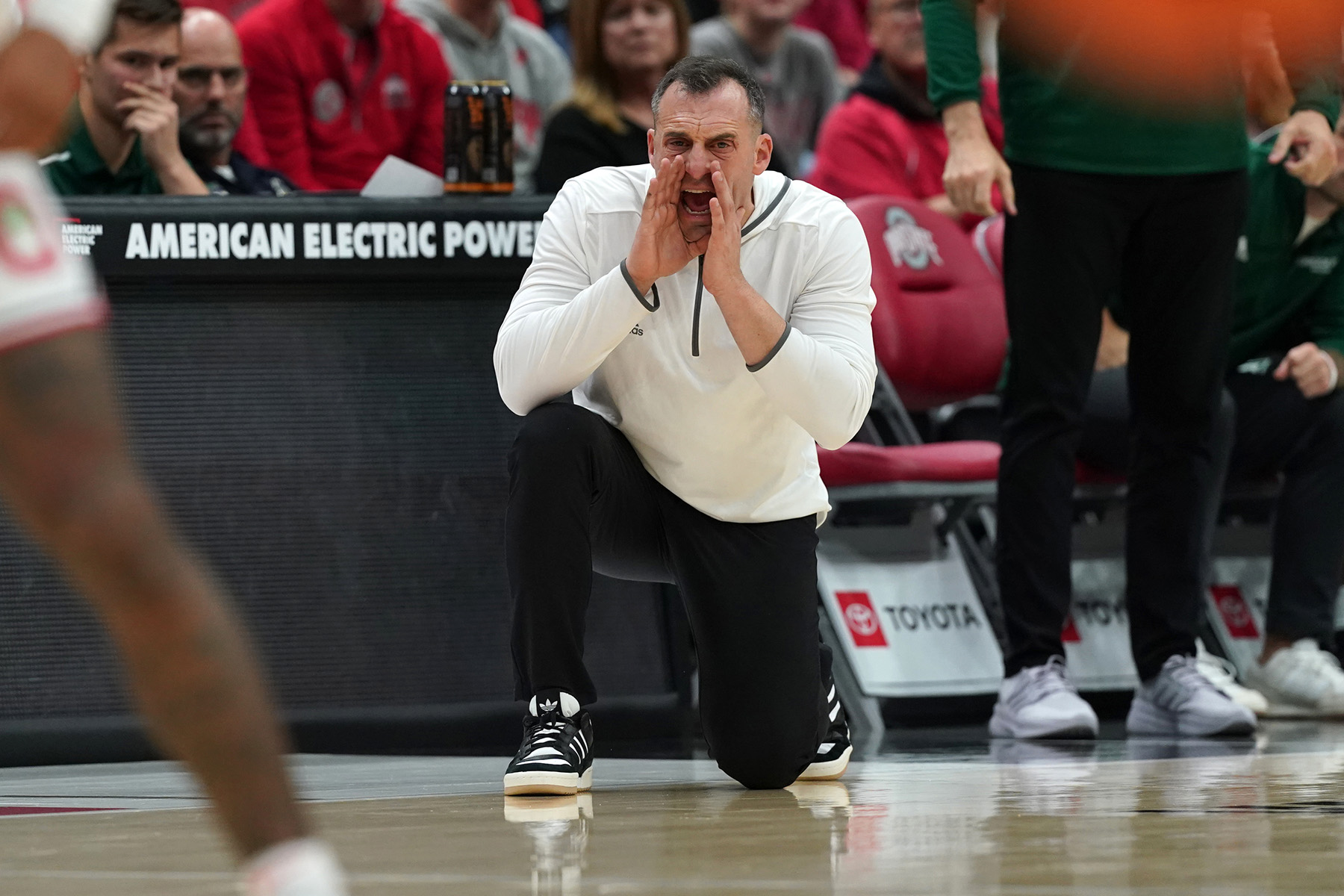
What I found, Andy, was I was so tired. And I also thought I lacked some of the proper emotions of letting things set in and the ability to stop and focus and do something during the day that’s not basketball team related. I just didn’t have that ability.
The last part is, I think the way you win at Green Bay ultimately is getting Wisconsin kids to bounce back or to come right away. And the only way you’re going to do that is if you’re everywhere in recruiting. And I just couldn’t.
When you get up at 5:30 every morning, you work out, you have a meeting and then you get to practice, and then you do a radio show, and then you, sometimes we’d have two practices a day, and then you have a meeting, and then you got calls to make, and then somebody goes, hey, you wanna go to a seven o’clock game that’s down in Milwaukee, it’s an hour and a half away? You’re like, I got nothing in the tank for you. So, it wasn’t one moment.
If there was a moment, it was honestly, we were at the U.S. Virgin Islands, and we hadn’t won a Division I game yet. We had some travel issues getting there, so I missed a couple days of radio. We go and play and nearly beat Yale — and everybody respects how good they are and how well-coached they are. We’re down two with 29 seconds to go. Like, we might be onto something after nearly beating Minnesota. And then we beat UMass and then we beat Iona. And I remember missing the week of radio and not missing it.
I also remember the text messages with my boss — a guy, Scott Shapiro, who I love to death. And I’m kind of putting him in a bad spot, but I’m like, look, dude, there’s nothing I can do. Some of this stuff travels out of my control. And I just, I felt like I was being a pain in the ass to everybody. My staff, staff in radio, even myself.
And so, I just thought it was time. I can’t change all these other things and not go, hey, I gotta change myself. So there’s your long answer, even though I promised you shorter answers.
Andy: Yes, that was like a Stephen A. answer.
Seth: We know better than to expect short answers, but I often wonder, how much do you miss it? Especially when certain stories come across the radar, whether it’s what’s happening with Mike Vrabel or whatever’s going on, and your takes on LeBron or your takes on everything.
When certain things happen, are you ever like I just wish I could have a microphone for 15 minutes?
Gottlieb: Yeah, yes, yes. You get take envy. I still do a pod now and I’ll crank that up a little bit more here in the offseason. It doesn’t, you know, it’s not the same, doesn’t resonate. I mean, again, the fun part about doing daily radio is you get to react kind of right away. Like it’s fun, right? And when you have a name — and I kind of created a name — people do react to your takes.
I miss it the 1st and the 15th very much. Those are those are my two days where I’m sad every — but honestly, like summertime? I do not miss it. Schedule release in the NFL on Thursday, May 14? Like come on dude. Now, it’s big for us in Green Bay because we’re trying to figure out our schedule and how it works for the Packers.
Do I miss talking about LeBron? Yeah. But do I miss talking about LeBron when they decide what he’s gonna do every single day when I’ve said the same thing over and over again? No, I do not. I did it for a long time. It’s super fun. I think I miss calling games probably the most. I miss a Monday after a big sports weekend a lot. Of course I miss the big stories and having the ability to react and also see things in a different way. But if the sacrifice is giving up this job, I wouldn’t do it. I love this job.
Andy: Doug, 76-team NCAA Tournament in 2027. Obviously it’s going to benefit more the power-conference programs, but there are going to be more units for more leagues that didn’t get them because you can get money if you win that game in the opening round. But you really need the Horizon League and other leagues to get their best team there or one of the best teams to have a chance to advance.
What are your thoughts from a Horizon League, Green Bay perspective on the expansion of the NCAA Tournament?
Gottlieb: So, I don’t know if you guys have gone over this — basically everything that’s been done by my estimation from the settlement until the expansion of the tournament is with one thing in mind: How do we keep the Power Five combined with everybody else? That’s it. So the settlement is disproportionately punitive the way in which it’s being paid off for us, right? It’s like 60-40, the little guy to the big guy. Which makes no sense, because we didn’t actually have the athletes that had any sort of name, image, and likeness, yet we got to pay 60 percent of it? And the answer is always, yeah, because if we don’t, then the big boys are going to threaten to break off and do their own thing.
It’s the same reason they’re expanding the tournament. Right? The NIT just doesn’t matter. The Crown is a joke. It was a uniquely poor idea that has been compounded with the transfer portal and the timing of it. None of the other posts — we could have played in the CBI, could have got me to 20 wins, and that’s gone — so there’s no other post.

So people are telling half of the story. The full story is: Look, it’s all intended for the big boys to keep the big boys and the tournament together for like 10 more years. We got to create more revenue for them. We got to put more teams in the tournament. This is the way to do so. Now, is there some runoff benefit to the little guys? Sure. We’ll get some units. What you didn’t say in those units is now all those units will be collected in Dayton or wherever this other site is, right? And so there’s only a 50-50 shot that you’re actually going to get to the real tournament anyway now, which sucks. It sucks.
But again, this is the business we’ve chosen. This is the level we’ve chosen. This is the deal. That’s how it works. You don’t like playing guaranteed games? Don’t coach at the high-, the mid-major, low-major level, right? You don’t like the way the NCAA Tournament’s selected? Don’t coach at this level. That’s really it. So, how do I look at it? It doesn’t mean anything to me. I don’t care. I just, I want to win 20 games. I want to get to the NCAA Tournament. After that, we’ll figure it out. We’ll try and win some more games.
And look, people need to understand, hey, there are all different levels. There’s super high-major, like the chosen ones. And then there’s the high-major, then there’s the low high-major, there’s mid-major plus. Like we are not in competition for players with the top of the Atlantic 10. We are not in competition for players at the top of, even the new WCC. I don’t know what happens to the new Pac-12, like the money is so — or the new Mountain West, right? The top of the new Mountain West is like three and a half, four million dollars.
I think we have three teams in our league that are over a million, which is actually pretty good for our level, but levels are — just like they always have been — has been based upon money. At the mid-major minus level, which is where we would be, I don’t really have any reaction. We’re still gonna get one team in the tournament. We’ll get a chance to win our first game. We’ll make it out like that’s the greatest thing ever. But the reality is that now we’re in the SWAC category, where if we lose, we’re gonna lose in Dayton or wherever this other site is.
Seth: Last question, Doug, and you touched on this —
Gottlieb: That’s it? I went too long, I only get like three questions? I have a bunch of other stuff that’s really good that’s interesting.
Seth: Well, if you want to talk about the NFL schedule release, we’ll have you back on tomorrow and we’ll do three hours on that.
Gottlieb: I don’t want to talk about that.
Seth: OK, we are in the season, or approaching the season, in terms of putting together your schedule. And this was obviously a big conversation with respect to Miami of Ohio and their nonconference schedule.
I think there’s a lot of confusion about how all this works again, particularly at your level, because people will say, well, it’s unfair to the Miami of Ohios, the Green Bays, because the big boys won’t — no one’s coming to your gym. So what’s kind of your thought in terms of how you’re managing your schedule? Because you also need to make money. And that means getting these buy games and guaranteed games to go to, you know, Allen Fieldhouse, which you did last season and get your butt handed to you.
So what’s your swing thought going into scheduling and where are you with your schedule?
Gottlieb: OK. So can I just get a quick dissertation in and explain the Miami, Ohio thing? We have a lot of people talking about things that they don’t understand. And then you allow, like, I talked to Travis about it at the Final Four, I think it’s great. But again, Travis has given you the Travis spin.
So the first thing is, his schedule last year is like my dream. Like, wait, you had an MTE at your place? You got to pay people to come to your place? Like, how did you swing that one? So the reality is you have money. And from zero to at our level, I don’t know, probably in the MAC, $2.5 million is probably the peak. So how you get to use that money is based upon your arrangement at your university.
Do you play a guarantee game and can you raise that money or do you play a guarantee game and it has to go to the rest of the athletic department? Again, everyone is different. So Miami, by my estimation probably spent $400,000 on their schedule last year. They bought seven wins. No one in low- to mid-major basketball can buy that many wins. They just can’t. They don’t have the financial resources. But it’s brilliant from Travis’ perspective because, hey, say he had $2 million to spend, which would have been top of the league. He only spends $1.5 million on his team. He spends $400,000 on buying those wins. And now you buy those wins, you win a bunch of games, and you get more money for the next year. That’s great.

So now to my schedule, OK? I have to make money. I’ll just tell you, I have to make $400,000. Four to 450. That’s a lot. That is, if you’re playing four high-majors, you should be able to get $400,000. But those are four ass whoopings. What nobody tells you about these things is, if you play somebody too big, too soon or at the wrong time, you kill their confidence. I mean, we played Kansas and our guys thought they couldn’t play basketball anymore. I had one of my kids go like, coach, they got six guys out there? I was like, no, they’re just better than us.
We’re going to play Duke next year. We’re on their schedule for next year. They do it differently than anybody else. So, like, we’re playing them next year. Here’s the date, take it or leave it. Here’s the money. So we were in conversation to play them again this year in this Palm Springs deal. And all my staff is like, it’s not enough money for the bludgeon because they’ll beat you so bad and there’s nothing they can do about it. Like their 10th guy is amazing and he’s an amazing coach.
So you have to balance out, OK, we gotta get a check, but can we at least be competitive? Right, that’s what Minnesota did for us last year. We go up, we had a gruesome injury to one of my point guards, we’re not doing well, and our ability to push Minnesota to overtime woke them all up and woke our staff up to, OK, we’re actually pretty good. But it took us like two weeks after getting our ass kicked by Kansas to figure out we’re still good at basketball.
So you have to balance out, yes, you gotta collect checks, but my first year we made the mistake of crisscrossing the country. We’re in Santa Barbara, we’re in Providence, we’re in Ohio, we’re in Oklahoma. You end up losing games on the plane or on the bus.
Where we are now, I have two games scheduled at Bradley, which they’re buying us. We worked out a really good deal with (Brian) Wardle last year where he came and played an exhibition in our place and then he’s buying us to go back there. And we have a series which soon will end with St. Thomas. I don’t like playing them because they kick our ass every year and Johnny Towers is an amazing coach, and he’s actually a really nice guy, which just ticks me off. And now he has one of my former players, too. I hate that guy.
So the rest of the games we have, here’s my scheduling philosophy, I’ll just tell you straight up. I eventually want to get to where we can play four or five buys, that’s what we’re gonna have to do to fund our program. We play two non-D-Is at home, and for anybody who’s critical of them, f*** you, because you don’t understand how our job works, right? It’s OK for Kentucky to play Prairie View A&M, it’s not OK for Green Bay to play a Division-III school? It’s the same game.
We have to get games that we feel like can build up our confidence, because when we play four or five guaranteed games, it’ll crush your confidence because they’re that much better than you. And if you don’t get that, you don’t get the psychology of coaching or basketball players. So you got five and two, right? That’s seven. What you do with those other five games is paramount in your season. So what we’re trying to do is play nonconference road games and pair them with a buy game.
Last year, St. Thomas, St. Thomas, Minnesota, together. One trip. OK? And what you do is you play the game. Look, the home and home is the one you think you have a chance to win or compete in. The buy game you just kind of go play and figure it out. You’re not going to win the buy game 99 times out of 100.
So you’ve got to be very, very specific with your scheduling. OK, we’re going to play West Florida. We’re playing West Florida. Tanner (Smith) is cool. We have the date. We have the contract. It’s signed. Now, I got to find a buy near Pensacola, Fla. Right? And so then you go and you’re like, all right, what’s within three hours? All right, Florida State. Will you play us? Here’s the number. Here’s the dates. Can we do it? Then you go, OK, if they can’t do it, Tulane, you’ll buy us. Auburn. Maybe we have to go up to Alabama.
So you check two games, you’re gonna lose one of them and the other one you hope to compete and maybe give yourself a 50-50 shot. So that’s what we’re trying to do with like three or four of the buys. Pair those games. And then the gold is, can you get a home game? And what happens when you go from four to 18 wins is everybody goes, you’re too good I’m not gonna play it.
And you’re like, we lost eight of our top nine. What are you talking about? You know? So that’s where we are schedule-wise. It’s coming together, but it’s hard now. If you’re not gonna play in an MTE, it’s hard because you’re trying to space it out. We try to give three days in between each game. That’s not realistic for how the schedule works. We have league games in December. The scheduling thing, you could do a whole podcast on just that.
Seth: It’s such a fascinating world. To me, what comes through from your answer is just how uncertain everything is and just how inexact it is. And especially at your level, I think how late it all comes together. Let’s get those 20 wins. Let’s get you to March Madness next season. How’s that sound?
Gottlieb: It sounds really good. Last thing, OK? I know you guys gotta go. Our first D-I win was against Frank Martin (UMass), so here’s your little legitimate, like all parts of my life coming together. So we’re getting ready to go out to play the game.
Andy Ground on my staff, Coach Ground, he was literally my high school coach all four years in high school — JV and varsity my freshman year, then my head coach left and he took over. So he’s my defensive coordinator. So everybody goes out. I always spend like 30 extra seconds gathering my thoughts. He’s back there with me. He’s like, hey, don’t lose your shit when we get our ass kicked tonight. I’m like, what are you talking about? He’s like, they’re way better than us. Frank’s really good. Might not go our way. Just keep it together. We’re going to be good eventually. Just keep it together.
So we go out there and Frank Martin — I’ve known Coach Martin a long time. Just always been a mensch to me. So to go from that moment where somebody who you trust — and Coach Ground wouldn’t have joined me unless he believed in what we’re doing — to go from the moment before the game to beating UMass, and then shaking Frank Martin’s hand. He said, well your dad would be really proud of you, did a hell of a job tonight, whatever. And you’re just like, all of that agony and stress — and there’s an unbelievable amount of stress in the job, and the people taking pot shots at you, whatever — all of that to shake a man’s hand who took South Carolina to a Final Four, who you respect and admire. And you feel like, OK, now I’m an actual college basketball coach. It’s a trip, man. It’s a wild, wild ride. And I love being on it.
Meet your guides