The game between Oklahoma and Missouri back in the late 1980s had turned nasty, with hard fouls and chippy behavior, and after referees left the Sooners on the short end of a handful of bang-bang calls, the crowd began raining debris. Something had to be done to avert a forfeit. So Oklahoma coach Billy Tubbs made his way to the scorer’s table to take the microphone. What he told the hometown fans won’t be found in the syllabus for De-Escalation 101. “No matter how bad the officiating is,” he began, “please . . .”
The rest of Tubbs’ words got drowned out in the howls of Sooners fans, stoked by the coach who just couldn’t help himself. But Tubbs’ blunt nature always made Norman one of my favorite stops in what was then the Big 8. In his office one day, chewing over the state of the game, the Oklahoma coach turned our conversation to improper benefits, which had been a part of life in that league since Wilt Chamberlain left West Philadelphia to play at Kansas.
Tubbs floated a modest proposal. Give every college coach the same pot of money, then let him allocate it as he saw fit. “There’d be a kind of honor among thieves,” he said, “and each of us coaches would be our own CEO.”
Tubbs had no way of knowing, but that’s precisely where we are today. There’s no banditry about it, just a state of affairs that many coaches had long told sportswriters, sotto voce, would be preferable and just.
Now Baylor staffers proudly strut around in shirts reading WE PAY PLAYERS and sell similarly-themed swag to benefit the school’s NIL budget. Kentucky is happy to let the world know that it will straight-up pay the No. 1 player in the transfer portal, Milan Momcilovic, some $6 million next season. Every college basketball GM in the land drifts off to sleep envisioning ways to seize for men’s hoops as large a piece as possible of $22 million, the revenue-share figure in the recent House settlement, so it can be sliced and diced to optimal effect.
The world was much different when Armen Keteyian and I began work on our 1990 bestseller Raw Recruits. Some coaches, like New Mexico’s Gary Colson and Clemson’s Tates Locke, had stepped away from the sport’s bright lights and could speak to us relatively freely. Inspired by Dustin Hoffman’s title character in Tootsie, Colson had actually hatched a plan to cheat that he believed would be undetectable. He decided that he would phone recruits, slipping into an upper register to impersonate a “Mrs. Williams,” the widow of a wealthy Lobos booster who wanted to honor her late husband’s memory by making payments to New Mexico players. Like the protagonist of any espionage thriller, he would use drops and cutouts to deliver the cash and throw NCAA gumshoes off the scent.
In 1988, before he could implement the scheme, Colson was fired despite averaging 18 wins a year over eight seasons. The reason: In the two-bid Western Athletic Conference, he could never beat out BYU and UTEP to reach the NCAA Tournament. Before Colson was cut loose, a coach he knew called him to say, “Gary, you’re gonna hear rumors that I’m cheating. And I want you to know they’re true. I’ve got a wife and kids. The league I’m in, it’s the only way I can survive.”
As active coaches filled our notebooks on background, Armen and I knew we were following in the footsteps of a book called Athletes For Sale, by Leonard Shapiro and Ken Denlinger, which in 1975 had described much the same landscape. And we knew that another decade or so would surely deliver some new tell-all—which it did, Sole Influence, by Dan Wetzel and Don Yeager, in 2000.
The schemes and details, the middlemen and routing numbers might change. But things remained essentially the same.
“I like transfers because their cars are already paid for,” UNLV coach Jerry Tarkanian said in the early 80s, while his mic-drop moment—“The NCAA is so mad at Kentucky, they’ll probably slap another few years’ probation on Cleveland State”— still lay a few years off.
Pay-for-play was college basketball’s open secret, and no league placed that secret more explicitly in the foreground than the SEC.
When LSU assistant Ron Abernathy reported the theft of $2,000 in cash from the trunk of his rental van while scouting a prospect in Gulfport, Miss., in 1982, the school’s chancellor accepted Abernathy’s explanation for why he had taken so much cash on a recruiting trip: Just before hastily lighting out for Gulfport, he had swung by a Baton Rouge bank to cash several personal checks, another for reimbursable business expenses, and yet another for a tax refund. (As one does.) In a conference of mutually assured destruction, no SEC rival lodged a formal objection. The loudest grumblings came from fans of . . . Tulane.
If you included football, at one point during the 80s virtually every school in the conference was either on probation or had a date with the NCAA’s Committee on Infractions. “The big joke among the coaches,” one member of the profession told Armen and me, “is that they have a salary cap in the SEC.”
As we made the rounds during the late 80s, the coaches who spoke to us usually cut a sympathetic figure. Like Gary Colson’s friend, most confessed to feeling huge pressure to win to keep their jobs. And they worked for athletic directors who counted on an escalating payout of NCAA tournament revenue to help fund every sport in their departments, including football — with that pressure only ratcheting up. Between 1979, when Michigan State and Indiana State drew what’s still the largest TV audience for an NCAA final, and 1989, when Rumeal Robinson sank the “million-dollar free throws” that gave Michigan a national title, that pot had grown nearly 1,000 percent, from $5 million to $55 million. Before 1989 was out, CBS would agree to pay the NCAA a billion dollars over the next seven years for the rights to the tournament.
Crucially, that money was paid out annually to conferences, to be passed through to member schools not in equal shares, but according to how many games teams from that league won in a given tournament.
Win more; make more. Naturally, coaches got the message: Procure the players who would win, at any cost, or watch your conference’s — and ultimately your school’s — financial model collapse.
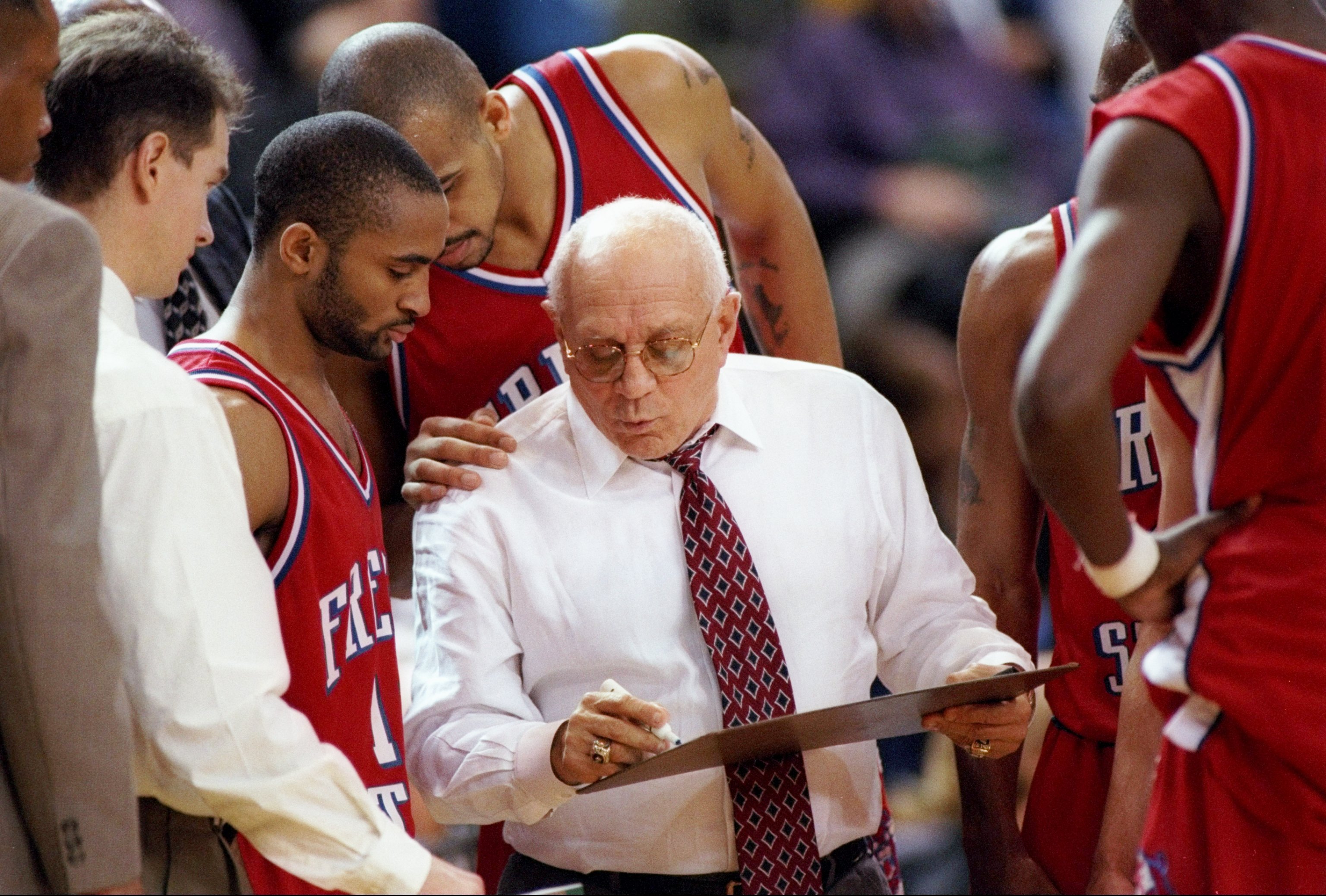
At the same time, college coaches could justify cheating by telling themselves it was only right to compensate their players, especially as Nike and other shoe companies helped make those coaches rich. Even easier to justify was so-called “back-end cheating,” where a player wasn’t so much enticed at the front end, but “taken care of” upon arriving on campus — so he wouldn’t have to go without a winter coat or the occasional burger or movie. Coaches like LSU’s Dale Brown and UTEP’s Don Haskins styled themselves as the Robin Hoods of the profession. Given a choice between following the rules or their conscience, they slept well knowing which they’d flout. As Rick Huckabay said after quitting as coach at Marshall in 1989, “There’s a fine line between being in the NCAA and being a Christian person.”
The most transactional deals prefigured our current era. Don Fields, the father of former UCLA star Kenny Fields, sat in on meetings on behalf of Los Angeles prospect and future LSU and NBA star John Williams, including one with a representative of UNLV in which Fields laid out terms including $50,000 in cash, a new Datsun 280ZX Turbo, a no-show summer job, and a $600-a-month allowance. “The allowance will have to be paid with dignity,” Fields added — no awkward visits to some booster’s villa to schmooze and otherwise “sing for your supper,” as Kenny had had to do as a Bruin.
UNLV dropped out of the Hot Rod Williams sweepstakes after hearing Don Fields out. Tarkanian felt he had no choice. With the Runnin’ Rebels already in the NCAA’s crosshairs, he said, to sign Williams would ensure that enforcement reps “wouldn’t have waited for the plane to land—they’d have come down in parachutes.”
Michigan State’s Jud Heathcote, as president of the National Association of Basketball Coaches, understood the market pressures and how they were affecting his membership. He pleaded with the NCAA to move to a distribution model that decoupled revenue payouts from tournament wins.
But the basketball committee was stacked with representatives from the power conferences. Each of those leagues would qualify five, six, seven or more schools for every tournament field, and could thus collect multiple “units” of revenue each year. So the pleas of Heathcote and coaches in the trenches fell on deaf ears.
A handful of coaches grumbled when Raw Recruits came out. Missouri’s Norm Stewart, UCLA’s Jim Harrick and Syracuse’s Jim Boeheim all objected to our portrayal of how their programs played the procurement game. But Armen and I believed then, and still do now, that the book was at its heart deeply sympathetic to coaches who had to operate in that world. “Sometimes I wonder what dishonesty is,” Georgetown coach John Thompson said. “Is it dishonest for a kid to be paid . . . or is it just against the rules?”
That question neatly frames up the decades leading to college basketball today, now that we’re in what might be called the Honesty Era. Today’s coaches may complain about the lack of enforceable contracts, and agents so green that they practically run their business out of a dorm room, and a portal that opens up while the final buzzer still echoes on championship Monday. But few would choose to go back.
Meet your guide