My introduction to LeBron James came a year later than it could have, and that probably turned out for the best. Perhaps if I’d watched him as a 15-year-old, the gifts that one day would make him the greatest player in the game’s history would not have been apparent. Perhaps if they were and I’d written about it with the enthusiasm I eventually delivered, the reaction might have been even more indignant.
In the summer of 2000, I arrived on the campus of Robert Morris University for the annual “Pitt II” session of the famed Five Star Basketball Camp. Although the ascendance of the invitation-only ABCD Camp introduced by Sonny Vaccaro and the Nike All-American Camp had made Five Star less of a destination for elite prospects, it still mattered. There still was plenty to see, on and off the court, and so my wife, Debra, and I usually would schedule one of several annual trips to our hometown of Pittsburgh to coincide with that event.
Just two years earlier, I’d visited the camp in the morning and wound up lunching at the nearby Ground Round restaurant with Fran Fraschilla. We’d only met once before, and I was fascinated to talk basketball with someone who knew the sport so thoroughly. So I ignored multiple calls on my flip phone that afternoon from Debra. This turned out to be a tactical error. I got in a whole lot of trouble, and deserved it.
I understood the parameters when I showed up at Robert Morris at mid-morning on that July day at the turn of the century: Watch whatever happened until mid-afternoon, and then head out so there was sufficient time to get ready for a dinner with family.
The first person I saw upon walking into the gym was the great Tom Konchalski.
We’d barely exchanged greetings when he insisted: “You have to see this kid, LeBron James.”
Tom was one of the great scouts in the sport’s history, trusted by some of the greatest college basketball coaches ever. He could have filled a scouting or GM role for an NBA or college team, but he chose to make the HSBI Report his life’s work.
Although I lived in Cincinnati in those years, I hadn’t spent any time following Ohio’s state basketball tournament, in which James already had won two championships by the end of his sophomore season. While James was dominating states, I was elsewhere covering the Cincinnati Bearcats and March Madness.
Tom’s impassioned plea was a clear indication “LeBron” would be a name I wouldn’t soon forget.
I asked Tom what would be the next opportunity to see James’ team.
“He doesn’t play until tonight,” Konchalski said.
And so I knew I wouldn’t see James for a while.
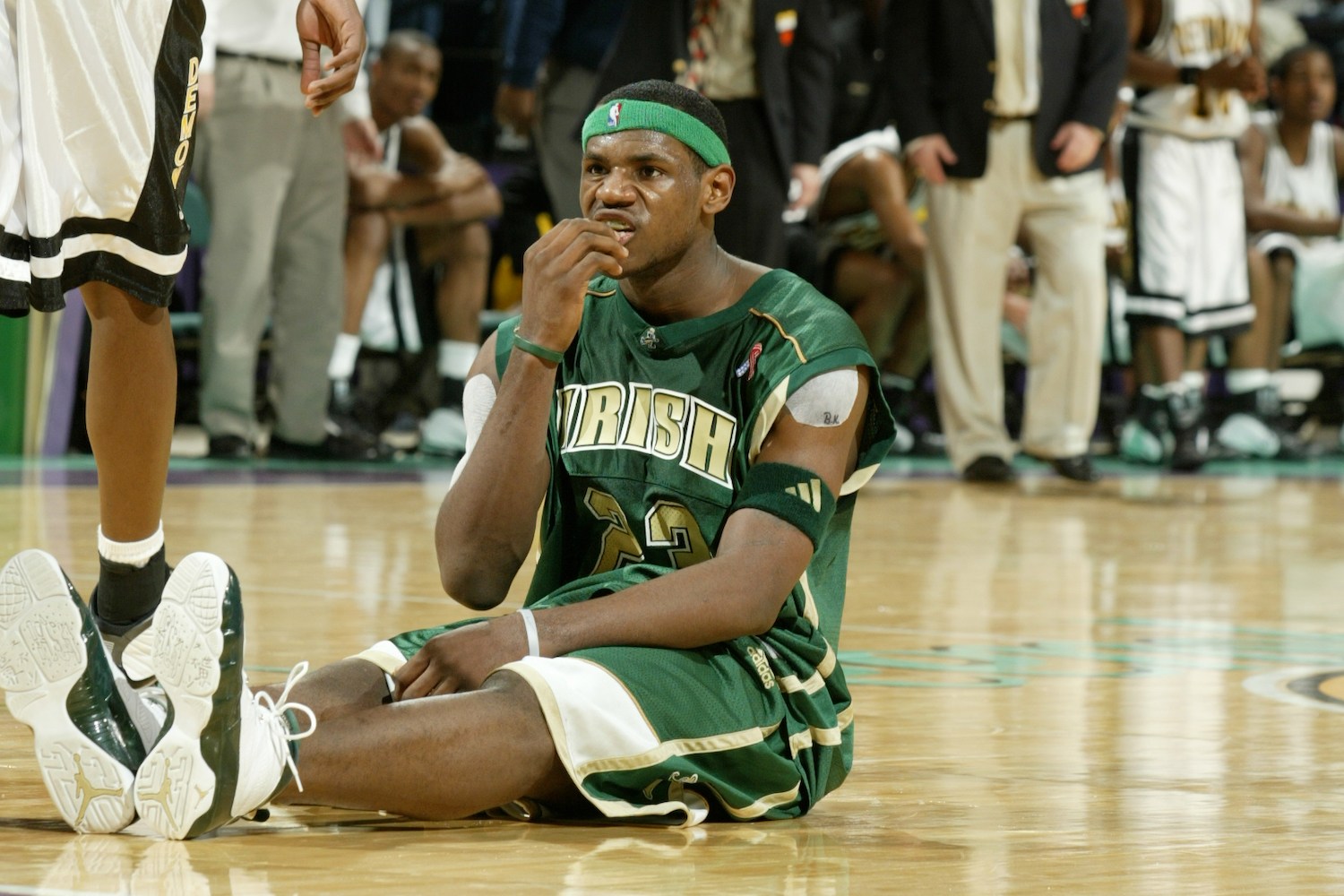
That occasion came just short of a year later, not long after I arrived in New Jersey for Vaccaro’s ABCD Camp. Those who were in attendance still talk about the game in which James dominated the player who’d gotten the most attention going into the camp, New York wing Lenny Cooke. I was splitting my recruiting-circuit trips between ABCD and Nike then, so I could get a look at all the essential players, and I had left for Indianapolis by the time that game occurred.
Which was fine. I didn’t need to see James destroy an established prospect to understand what would be coming over the next quarter-century. I just needed to watch him.
He was shorter and lighter than the player who’ll suit up for the Sixers this year; he stood 6-foot-6 and weighed about 225 pounds. There was no way to know he one day would grow to 6-foot-9, 250. It was easy to recognize this would not be necessary for him to be classified as the greatest basketball prospect I’d ever encountered – and quite possibly the best to be gifted to this planet.
By that point, I’d seen nearly all of America’s top prospects as high schoolers over the course of a quarter-century. Growing up in the Pittsburgh area in the 1970s was sports heaven; we had Roberto Clemente and Willie Stargell, Franco Harris and Mean Joe Greene, and the singular Tony Dorsett. There were two World Series titles, four Super Bowls rings and a college football national championship. There wasn’t a lot in the way of basketball, but we did have Sonny Vaccaro – and that helped me to fall even more in love with this sport than the others.
I attended my first Dapper Dan Roundball Classic in 1976, and then every one until leaving Pittsburgh for Memphis in 1993. Through those years I saw Isiah Thomas, James Worthy, Patrick Ewing, Pearl Washington, Shawn Kemp, Shaquille O’Neal and Chris Webber play at Pittsburgh’s Civic Arena. And so many others, as well. By the early 1990s, starting with Vaccaro’s ABCD Camp in Indianapolis and New Jersey and later the Nike All-American Camp, I was able to see Kevin Garnett, Tracy McGrady, Lamar Odom and Yao Ming.
So it was not an untrained, inexperienced eye beholding James from courtside at Fairleigh Dickinson’s Rothman Center on that afternoon in July 2001. I knew what I was seeing and had a frame of reference for comparison. And I knew how to capture it in print.
Understand, in that era of Sporting News, the magazine was “siloed”, as we say now. The NFL pages were about the NFL. The college basketball page was about college basketball. And I knew immediately James never would appear in the uniform of any Division I program. This was the “Preps-to-Pros” era, and he was as glorious a pro prospect as any prep in that period would become. LeBron wasn’t really my department, and yet I was compelled to say something about what all of us in attendance witnessed that afternoon.
That Time When a Tornado Struck the Georgia Dome
Falling debris and a life-saving buzzer-beater set the stage for a legendary SEC Tournament run. I watched it unfold from beneath the press table.
What I wrote about LeBron was the second item of a notes-type column – a collection of various observances from my travels along the camp circuit. There was no bold headline declaring him as the future of basketball. And yet my words in SN were not reserved:
“Some baby boomers who’ve got me by a few years make a big deal of the first time they saw the Beatles on the ‘Ed Sullivan Show.’ Now, I’ve got a moment to compare with that. Watch James make one routine trip down the court, and the whole package hits you at once: the size, the skills, the awareness, the competitiveness. The volume of his talent is staggering, even breathtaking. All that you’ve heard about his ability is true, except that it may be incomplete. The first thing that came to mind upon watching him was this: Magic Johnson’s head on Michael Jordan’s body.”
The humorous denouement of this episode is I immediately was lectured in print by a top sportswriter in James’ hometown for being excessively extravagant in my praise. And then before the year was out, ESPN had taken a crew featuring Hall of Famers Dick Vitale and Bill Walton to televise a St. Vincent-St. Mary game against Oak Hill Academy.
“The ball’s an extension of his mind,” Walton said on the telecast.
Vitale deployed one of his catch phrases — “Are you serious?” — to convey the spectacle.
And two months after that, Sports Illustrated pictured him on the cover with the headline: The Chosen One.
I hadn’t overhyped LeBron James. I just got there first. Well, first relative to spreading the word to the broader public. Tom Konchalski knew well before I did, as inevitably was the case.
Meet your guide