Editor’s Note: This story is part of a recurring “That Time When … ” nostalgia series that Hoops HQ will be publishing throughout the summer. You can read the previous installment about Bob Knight here.
Is that smoke? Because it sure as hell looks like smoke.
That was my thought as I first saw the white plumes coming from the engine of a 1950s-era Convair 440 plane I was riding, along with coaches, players and staff of East Tennessee State’s basketball team on the morning of Dec. 16, 1984.
Suffice it to say, when you see smoke coming out of the engine of a plane in which you’re traveling, it’s unsettling. But I tried to keep my wits — and wit — about me when I called the flight attendant over and asked, “Does this sort of thing happen all the time?”
The smoke was freaky enough, but when the attendant didn’t answer my question and instead turned and ran to the cockpit and slammed the door behind her, my heart started beating a bit faster. And when she emerged, along with another man in street clothes, and both bolted to the back of the plane and strapped themselves into seats, my heart was now a John Bonham drumbeat. What was going on?
It wasn’t long before the other passengers on the plane — 33 in all — noticed what I first discovered. And when the smoking engine eventually burst into flame, panic quickly spread among them. Some players began to cry. Others prayed. The team’s trainer, sitting behind me and to my left, was crying. I reached back and patted his knee. “My wife’s pregnant with a girl,” he said. “I’m never going to get to see her.”
“Yes you will,” I said.
The junket from hell
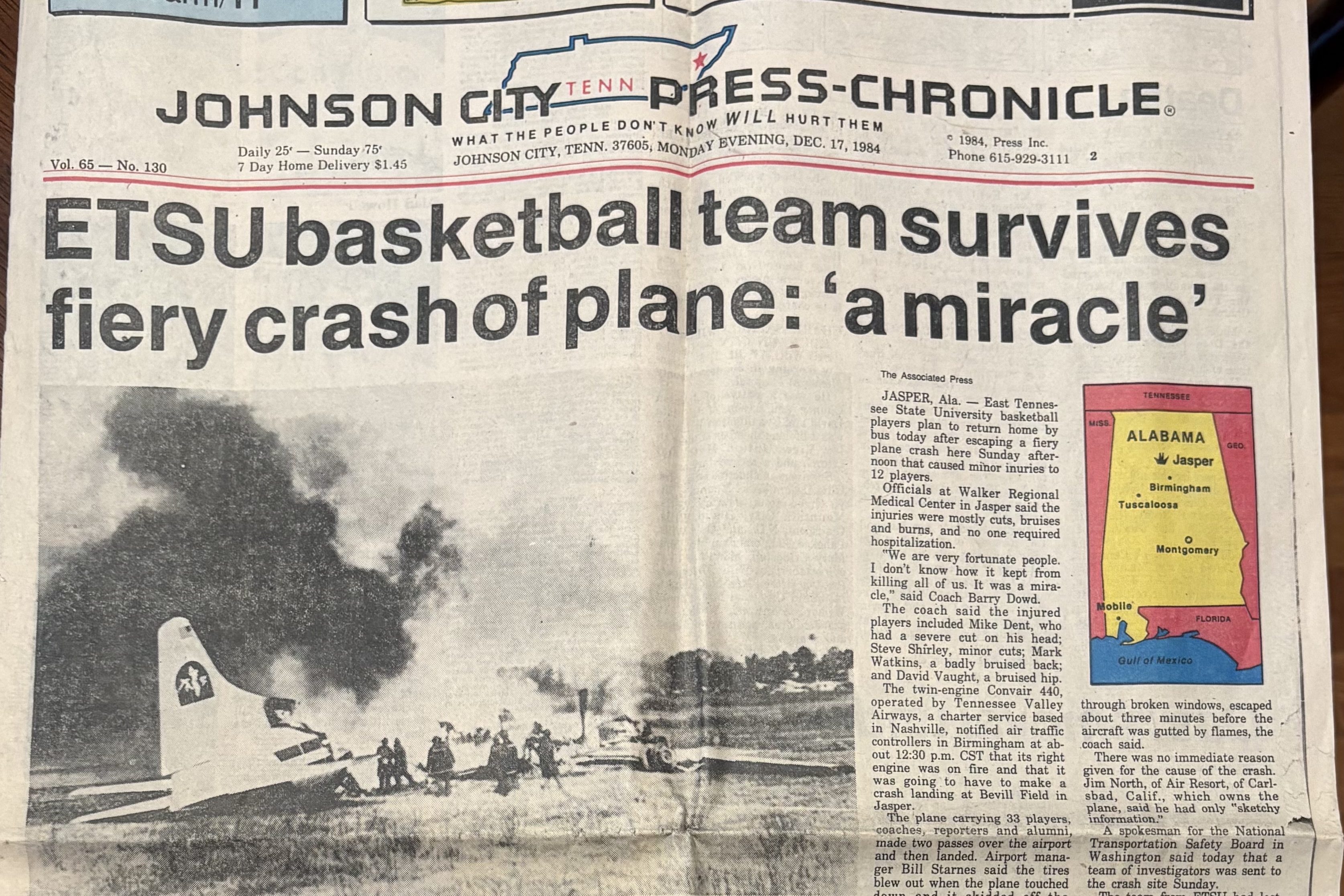
The decision that led to this impending disaster was innocent enough. Former ETSU coach Barry Dowd, once an assistant to Texas coach Abe Lemons, wanted to make a Lone Star State production out of a two-game road trip to UAB and Ole Miss. Instead of flying commercial, he decided on a charter plane so members of the media, alumni and other program VIPs could tag along.
What could possibly go wrong?
At the time, I was a young sportswriter with many lessons — some of them hard lessons — still to be learned. Here’s one I’ll never forget. When I showed up at Tri-Cities Airport on the day before ETSU was to play at UAB, our flight was delayed because the plane deployed by the charter company Dowd hired was being repaired. Something about the engine. In those days, I was a fearless flyer. Just two weeks before, I was cruising the skies above Cincinnati in a four-seat propeller plane piloted by my father-in-law, who didn’t have that many flight hours behind him and whose right hand was a little shaky, the result of coming into contact with Agent Orange during two tours of duty in Vietnam.
So I didn’t give a second thought to this delay for engine repair. I figured they’ll take care of it. It sure seemed like they did, because the flight to Birmingham was the smoothest I’ve ever been on.
The next time I rode that plane, the flight was just a bit different. Back to that hard lesson: When you’re scheduled to fly on a plane that develops engine trouble, maybe book another flight.
After the team landed in Birmingham, I rushed to rent a car. Unbeknownst to me, that supposedly repaired engine was leaking oil like a waterfall, soaking some of the team’s baggage. No one bothered to share that with me. Had I known, I’d have kept that rental car and driven the next leg of the journey to Oxford, Mississippi.
ETSU lost to UAB, and the next morning provided a harbinger of things to come, though I couldn’t have known at the time. As I was packing my bags, I turned on the TV. The movie Airplane was playing.
That Time When Rick Majerus Bared All
My relationship with the brilliant coach began with a memorable encounter in the Salt Lake City hotel room he called home
Where there’s smoke, there’s fire
My seatmate on the flight was one of the players. Mike Dent was a large man — 6-foot-9 and 250 pounds — with flaming red hair and a quick smile. Everyone loved Mike, and I was happy to share the ride with him.
When I first saw smoke coming from the engine, I tapped Dent and pointed outside. He was a laid-back dude, and at first, he didn’t seem all that concerned. But in minutes, the engine, which was right outside our window, was ablaze. Dent asked if I wanted him to close the window shade. Given the panic spiraling around us, I nodded my head.
But no one needed to see that engine to know what was happening. Which in a way was helpful, because we got zero warning from the plane’s captain or that flight attendant about how dire our situation was. We all knew the plane was descending, and we could see below us the north Alabama terrain — nothing but hills and trees. On our way down, we passed a runway that had giant X’s painted on it, which, we later found out, meant it was no longer in use. “Why doesn’t he land this goddamn thing?” a reporter from the Kingsport Times-News shouted. Even at that moment, my sense of humor remained intact. “I don’t think now’s a good time to take the Lord’s name in vain,” I told him.
A few people who heard that laughed, though fear still gripped all of us. That’s when it hit me to try and do something. I turned around and yelled as loud as I could, “This thing is going down hard. When it does, get ready to get out and run. We’re going to make it. We’re all going to make it.”
As we continued our rapid descent, the engine finally conked out. We were barely above Jasper, Ala., and four players at a nearby golf course were about to putt when they looked up and saw a burning plane headed toward the ground. It would have been nice to know this at the time, but the pilot’s destination was Walker County Airport, which had opened in Jasper just six months before.
Lower and lower the plane dropped, and eventually, the right tire on the landing gear caught fire. To this day, the smell of burning rubber takes me back to that moment. It’s impossible to shake. Then the left engine failed, too, and we were in freefall. The pilot, who had been in communication with the air traffic control tower in Birmingham and was told to try and reach Jasper, was about to make the scariest landing of his life.
Chaos and the high-top sneakers
Just before the plane hit the pavement, the flight attendant who had been quieter than a mime finally spoke. Or yelled. “Grab your ankles!” she said.
That turned out to be good advice. Meanwhile, the screaming, crying and praying grew louder, more desperate. “We weren’t praying to live,” one player later told me later. “We were praying to go to heaven.”
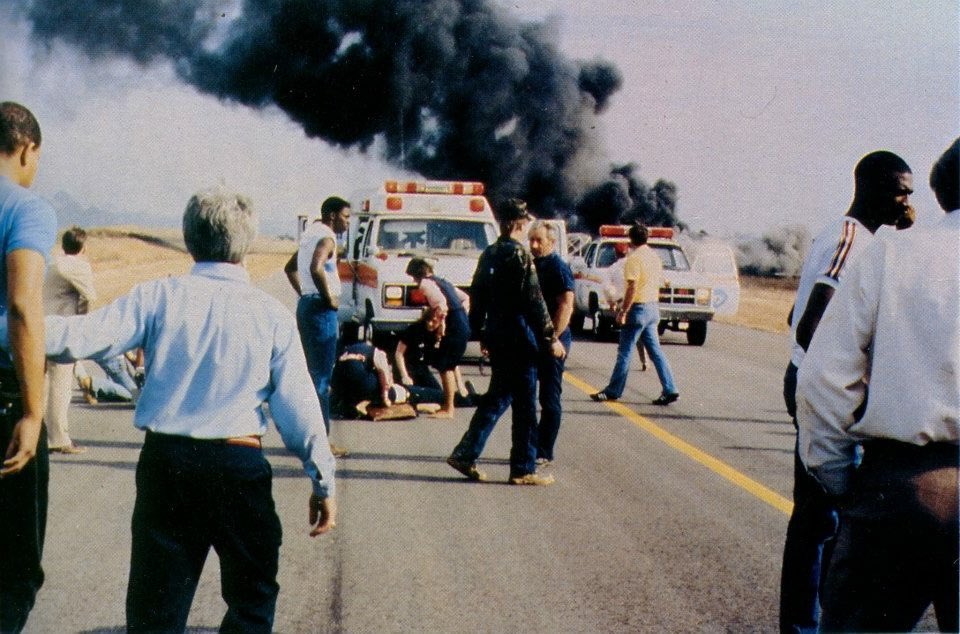
The plane bounced onto the concrete, and though the pilot fought to slow it down, it did two-and-a-half revolutions before leaving the runway and crashing nose first into the ground. The sound of crunching metal is etched in my brain. I’m not expecting that sound to one day suddenly be exorcised, so I’ve learned to deal with it.
After the plane came to a stop, I let go of my ankles and sat up. A quick check revealed my limbs were intact, so I unbuckled my seat belt. Dent and I were sitting by an emergency exit door, but the fire around it was too intense. That escape route was impassable.
I saw players, coaches and media running toward the front of the plane but couldn’t imagine why. How could they get out? I wasn’t sure, but I wasn’t about to join that conga line. Smoke had already begun to pour into the cabin. I didn’t want to survive the crash, only to die because my lungs got filled with the stench of burning rubber.
I still have a hard time believing the courage I was granted that day. Was it from my guardian angel? Adrenaline? The will to see my wife and young son again? Maybe all the above. I looked to my left and saw the exit door everyone had been bypassing in the mad rush to the front of the plane. It was sealed with duct tape. This tub wasn’t exactly Air Force One. I reached to open it, and it wouldn’t budge. Then I did something I probably couldn’t duplicate in 1,000 more attempts. I’m glad I was wearing high-top leather basketball shoes, because I reared my right leg and kicked the door with all the might I could muster. It flew open and clattered to the ground.
I looked around for people to toss out that door. The first was the trainer I promised would live to see his baby girl. Then a couple of players. After that, I jumped — it was about six feet to the wing — and the metal was so hot it singed the fingertips on my right hand. I scrambled to my feet and ran like hell.
Suddenly I stopped, feeling guilty I hadn’t done enough to help others get out of the plane. I looked back and saw a player named Albert Sams dragging his 6-foot-5, 220-pound teammate Calvin Cannady away from the wreckage. On impact Cannady re-injured a knee he had been rehabbing. I ran to them, draped one of Cannady’s gasoline-hose arms around my shoulder, and Sams and I ran for all we were worth. I swear Cannady was airborne trailing behind us.
A small town steps up
I got to the runway and started counting people. I looked for Mike Dent but couldn’t spot him. How could I lose track of this giant of a man? After a couple of minutes, I found him lying face-up on the runway, blood streaming down both sides of his neck. I feared Dent, who hadn’t grabbed his ankles in time, had been hit by one of the myriad objects that flew through the cabin after we crashed.
I looked back at the plane, which firefighters were bravely trying to extinguish, thinking at least we could salvage our luggage. The next time I glanced at the plane, all that remained was the nose and tail. In one of the many miracles that happened to us, an EMT team that had opened for business for the first time that very morning was also on the scene. One of the first responders stopped me. “You’re covered in blood,” he said. “Take your clothes off or we’re going to have to cut them off you.”
I hadn’t noticed the blood but did as I was told. Except for a puncture wound in the groin area caused by the seat belt buckle and some scratches on my back, I was fine and didn’t want to go to the hospital. But where did the blood come from? I later figured out it belonged to Dent, whose chin was cut when we hit the ground. Strange, but I don’t remember seeing him after impact, much less watching him soak my shirt and pants with blood. Such was the laser focus I had to find a way out of that burgeoning inferno.
The day wasn’t without its gallows humor. Some of the players had exited from the rear of the plane and run into the woods because they thought it was going to blow up. That explained the erroneous report we’d heard that a drug smuggling plane had crashed, and its occupants were high-tailing it to avoid arrest.
I was luckier than most of the players. I still had my coat and shoes, plus my wallet. Some of them were without all three. But my bag with my laptop and other tools of the trade were burned to a crisp. Jimmy Denton, a reporter for one of the Tri-Cities’ TV stations, lent me a pad and pen, and I immediately began interviewing everyone about what they had seen, heard and felt. Agents from the National Transportation Safety Board were there almost as quickly as the first responders. I asked one how lucky we were. “Ninety-nine percent of the time, a spark gets in the fuel line, and well… you know,” he said.
Several kindly residents of Jasper came to our rescue. One woman took us to the home of Glen Clem Sr., who was the basketball coach at Walker College (now called Bevill State Community College). In a strange coincidence, during the car ride we discovered we had a mutual friend — a basketball coach — who was also involved in a plane crash. When we arrived at coach Clem’s house, I couldn’t believe how kind he was by offering us food, something to drink and the use of his phone. None of us felt much like eating, but we lined up to get at that phone. It took a few tries because the lines into Johnson City, Tenn. were jammed, but I finally reached my wife, Patty, who had heard about the crash on the radio but was not aware if anyone made it out alive. When the pastor of our church came to our house, she wouldn’t let him inside, afraid of what he might tell her.
I asked an ETSU assistant coach why coach Clem was being so gracious, and he said, “Don’t you know who his son is?” I said, “Yeah, Glen Jr. He plays for Vanderbilt.” Then the assistant told me something that gives me chills even as I type these words. “Well, three days from now, Vanderbilt was supposed to take this same plane to a game at Indiana State.”
The town of Jasper was incredible, too. We got to stay at a hotel, which served a huge steak dinner for all the survivors. The local movie theater let us see a film and eat anything we wanted for free. We looked like we’d been in combat because many of us were bloody and bandaged, or our clothes were tattered. But my popcorn and Junior Mints never tasted so good, and Beverly Hills Cop, the movie I chose, is another memory I’ll carry forever.
After we settled into our hotel, and before our dinner and the movie, a bunch of media folks and players gathered in my room. We watched the CBS Evening News to see if our crazy day was worth mentioning on national television. It was, but it was the last story of the broadcast. One of the players groused that our story had been buried.
A TV reporter who was in the room then said something that gives me the shivers every time I think of it. “Son,” he said. “You should be glad we weren’t the lead story.”
Meet your guide