Editor’s Note: This story is part of a recurring “This Time When … ” nostalgia series that Hoops HQ will be publishing throughout the summer. You can read the first installment about Rick Majerus here.
When the news broke that Indiana University basketball coach Bob Knight, in a fit of practice pique, may have placed his hands upon the neck of his starting point guard, Neil Reed, my reaction was: Of course it happened. Befitting his volcanic temper, Knight was entirely capable of such an action, and, well, it had happened to me years earlier.
Before we get too far into this, it’s my hope that reasonable people can agree—if reasonableness is still a thing—that choke is a word with room for nuance. You can choke someone with intent to kill or incapacitate, or you can be, say, Rowdy Roddy Piper, who was not only allowed to grasp his opponent’s neck for his famed Sleeper hold but was expected to. This is not me accusing Knight, three years after his death, of an illegal act. He broke no laws when he put his right hand on my neck and squeezed in the Indiana basketball dressing room. Well, no laws except those of common civility, to which he paid scant attention. So …
In March of 1983 I was dispatched to Bloomington for Indiana’s final regular-season game against Ohio State, which the Hoosiers won handily. (That Big Ten championship team, led by Randy Wittman, finished the season with a 23-5 record, won one NCAA tournament game against Oklahoma, then bowed out in a 64-59 loss to Kentucky.) The story was about the players and the season — it was not a Knight profile — and, indeed, I spent relatively few column inches on him, instead featuring Wittman, center Uwe Blab (for whom the IU band played the German national anthem Das Deutschlandlied, whose words Blab later confessed he did not know) and an injured Ted Kitchel, who checked himself out of the hospital and made a dramatic entrance, in mufti, to the locker room before the game. Kitchel, Wittman’s close friend and fellow Hoosier-born jump-shooter, had days earlier undergone an operation for a ruptured disc in his back. “He looked like a corpse in a three-piece suit,” said Shirley Wittman, Randy’s mother, whose contributions added much to the story.
But every IU story during that era essentially began with Knight, just as every Duke story would later begin with Mike Krzyzewski. As soon as you hit the city limits of Bloomington, maybe even in the state of Indiana, you felt his presence. I would argue that no basketball coach ever, not even Krzyzewski in Durham, had as much sway over a town as Knight over Bloomington. (Bear Bryant in Tuscaloosa is probably the best comparison.) I was chosen for the assignment largely because Knight didn’t know me, meaning that I hadn’t pissed him off, as had SI’s nonpareil college hoops writer at the time, Curry Kirkpatrick. On the night I got there, I had dinner with Knight and a few of his friends — I was instructed by veteran SI photographer Rick Clarkson, who had known Knight for a long time and thus was part of his accepted circle, not to laugh or otherwise comment if he mixed 7-Up into his white wine — and so I was prepared when the coach did exactly that. The table talk, as I recall, was more of an extended Knight soliloquy. I imagine that golf dinners at Mar-a-Lago roll out with essentially the same dynamic.
Before practice the next day I was in the IU locker room with Knight and his assistants, Jim Crews, Joby Wright and Royce Waltman. It was the usual drill for a journalist — getting the overall lay of the land from The Voice That Matters. When we came to Jim Thomas, a 6-foot-3 senior guard, Knight suddenly became animated. He walked over to where I was sitting on a bench, bent down and grabbed my neck, getting a handful of chest hair in the process. I don’t remember exactly what he said but it was to convey that he wanted Thomas to be more aggressive, the kind of player that would, metaphorically, grab someone by the neck. To understate the obvious: He felt he wasn’t getting enough out of Thomas, probably something that had roiled inside of him over four seasons.
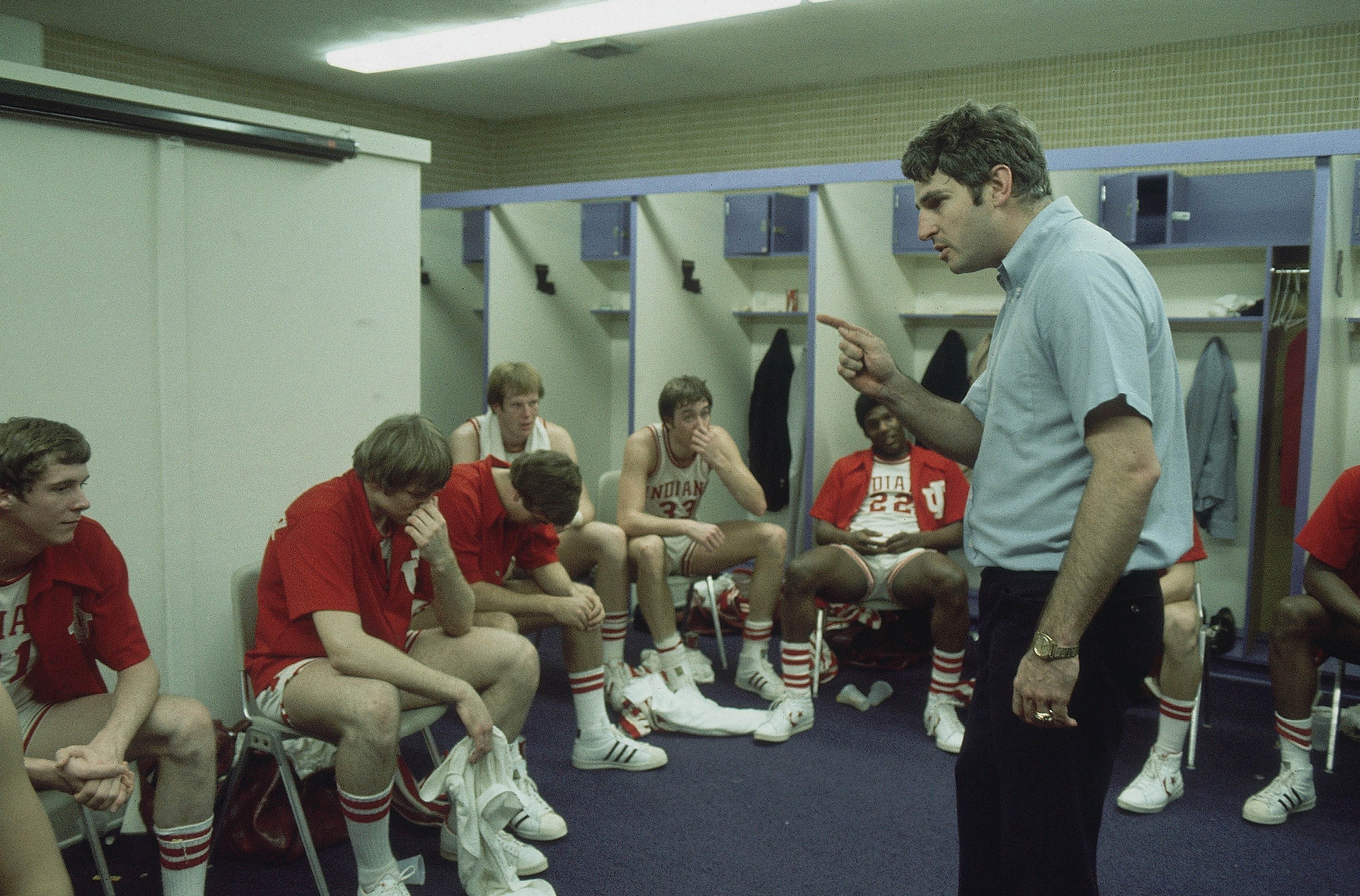
How long did he have hold of my neck? Only for a few seconds. Did it hurt? Damn straight. I remember sitting there and staring at him and making sure not to react. Yeah, I get choked all the time. Was I worried for my safety or anything that dramatic? Not at all.
It was over in a flash, and it left me to ponder:
Did he really get so involved in the conversation that he was compelled to do that? To someone he barely knew?
Or was it more a way of sending an overall message that he was in charge of this story, and no damn unknown magazine writer was going to come to his town and start criticizing the IU basketball program. (Which I was not there to do.)
At the time it seemed more spontaneous than calculated, but, upon reflection, I suspect it was a bit of both.
“Did it hurt? Damn straight. I remember sitting there and staring at him and making sure not to react.”
The weekend went on and I was too busy to think much about it. I had facts to gather and a story to write, and the piece (which ran in the March 21, 1983 issue) was headlined: “Back Home Again, It’s Indiana.” After the win over Ohio State, I sought out Knight for a few final quotes. “What the hell do you want, Jack,” said Knight. (It was not a question.) “Jesus, you guys never get enough.” I took it as kind of a good-natured jab, and, as pathetic as it sounds, felt proud that he had remembered my name. Such was the power of Knight in those days.
I switched to the NBA beat and never interacted with Knight again. As a journalist, one of the main differences between the two sports is that many (most?) college coaches are dictators (even if they’re relatively benevolent), while NBA coaches know they are one superstar criticism away from being fired. Insecurity abounds, even for the great ones. This is far too glib but let’s put it this way: In the NBA, the coaches are the ones who get choked and the players do the choking; witness the Latrell Sprewell-P.J. Carlesimo confrontation at a Golden State Warriors practice in 1997.
That is the same year that Knight put his hands on Reed’s neck during a practice session, though the truth took a while to get out. When Reed was later thrust into the spotlight, one could sense his discomfort, confusion and melancholy, the degree to which Knight had ruined his experience in Bloomington. Like anyone with a pulse, I felt saddened when Reed, who had gotten his life together as a small-town coach and teacher in California, died of a massive heart attack at age 36 in 2012. But I always felt that the choking incident was a trifle overblown. (Man, I feel the pushback already.) No, coaches shouldn’t lay hands on their players. But if you went to play for Knight, if the decision was made that Knight’s Bloomington was a good way to spend a few years of your life as a basketball player, well, you kind of deserved what was coming to you. Or you should at least expect it.
What I had against Knight was the way he treated everyone else, the secretaries, the NCAA officials, the peripheral people — okay, kinda, sorta the journalists — the way he bullied and insulted and stomped his way through the basketball universe like Big Foot with a genius for X’s and O’s.
Writing this piece led me to wonder whether, had it happened in the social media age, would I have mentioned it. Tweet? Too few characters to explain it properly. How about a column for the website? Possibly but I don’t know. I’ve never been one to, you know, stick my neck out.
Jack McCallum is a veteran sportswriter who covered college basketball, the NBA and other beats for Sports Illustrated for 37 years. He is the author of several best selling books, including The Dream Team, and was the recipient of the Basketball Hall of Fame’s Curt Gowdy Award for excellence in print media in 2005.
Meet your guide