
In early March, as the 2025-26 regular season was winding down, Saint Louis coach Josh Schertz met individually with the 10 players on his roster who could potentially return for the 2026-27 campaign.
These weren’t negotiations. No money was discussed. No commitments were made. Schertz just sought to take the temperature of his team before the chaos of the postseason began, not to mention the unavoidable surge in outside noise about his own future as other coaching jobs opened up. “Where’s your head at?” Schertz asked each player. “Are you planning on coming back if we can make it work?”
Over his 18 years as a head coach, Schertz has always valued retention. “I became a head coach in 2008 in Division II and my thought on program building then was honestly the same as it is now,” he tells Hoops HQ. “Which is, you have to recruit great players, you have to develop the heck out of them, and you have to retain them.”
Saint Louis was putting the finishing touches on one of the best seasons in program history. Still, with the boom of the portal and the opportunities that would be out there for many of SLU’s players, retention would be a challenge. To Schertz’s delight, nine of the 10 guys said that they wanted to return, with the other being on the fence.
Three weeks later, after the Billikens were knocked out of the NCAA Tournament by eventual national champion Michigan, Schertz set up exit interviews. While Saint Louis had upped its NIL budget, there was no doubt that some players could earn more on the open market. The DMs from other programs were coming in. The pressure was mounting. And yet, the temperature remained the same. Over a two-day span, the nine players Schertz anticipated would return formally committed.
In today’s college basketball world, that level of retention is basically unheard of. More than 2,000 players have entered the portal since it opened on April 7. Teams across the country, including bluebloods such as Kansas and Kentucky, have been completely decimated. Meanwhile, Saint Louis is bringing back five key rotational pieces — three of whom earned All-A-10 honors (6-foot junior guard Trey Green, 6-foot-5 junior guard Kellen Thames and 6-foot-6 sophomore guard Amari McCottry) — from a team that broke the program record for wins in a season (29) and earned a bid to the NCAA Tournament. The table has been set for even more success in 2026-27, as the Billikens will likely open the season ranked in the top 25. “You can make a case, a pretty easy one, that this will be the most anticipated season in Saint Louis basketball history,” Schertz says.
Schertz has also made his commitment to Saint Louis clear. He was believed to be a top candidate for several high-major coaching positions in the past month, including NC State and Syracuse. From the outset, he was direct with his players about the uncomfortable situation. “I told them that there’s going to be a lot of speculation online and the vast majority of it is going to be unfounded or incorrect,” he says. “And that if anything was to happen, they would be the first to know. It would come directly from me. There was never a time when I sat in front of them and said, ‘Hey, this is going to happen,’ because it never got to anything where that was needed.”
Given SLU’s success, it was inevitable that other schools would try to poach Schertz and his players. The Billikens finished 29-6 (15-3) and claimed the A-10 regular-season title. They entered the AP poll for the first time since the 2010-11 campaign and climbed as high as No. 18 in the country. As a No. 9 seed in the Big Dance, they dismantled Georgia 102-77 in the first round — the program’s first March Madness victory in 12 years — before falling to Michigan.
Schertz agreed to a long-term contract extension with the university in mid-March. Among the many factors that weighed into his decision — the infrastructure, investment, city, people, etc. — was the fact that so many of his players were intent on coming back next season.
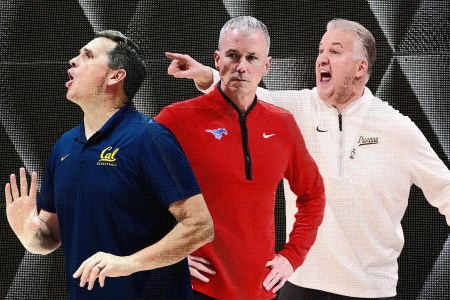
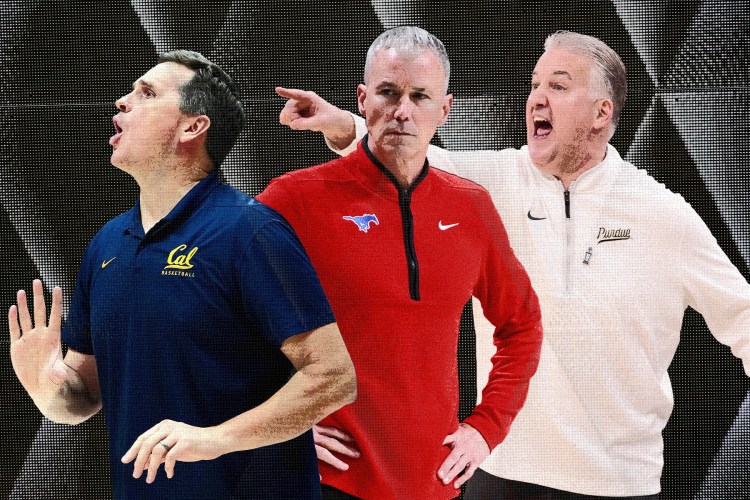
Top 10 Teams Most Likely to Take a Step Back in 2026-27
Cal, UCF and Stanford are set up to suffer the biggest setbacks in college hoops. Who else made the list?
But how, exactly, did a mid-major like Saint Louis achieve such retention?
The first and most important step was recruiting the right guys. A year ago, Schertz and his staff delivered a masterclass on modern roster building, bringing in 10 new players (six transfers and four freshmen) who meshed perfectly with each other and the program. During the portal process, they didn’t just chase talent. They targeted players who best fit the Billikens’ style, culture and additional pieces. “You can recruit to get the player or you can recruit to make it work,” Schertz explains. “I think if retention is really important to you, then you have to recruit to make it work.”
In conversations with recruits, Schertz doesn’t make any promises about roles or playing time and provides an “unvarnished” look at his program so that there are no surprises. Of course, retention is far more likely when a player’s experience matches his expectation.
The 2025-26 roster was constructed around centerpiece Robbie Avila, a 6-foot-10 senior center. It was loaded with elite shooters and playmakers, all of whom bought into specific roles and thrived within Schertz’s system, which emphasizes spacing, cutting, ball movement and pushing the pace. Saint Louis ranked 10th nationally in scoring, eighth in assists, fifth in field goal percentage and third in three-point percentage. Seven players averaged between nine and 13 points per game, including five who are set to return: Green, McCottry, Thames, 6-foot-5 sophomore forward Ishan Sharma and 6-foot-5 junior guard Quentin Jones.
Green and Sharma shot 44.2 and 41.7 percent from three, respectively; McCottry was second on the team in rebounding and third in assists; Thames led the entire A-10 in field goal percentage; and Jones provided lockdown defense and steady offense.
The chemistry and success of the group, combined with a heightened financial investment from the school, led to the nine re-commitments. “Our guys take pride in being here,” Schertz says. “They have ownership. I think they felt like, man, we got to this point and accomplished these things, but if we come back as a group, we have a chance to do more.”
Saint Louis still has to replace a few critical pieces, primarily in the frontcourt. Both Avila and 6-foot-9 forward Paul Otieno are out of eligibility. Avila, the reigning A-10 Player of the Year, was the team’s leader and fulcrum on offense. He led all centers in assists per game in each of his seasons with the Billikens and shot 37.9 percent from three over his collegiate career.
Finding an affordable player with the unique skill set of Avila will be impossible, but the program is scouring the portal for bigs who can stretch the floor horizontally (as outside shooters) and vertically (as lob threats). Schertz is hoping to add more athleticism and muscle inside, especially after seeing how physically imposing Michigan was during the NCAA Tournament.
Earlier this week, Saint Louis earned a commitment from 6-foot-7 point guard Yousaf Ahmad. The Toronto native out of King Heights Academy is considered one of the top prospects from Canada. His addition was SLU’s first move of the offseason, with more to come in the ensuing months.
The Billikens will have to slightly tweak how they play — in Avila’s absence, Schertz anticipates the guards assuming more playmaking duties than they had last year. But with nine returnees, adjustments will be minimal compared to that of most college basketball teams. As other programs scramble to assemble their rosters and foster chemistry throughout the offseason, Saint Louis is already miles ahead.
“In today’s world, a lot of people talk about ‘get old, stay old,’” Schertz says. “I do think there’s value in that. What people miss is getting old together, shared experience, accumulated mileage. Having a bunch of guys who played major roles on a team that won an Atlantic 10 championship, got into the NCAA Tournament, won a game in the tournament, played Michigan. Those shared experiences, if processed right, will give us a really significant leg up coming into next season.”
Meet your guide