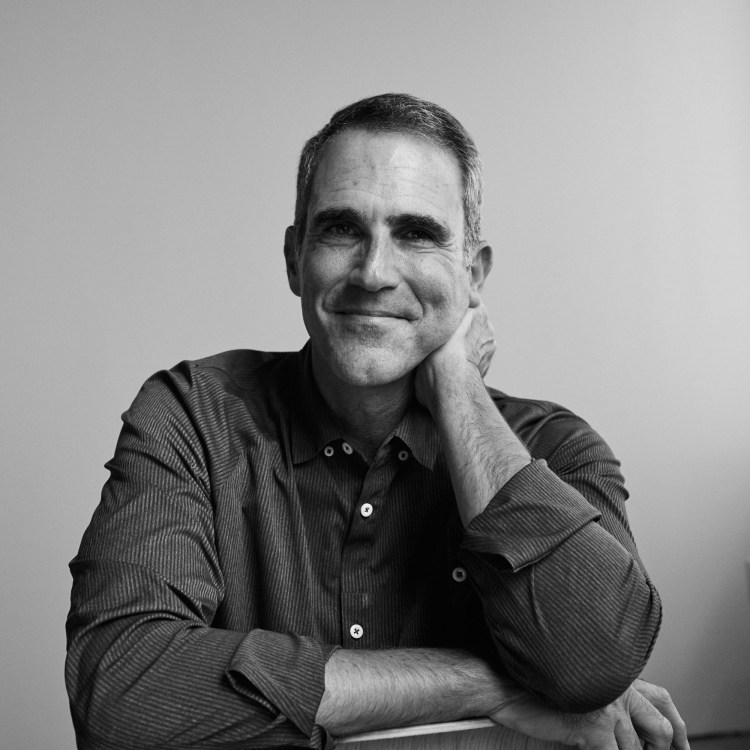

Unlike many college basketball referees, Roger Ayers does not have another job. That does not mean, however, that he doesn’t work during the offseason. A typical weekday includes a two-hour morning workout, followed by a five-mile afternoon walk, followed by a second workout at night. He teaches at clinics around the country through the summer and dedicates an hour each evening to studying the rule book. “My buddies at the gym ask me, why are you here every day except Sunday?” Ayers, 60, told Hoops HQ. “I say it’s because I hear footsteps. There’s younger refs coming and I understand that my days are numbered. I never want anyone to turn the TV on and think, ‘He can’t keep up anymore.’”
In November, Ayers will begin his 30th season as a Division I official. As far as he’s concerned, it can’t get here fast enough. The sooner Ayers refs his next game, the sooner he can move on from what happened in his last one.
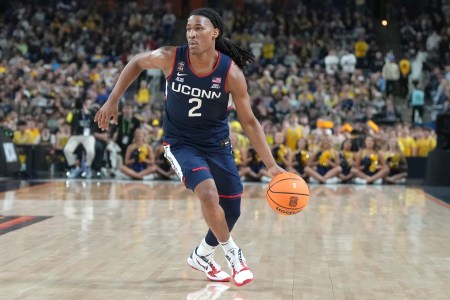
That was the NCAA East Regional Final in Washington, D.C., on March 29 between Duke and UConn. It was an epic contest, with UConn coming back from 19 points down to win on freshman guard Braylon Mullins’ dramatic three-pointer. After it was over, Ayers celebrated with his partners. “We were hugging each other in the locker room,” he said. “We thought we probably worked maybe one of the top 10 NCAA Tournament games ever. I told the crew, ‘Nobody will be talking about the officiating.’”
Ayers was right about that first part. The second, not so much.
In the hours that followed, video of an interaction between Ayers and UConn coach Dan Hurley, in which Hurley appeared to headbutt him, spread on social media. Ayers was unaware of this for two reasons. First, he is not on social media. Officiating supervisors strongly discourage it, and even if they didn’t, Ayers prefers to seal himself off from angry fans and gamblers.
The second reason Ayers was unaware of what was happening was because he was tending to his dying brother.
Allen Ayers was one year younger than Roger and had been battling health issues for some time. He suffered a heart attack the previous Thursday and was admitted to a hospital in their hometown of Roanoke, Va. Roger offered to stay with his brother, but Allen insisted he fulfill his assignment.
As Roger was driving home Sunday evening following the game, one of Allen’s doctors called to say he had taken a turn for the worse. Roger drove straight to the hospital, where he found Allen barely conscious in bed. “I watched the game,” he said. “You did good.”
“You need to rest,” Roger replied.
The next morning, Allen’s doctors told Roger that his brother had lost all function in his kidney and liver. They suggested the humane thing to do would be to take him off life support. Since Allen was not married and had no children, it was up to Roger to make the wrenching decision. He got a cup of coffee, walked around for a while outside, and then came back to tell the doctors to proceed. They removed the support and moved Allen into hospice care.
Big East Preseason Power Rankings for the 2026-27 Season
UConn and St. John’s still lead the way in the top-heavy Big East, but the conference is expected to be a bit deeper this season
Still oblivious to the growing controversy, Ayers was still at the hospital on Monday night when he received a call from ESPN analyst Seth Greenberg. “I’m about to go on air,” Greenberg said. “Can you tell me about the interaction with Hurley?”
“What interaction?” Ayers asked.
“The headbutt,” Greenberg replied.
Ayers was confused. “I thought maybe we missed a headbutt between players or a flagrant foul,” he said. Greenberg texted him the video. Ayers watched it and explained to Greenberg that he had gone over to Hurley to let him know that there were still 0.3 seconds on the clock, and that the refs had to conduct a replay review to determine if that was accurate. The review was significant because a team cannot possess the ball with 0.3 seconds or fewer remaining.
Over the next several hours, Ayers’ phone continued to ping. His daughter called from Boston, worried because her coworkers were asking if her dad was going to be fired. “For all of this to blow up on social media, it really bothered me,” Ayers said. “I was like, what did I do wrong? By rule, I did everything right.”
Indeed, there is nothing in the rulebook that says contact between a coach and official must automatically result in a technical foul. Rather, Rule 10.3.2.h. states that a technical is warranted if a coach “(d)isrespectfully contacts an official or makes a threat of physical intimidation or harm to include pushing, shoving, spitting, or attempting to make physical contact with an official.” It would be a huge stretch to conclude that Hurley was trying to intimidate Ayers given what had just transpired. It’s also hard to fathom the controversy that would have ensued if Ayers had teed Hurley up and possibly delivered the game to Duke.
When asked about the contact by Hoops HQ, Hurley characterized it as a “head rub or head high-five” that stemmed from his excitement over Mullins’ shot. More than anything, he said it reflected the mutual respect he and Ayers share. “If it was another referee where the relationship was different in-game than mine is with Roger, there wouldn’t have been that type of interaction,” Hurley said. “He’s one of the best that’s ever done it. The games he refs, I’m probably the most calm. He gets his calls right and he controls the game. He knows when to tell you to shut up and get your respect that way, but then he also defuses things. He’s got a great way about him in how he handles a tense environment.”
Monday was a long day for Ayers, to say the least. On top of dealing with the Hurley fallout and his brother’s declining health, Ayers was awaiting word on whether he would be assigned to work the next weekend in Indianapolis. Ayers has reffed in seven Final Fours as well as the 2023 championship game between UConn and Purdue. Those assignments are ultimately made by Chris Rastatter, the NCAA’s coordinator of men’s basketball officiating. Only 11 officials get to work the final weekend (three in each game plus two alternates), and Ayers had been through the drill enough times to know that if he didn’t get a call by the early evening, he wasn’t going.
The call never came. Rastatter did reach out on Tuesday to tell Ayers he was sorry to hear about what was happening with his brother, but according to Ayers they never discussed the Final Four.
Did the Hurley contretempts factor into the decision, whether as a form of punishment or a desire to avoid a distraction? “In my heart, I don’t think it was. I don’t know for a fact,” Ayers said. “If I didn’t get selected because I screwed the game up or I missed a rule, I can live with those things. The thing that stings is, if that play happens in January, I’m working the next day. But I’ve got six, seven months to replay that over in my mind. Like, what could I have done different? It’s just a tough way to end the season.”
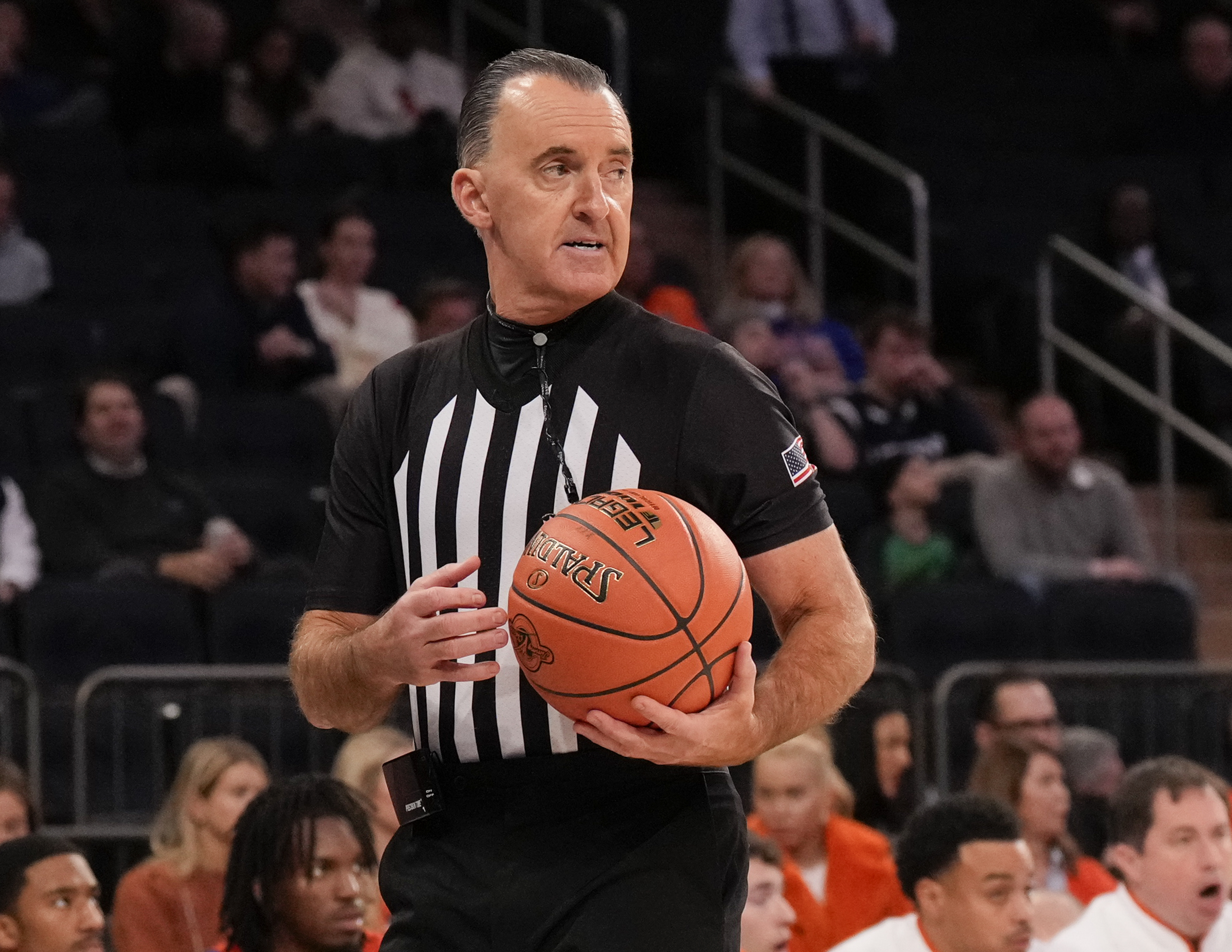
When reached by Hoops HQ, Rastatter, who refereed many games with Ayers during his 27 years as a Division I official, declined to say whether the incident with Hurley factored into his decision not to assign Ayers to the Final Four. But he affirmed his confidence in Ayers’ ability to work the biggest games. “Roger’s such a good play caller, but he has a way of putting the crew at ease,” Rastatter said. “He gets the big matchups because you have so much trust not only in his ability, but to manage things, get the job done, and do what’s right.”
Regardless, Ayers insists he is not bitter. “There’s only so many spots, and those guys did a great job. I was happy for every single one of them,” he said. “We’re peers, and I want all of us to succeed. The way I look at it, I was on the court in a history-making game. I was blessed to be there.”
That sense of gratitude is a big reason why Ayers has risen to the top of his profession. He loved reffing from the very first time a friend asked if he wanted to call a local youth basketball game in Roanoke three decades ago. Ayers quickly worked his way through AAU ball and Division II and III college games before moving up to Division I in 1995 at the age of 30.
Ayers began primarily working in the Big South Conference. In 1998, he was invited to move into the ACC. (“I still have the letter,” he said.) Six years later, the SEC called. Ayers later added the Big East and Big 12 to his docket. These days, his primary league is the ACC, but he calls plenty of games in those other leagues and picks up other assignments wherever he can. Last season, he reffed 114 games, which tied for the second-highest total in the country, according to KenPom.com. Ayers was No. 8 in KenPom’s officials rankings, which factors in the quality of the games officials worked.
When the doctors removed Allen from life support, they told Roger he would probably live another one or two days. He lived for 12, passing away on April 13 with his brother by his bedside. Between the grind of the season, the death of his brother and all the controversy, Ayers was wrung out. He even considered retiring, and wondered whether his best was good enough anymore.
In late April, he took a two-week vacation with his fiancee to Italy, where he ate a lot of pasta and drank a lot of wine. He returned to Roanoke refreshed and recharged. It won’t be easy waiting for the season to come around again in November, but Ayers is ready to get back to doing what he has done for so long, and so well.
“The more I thought about it, the more I’m like, I’m not going to go away like that,” he said. “I still get excited. When I don’t, that’s when I’m going to walk away. A lot of coaches probably hope that happens sooner rather than later. But I’ll be back out there November 1. I’m having too much fun to stop.”
Meet your guide