
UConn women’s basketball legend and 12-Time NCAA champion Geno Auriemma joined Seth Davis and Andy Katz on The Hoops HQ Show on Friday morning. Stream full episodes of the podcast on Hoops HQ’s YouTube channel, @hhqsports, or live on the Fubo Sports Network.
SETH DAVIS: We are joined by the legend himself, 12-time national championship coach of UConn women’s basketball, Geno Auriemma. Geno, thanks for being with us. You went nine years between winning national championships. Your initial rush of all those championships was impressive in its own right. But to me, going that long while the rest of women’s basketball caught up, largely because of the standards that you set, to now have this rush, not only winning it last year, but also being the dominant team so far this year. What would you say went into that resurgence?
GENO AURIEMMA: I resent that “while the rest of college basketball was catching up” — we were falling back.
I’m just kidding. Obviously the game has changed in so many ways. I mean, the NIL part, the transfer portal part, more kids spread around all over the country. It’s a different landscape. In the nine years, I never thought “we’re never going to win another one.” And I never thought, “yeah, we are.” It’s interesting because in eight of those nine years that we didn’t win, we were in the Final Four. So if your program is going to tank, and tanking means you’re in the Final Four with a chance to win it every year, that’s the best you can hope for in an absolute utopia.
But only at Connecticut is that considered “they’re ancient history.” So what happened last year? I got to the point at my age where Paige Bueckers was the story, as it should be. It’s not, for me, about whether 13 is in the cards or not, or any more beyond that. My life won’t change one iota, no matter what. My thing is over. This is not about me anymore. Now it’s about something way, way, way different.
ANDY KATZ: Geno, you’ve had so much experience in having the target on your back, being undefeated, being basically the Super Bowl for every road game. But you’ve had so many different players that come through. How do you teach them that they are going to be the hunted every single time?
Auriemma: You know, for the longest time, Andy, it was like, I can’t wait to go on the road. I’d rather play on the road than play at home. I remember playing at Duke, it was like No. 1 versus No. 2 in the country and the place was crazy. The players were coming off the court and they couldn’t hear me and I couldn’t hear them. It was so loud. And, you know, (Diana) Taurasi put on a show and we won. It was like a national championship game, doing it in front of a hostile crowd. But it takes a certain kind of player to flourish in that kind of an environment. And I would say that for a number of years there, between 2017-18, maybe as social media got bigger and bigger and bigger, I think maybe the bigness of it all got to some of our guys. And the fear of losing, I think for the first time became greater than winning.
And that’s the first time, maybe 2018, ‘19, especially the pandemic, even though we were getting to the Final Four, I think getting to the Final Four became almost a relief. And then winning was just too much for them to handle at times.
Seth: It’s so interesting to hear you describe that, Geno, because when I say other places “catching up,” that’s the ultimate compliment to you guys, because you had so much to do with the growth, the explosion of women’s college basketball a couple of years ago. With Caitlin Clark and everything that she did, we are seeing more teams in the mix. We’re seeing bigger crowds in these venues. We’re seeing more involvement with television.
Give us a state of the sport, if you will, as far as the growth of women’s college basketball and the areas where you think it still needs to grow.
Auriemma: Yeah, it’s taken a funny journey, because our very first Final Four, 1991, I think we were the first team from above the Mason-Dixon line to get to the Final Four. So we get there, and it’s in New Orleans and it’s at Lakefront Arena in front of 8,000 people. There was like one TV camera in New Orleans asking us, “Hey, how’s it feel?”
Fast forward to 2002, we’re playing in the Alamo Dome in the first dome game ever in the Final Four for women’s basketball. We had 30,000 people. So just from 1991 to 2002, look how much changed. And then it seemed like it started to go the other way.
I can’t pinpoint it, but I think people got a little bit tired of UConn, Tennessee, UConn, Tennessee, UConn, Tennessee, you know? And we needed something to shake up a little bit. We needed more teams to get good. We needed more places around the country to feel invested in women’s basketball.
We needed more schools to put more resources into the game. And hoping that they said “Hey, look, Connecticut came from nowhere. Why can’t we do the same thing?” Then you get to today, and the whole women’s sports world has exploded for a lot of different reasons.
There’s never been more attention paid on the game. There’s never been more interest. There’s never been more investment in most places. So it’s in a better place than it’s ever been in some respects. More games are televised, more people at the games. Fewer great teams, so I think that’s always like, “where can it go next?” There’s always got to be some great teams that everybody’s shooting for, that everyone wants to be, that the whole country can gather around.
Half the people in America want UConn to win every game. The other half, and I can be understating, more than the other half, want us to lose every game. But that’s good. It’s good that people feel like that about teams. We need that. We need great teams. But what we have now is more good teams.
That’s driven some of the parity. The level of play has to keep improving. But then I look at men’s basketball and I don’t see the same thing that I saw 10 years ago. The whole thing is different today. The whole college sports world is different. People move from one school to another, money becomes an issue and fans lose connection to their teams. Women’s basketball has always been the kind of sport where you grow up with your team. You know you’re gonna have a kid for four years, generally. And if that starts going away like it has on the men’s side, I think it’s gonna affect how people feel about their college team, and the only thing that will matter is March Madness.
Purdue Legend: NIL and the Transfer Portal Are Depriving Today's Players
The former Boilermakers captain and current Big Ten Network analyst discusses program loyalty and life after college basketball
Andy: Geno, help educate us on that part of the women’s side because there’s so much chatter about money, agents, poaching and transfers on the men’s side.
Auriemma: I made this comment one time and I was kind of saying it in jest — it’s almost like human trafficking, in the sense that you’ve got a kid who plays on a certain team and this person runs the team during the summer and they may have three or four really high level players. They go to college and get paid to go to that school. Does that person get a piece of it or not? I don’t know. I don’t ask. Now they’ve got an agent too. Now that kid’s at school. By January, there’s already plans for that kid to go somewhere else. And so those people are on the phone with representatives of schools or the coach at that school is on the phone with somebody.
And they’re already talking about where this kid is gonna go next. So the whole system kind of smells of, we’re all in it for the transaction, the transactional fee and how much money we’re gonna make.
Is it as prevalent as the men’s side? Yeah. Is there as much money in it as the men? No, I don’t think there’s a women’s basketball player coming out of high school that’s going to get five million. I don’t think there’s a college player that’s going to leave one school and go to another school for five million. However, what some of these kids coming out of high school are asking for is so stupid. It’s so ridiculous.
Andy: Give me a number. No names, but what would be a number someone would ask for?
Auriemma: Let’s just say it’s in the $300,000 range. Then you hear, you know, $200,000. Then you hear that now, this kid’s getting a million to go to this school. And I’m like, how? Okay, kid’s going to Ohio State to play football. Kid’s going to go to Indiana to play football. And they’re going to generate $200 million in revenue. And they’re going to give this kid $4 million to play quarterback. Fine.
So you’re to pay a million dollars to have a kid go to school to go play in a women’s basketball program that’s going to lose money, a lot of money. Like a lot of money. What it costs to charter, what it costs in scholarships, what it costs for salaries. It doesn’t make any sense. It doesn’t make any sense. If that becomes the driving force. then it’s gonna lose the one thing that has drawn people to the game, that it’s still, somewhat, being played by so-called student athletes.
Seth: Things are changing fast, man. Geno, I want to talk about your current team, which is undefeated and ranked No. 1. The other night, Jimmy Dykes, who of course was a women’s coach at Arkansas for a number of years, made a comment that Sarah Strong could end up being the best women’s college basketball player of all time. She’s certainly a great sophomore. But I don’t have enough of a sense of the historic nature of what she’s doing. I’m curious as to your thoughts on her and this team in general — are you guys as dominant as you appear to be?
Auriemma: That’s what I keep asking my staff: Are we this good? Some of the teams that we played in our nonconference games, I thought were going to be a huge, huge test for us and they turned out not to be. Was I expecting that? No.
Are we as good as South Carolina? I don’t know. I have no idea. Are we as good as Texas? Are we as good as UCLA? You know, the teams that everybody thinks are the top four teams in the country. Could we beat them tomorrow? I have no idea. And would I be surprised if we lost to them? No, not at all. Because that’s the nature of the game.
If I was going to be completely honest with anybody, we have three really, really high level players. Sarah Strong is the best player in the country, and every coach thinks their best player is the best player in the country. I get that. But there’s no kid that does what she does. Period. None. And then we got Azzi Fudd, who’s Azzi Fudd, the MVP, all that. And then we got this kid who’s a freshman, Blanca Quiñonez. So okay, we got three really, really high level players.
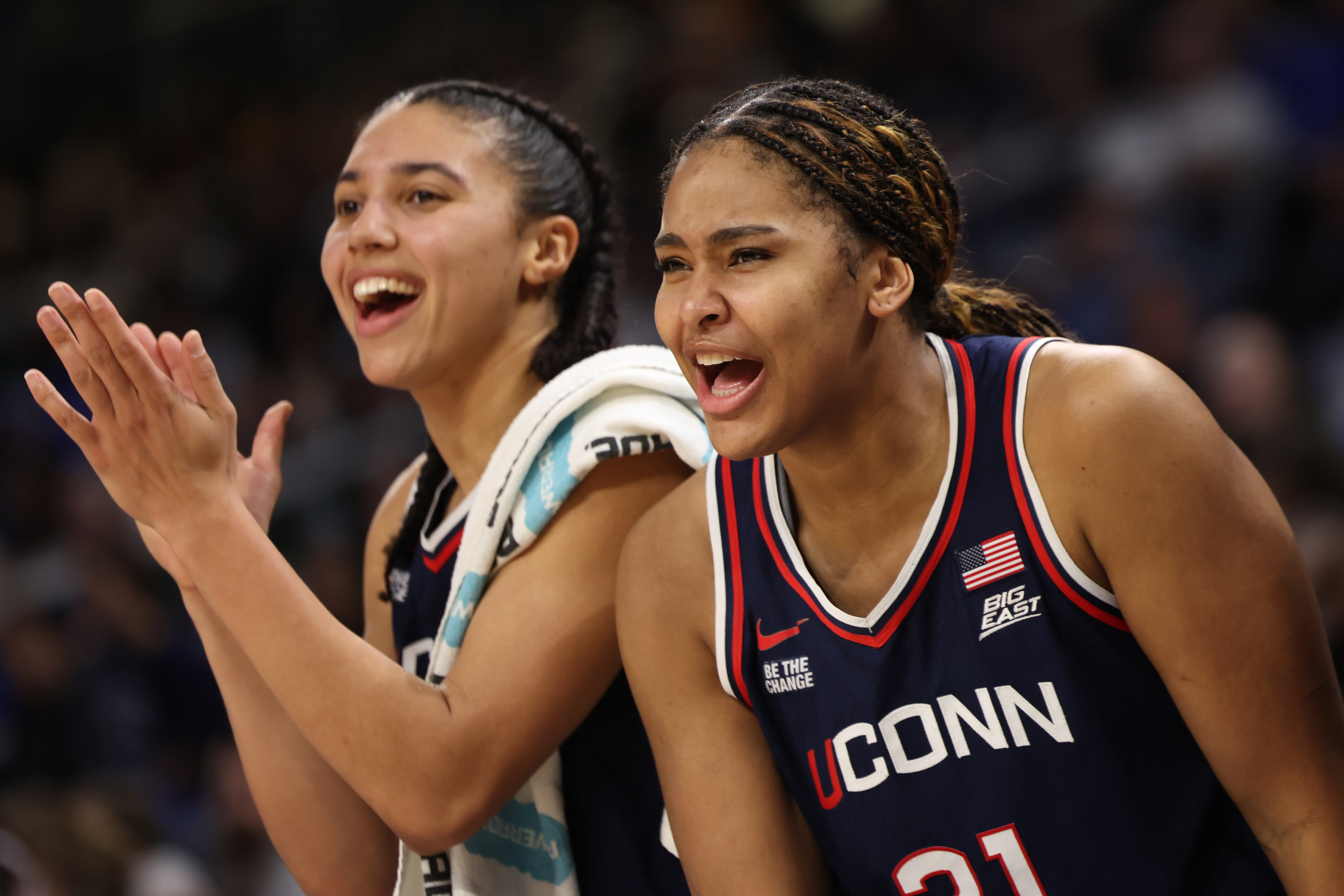
People tell me that these other programs, they have five kids that are going to be first round draft choices, whatever. But what we have is four or five kids that are great at their role, great at what they do, and they bring it every night. So if we have those three that I just mentioned play at the level that I think they are, and these other guys bring it every night, their little piece of it, then yeah, I think we can beat everybody in the country.
But there’s teams we could lose to as well. That’s what makes the NCAA Tournament so great. There’s no guarantees.
Andy: Rather than an All-Star Team, okay, you have to put together your all-time UConn team by position. Who are five great players you’ve coached that you would mesh together perfectly?
Auriemma: Man, that’s a hard one because we’ve had so many great players. Sue Bird is the greatest playmaker, maybe in the history of basketball — college basketball, pro basketball, I don’t care. You know, Diana Taurasi. I had those two in the backcourt together. Shows you how much the world has changed. Somebody asked me, “What was it like coaching them?” I said, “What’s it like having Gail Goodrich and Jerry West in your backcourt?” And one of the young writers asked me, “Gail Goodrich, who does she play for?” I said, “Yeah, okay. Next, next, next.” So, I got Sue Bird and Diana Taurasi in that backcourt. I think Tina Charles is probably the best rebounder, the best, most forceful kid that we’ve had in there, and they’ve played together on Olympic teams.
(Breanna Stewart). Stewie being Stewie meshes with everybody and is unguardable and is at that level of playmaking.
You know that that other one probably goes to Maya Moore. And it’s funny because I coached that team at the Olympics. They were on the floor in Rio de Janeiro. Playing for the US and went on like a 15-0 run against Spain or whoever the hell we were playing. So yeah, if somebody said pick one team, that’s the five I would put out.
Seth: What’s funny about that, Andy, is you try to go next level and say let’s find some role players and he basically picked the five best players he’s ever coached. So I think coaches, they’re going to lean towards talent and then figure out how it all works. There’s a reason why he’s won 12 titles, right?
Meet your guides