
In the middle of a Nike Mamba League Invitation game, Aaliyah Chavez turns to the camera. She holds a cup of water in one hand, and uses the other to emphasize the point she’s making. “I’m in your town, and you’re not lacing it up,” she says to an unnamed rival. “You don’t want that smoke. You know who you are.”
The viral moment in 2025 was many people’s first introduction to Chavez, a 5-foot-10 guard from Lubbock, Texas with a sharp tongue and an even sharper game. She pulls up for three-pointers from deep, deep range. She keeps the ball on a string, breaking ankles and contorting her body, finding unusual and unimaginable ways to score.
She has a dazzling hold on the basketball world, with skills that few possess. Chavez is simply better than her opponents, and she’s not shy about letting them know.
That was Oklahoma senior Payton Verhulst’s first impression of her new teammate. She looked like a villain, a hard-ass, a player that spectators would love to hate. Then she came to campus.
In her first practice with the Sooners, Chavez wouldn’t shoot. She was afraid to step on toes, worried that if she dominated the ball, her new teammates wouldn’t like her. “I wanted to learn and see how everyone was feeling about me,” Chavez tells Hoops HQ. “I took maybe three shots in that scrimmage. But then like half of my teammates pulled me aside and were like, ‘What are you doing? Why are you passing so much? We brought you here to make shots.’”
Chavez’s willingness to assimilate into the Oklahoma offense was a welcome surprise. Turning down shots, however, was not. But in that first practice, Verhulst and the Sooners discovered something the rest of the basketball world wasn’t privy to: Aaliyah Chavez is shy.
“I kind of didn’t know what to expect,” Verhulst says. “Especially with social media these days, people try to tell you who other people are, what their emotions and personalities are before you meet them. Then you do and it’s like, ‘What the heck? You’re not the person I’ve been seeing online.’ ”
If you wade through the online persona, there are signs of the real Chavez. Her brown curls are like partially closed curtains, giving a glimpse, but not a full look at her face. When she starts interviews, Chavez’s words come out slowly and carefully, her voice marked with a subtle shake.
But as the conversations continue, Chavez starts to open up. Just like she did to her teammates after that first practice.
“As a freshman, you never know what you’re going to get out of the upperclassmen,” Chavez says. “But they welcomed me with open arms. After that practice I realized they believed in me. They wanted me to be me. So I was like, ‘OK, I’ll go make some shots then.’”
For Chavez, making shots has always been the easy part. As a kid, she scored 26 points in her first game after just three months of training. Basketball called to her in a way that nothing had before.
It found her almost randomly. Chavez and her father were driving past a park where a pick-up basketball game was taking place. Chavez was a kid who went to school and came home. She needed a hobby, and suddenly, there it was.
“I want to play that sport,” Aaliyah told her dad, Sonny Chavez.
But he wasn’t so sure. Chavez had never shown any kind of athleticism. She couldn’t even ride a bike. But she was persistent, so Sonny caved, kind of. Originally he set out to prove that she didn’t really want to play basketball.
For the first few weeks of her training, Sonny didn’t let Aaliyah touch a ball. They did conditioning, strength training, agility – everything and anything, other than actual basketball. “He did everything in his power to make me quit,” Aaliyah says. “But I didn’t. I just wanted to play so badly.”
Everything about basketball was new to them, including their budding father-daughter bond. Sonny admits that he was the kind of dad that spent all of his time at work, which left little energy for Aaliyah and her siblings. But basketball changed things. Sonny had no experience with the sport, but suddenly he was researching drills and crafting training plans.
At first, Chavez just wanted to play. There were no grand plans or professional dreams. But by fourth grade, she noticed a difference in her game and that of her peers: She was better.
Before that, Chavez was on a rec basketball team. A teammate often showed up late to practice, and Chavez, who was always on time, had to know why. The answer was something called “travel ball,” a concept that intrigued her. Chavez didn’t care that it was a higher level of the game. She didn’t care, or know, about the exposure she would get. It was simply an opportunity to play more basketball. And to Chavez, there was nothing better.
“I realized then that I was pretty good,” she says. “I thought maybe I could play in college. I just needed to start pushing harder.”
So she did. Workouts became more intense. Hours in the gym increased. And Chavez started rising the ranks of the country’s best players. She won three separate national player of the year awards as a senior in high school, averaging 37.8 points, 10.1 rebounds, 4.4 assists and 3.5 assists per game. Chavez was also named to the McDonald’s All-American team.
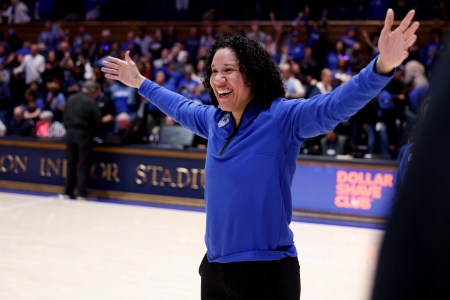
Duke’s Kara Lawson Pivots from Team USA to the Final Four Chase
The Blue Devils are loaded for another deep run in March, but Lawson is also prepping to coach the U.S. in the 2028 Olympics
But even with the accolades, part of Chavez always felt like the little kid whose dad tried to dissuade her from playing. The one who didn’t know what AAU was. The kid who couldn’t do a layup in her first few games, opting instead for a push shot from the block. The high school player who dropped from the No. 1 ranked ESPN recruit in the country to No. 3 behind USC’s Jazzy Davidson and UCLA’s Sienna Betts, despite everything she accomplished during her senior year.
That’s where the player who talks trash and states that opponents “Don’t want smoke” comes from. Despite everything, Chavez still wants to prove herself. The flip side is a 19-year-old who is often reserved and unsure in her everyday life. “People think I’m disrespectful or cocky,” Chavez says. “But that’s something that people get wrong about me. They think I don’t care about anything, but in reality I care about everything and everyone.”
Verhulst noticed that instantly when she met Chavez.
“She’s not someone that came in soaring high,” Verhulst says. “So once we got to know her and understand her, we wanted to help her build up that confidence.”
Every day, Chavez comes out of her shell a little bit more. She comes up with a joke of the day to share with her teammates in every practice.
“She’s so goofy,” fellow freshman Emma Tolan says. “I don’t think many people realize how funny she is.”
Verhulst often hears the jokes before the rest of the team as she and Chavez get taped up together in the training room.
“I always try to guess the punch line,” Verhulst says with a laugh. “But sometimes she comes up with these outlandish jokes that don’t even make sense.”
The more jokes she tells and the more she opens up, the better Chavez does on the court. She’s never one to be timid – other than in that first practice – but the level of comfort has only increased throughout her freshman campaign.
One of the highlights came in a 94-82 upset win over South Carolina on Jan. 22. Chavez erupted for 26 points, making 5 of 10 three-pointers and leading the Sooners to an overtime victory.
Oklahoma coach Jennie Baranczyk expects a similar performance in Saturday’s Sweet Sixteen game, when the two teams meet once more.
“She’s not a one-hit wonder,” Baranczyk says. “She just gets better and better and better. And she’s learning more and more and more. Some freshmen have great games and then they don’t, and then they do and then they don’t. She hasn’t really been like that for us. She’s just been really, really steady.”
Chavez is averaging 18.3 points, 3.9 rebounds and 4.2 assists per game, numbers that earned her a spot on the SEC’s All-Freshmen team. Scoring will always be Chavez’s calling card, but her assist average this season is higher than it was in high school. Chavez is an underrated and willing passer.
So when Baranczyk says Chavez isn’t a one-hit wonder, that’s two-fold. It means she’s consistent, and that she’s good at a lot of things on the court.
“Whatever is going to help my team the most is what I’m going to do,” Chavez says. “If that means shooting every time then that’s what I’ll do. If it means passing every time, then that’s the plan.”
Chavez aspires to be a team player, to fit in the Oklahoma system and to win games. She never planned to go viral, or to be thought of as the online persona she’s been assigned.
Being misunderstood used to bother Chavez. She wanted people to like her, even opponents. “My dad always tells me that those people’s opinions don’t matter because they don’t really know me. They know the social media version of me,” she says. “I understand that now.”
And the thing is, if they really knew Chavez, they probably would like her. They’d appreciate her shy side and her ridiculous jokes. But it’s hard to like an opponent who tears you up on the court.
“I know there’s outside stuff sometimes that gets projected onto her,” Baranczyk says. “I don’t really think it’s fair. Because I think that everybody that plays with her loves her.”
As for everyone else, they just don’t want the smoke.
Meet your guide