GREENVILLE, S.C. — Three days after turning in a superhuman effort in leading Penn to an improbable victory over Ivy League juggernaut Yale in the league tournament championship game, TJ Power, the Quakers’ 6-foot-9, 220-pound junior, was feeling subhuman. Some sort of bug had invaded the big man’s system, rendering him unable to speak to the media or be much of a participant in Penn’s open practice in preparation for Thursday’s first-round NCAA Tournament South Regional game against Illinois.
An intelligent, articulate and thoughtful speaker, Power doesn’t normally turn down requests to share his amazing story, which has led him from Duke to Virginia to Penn in the first three seasons of his college career. But his coaches and teammates had no such bacterial barrier from the media and were more than willing to speak with Hoops HQ about Power, whose story is a testament to hard work and self-belief.
To a person, everyone in Penn’s traveling contingent is praying Power’s illness is of the 24-hour variety, because if he’s as good to go as he was on Sunday against Yale, who knows? The Quakers just might have a shot to pull off another March miracle.
Power was dominant against the Bulldogs. Penn won 88-84. Power scored half those points. Teammate Cam Thrower says Power was in a “flow state,” and that about sums it up. He made 14 of 26 shots from the floor, 7 of 14 from three-point range, all nine of his free-throws, grabbed 14 rebounds, drew 10 fouls, handed out 2 assists and added a steal and blocked shot. He set an Ivy League tournament record for points in a game and tournament (60), and in the process, fulfilled Penn coach Fran McCaffery’s prophecy.
“When he called me (last spring) and told me he was coming,” McCaffery tells Hoops HQ, I said, ‘Okay, we can win this league.’”
McCaffery was qualified to make that prediction. While still the coach at Iowa, McCaffery was tipped off by Power’s Massachusetts high school coach, an old friend of McCaffery’s.
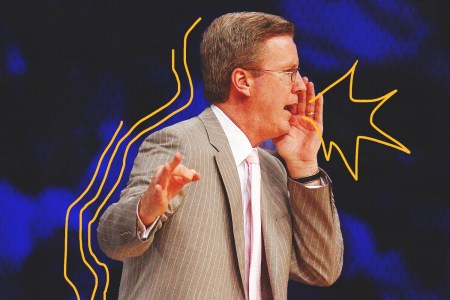
In Return To Penn, McCaffery Honors Legacy of Fran Dunphy
Under Dunphy, the Quakers were frequent visitors to the NCAA Tournament. McCaffery has brought his alma mater back to the Big Dance.
“Right away I knew this guy could have a big impact for me,” McCaffery says. “He visited (Iowa) as a junior. I went to every game he played, and developed an unbelievable relationship with his mom and dad, and him. I just never gave up on the possibility of signing him.”
Alas, Power, a five-star recruit, eventually signed with Duke. As a freshman he played in 26 games and averaged 2.1 points and 7.0 minutes. But after the Blue Devils signed Cooper Flagg and Kon Kneuppel, Powers didn’t hold out hope for more playing time, so he checked out, deciding to stay in the ACC and play for Virginia.
If an addition led him to leave Duke, it was a significant departure that eventually forced another transfer. Before the 2024-25 season began, former Virginia coach Tony Bennett shocked the college basketball world by retiring. He was replaced by assistant Ron Sanchez, but after the season, Virginia sent Sanchez on his way and hired Ryan Odom, who chose to bring in his own players, leaving Power once again looking for a home.
At the same time, McCaffery’s largely successful 15-year career at Iowa was coming to an end, but he wasn’t looking to get out of coaching. That’s why he was so excited the day Power’s parents texted him.
“They said, ‘We think often that he should have gone with you the first time,’” McCaffery says. “And I said, ‘Well, I’m still in the fight. I’m going to go somewhere. Wherever that is, I want him to come play for me.’”
McCaffery wound up at Penn, his alma mater. Power, who had previously attended two prestigious academic institutions, was intrigued about going to another one, but what sold him on Penn was the day he and his dad took a drive to Philadelphia’s famed Palestra, where the Quakers play. As soon as Power opened the door to the historic arena, he knew.
McCaffery was elated, because even though Power had barely played at Duke and Virginia, the coach knew what he was capable of doing. He just needed minutes.
“…When he gets on the court, he’s a stone-cold killer. My nickname for him is All Business. He does not mess around.”
—Penn assistant coach Tristan Spurlock
“You couldn’t draw up any better player for my system,” McCaffery says. “We play with motion and freedom in transition, and he can play with the ball, without the ball, in the post, on the perimeter. He has a complete skillset. He’s incredibly skilled offensively, and we take advantage of that, but he’s an elite rebounder. And he defends. He truly understands and prioritizes winning and how to impact winning. He doesn’t have to score 40. And that commands a ton of respect in the locker room. He’s a leader.”
Penn assistant coach Tristan Spurlock, who was on McCaffery’s Iowa staff, knew what the Quakers were getting after Power signed and the two spoke on the phone.
“I was like, ‘Yeah man, I was Tony Bennett’s first recruit (at Virginia). And he said, ‘Well, I was Tony Bennett’s last recruit.’ You could tell then he had a great personality, and a great sense of humor. But when he gets on the court, he’s a stone-cold killer. My nickname for him is All Business. He does not mess around.”
Power made up for his lack of PT at Duke and Virginia by leading the Ivy League in minutes per game (35.0). He also topped the conference in three-point accuracy (42.7 percent) while averaging 15.8 points and 7.6 rebounds and easily earning All-Ivy honors.
“His impact has been huge,” Thrower says. “What he does for us on and off the court is amazing. In terms of leadership, he’s the voice of reason for our team. And then he’s capable any night of a game like he had against Yale. He scored 44 points, but the most amazing part of that game was his 14 rebounds. Having that impact on the glass as a small power forward — to do it in a college game is one thing, but to do it in a league championship game is very special.”
If Power can shake off whatever it is that ails him, he might have some more fireworks in store for Illinois. And regardless of what happens, he still has another season of eligibility, and after his travels through the ACC, he isn’t about to take NIL money and leave the coach his parents think he should have played for all along.
“His journey is one of perseverance,” McCaffery says. “He never quit on himself. He just needed to find the right place. It was inevitable that this was going to happen.”
Meet your guide