Last March, former Troy coach Scott Cross couldn’t believe what he was watching during a 4 a.m. film session in preparation for his team’s first-round NCAA Tournament game against Nebraska, so he resorted to slow motion to get a better look at Nebraska wing Pryce Sandfort. The latter possesses the kind of jump shot form coaches teach at clinics, but what Cross wanted to see — and was most concerned about — was the speed at which Sandfort could get the ball in the air.
“I hit slow motion,” Cross, now coaching Georgia Tech, told the media during a pregame press conference, “and I looked at the timer on there. I believe he got his shot off in, like, 0.3 seconds. Under one is good. Probably 0.5 is elite. Zero-point-three, that’s, like, Steph Curry-type shooting.”
Sandfort, a 6-foot-7 senior, laughed when, during a recent conversation, Hoops HQ read that quote to him. Of course he loves the comparison to Steph Curry, but he knows the quick release Cross marveled at wasn’t some sort of happy accident. It’s not possible to create the perfect jumper in a laboratory, but Sandfort comes as close as anyone could. He was born into basketball. His father Brian and mother Gretchen played at the college level. His grandfather was a successful Iowa high school coach. And whereas many kids have a backboard in their driveway or access to a nearby playground, Sandfort and his older brother Payton could walk down the stairs in their home to a halfcourt gym, complete with a three-point line and padding on the wall behind the basket.
“There was no way out,” Sandfort tells Hoops HQ. “It was always basketball. I had great coaching from my family my whole life. But it helped that I loved the game. And it was pretty awesome to have a gym in my house. I could get a lot of shots up there.”
Surrounded by basketball
That home gym is where Pryce and Payton, who played four years at Iowa and last season saw action in four games for the Oklahoma City Thunder, learned the game’s finer points. And some of its rougher edges, too. In a mini documentary called “Spotlighting Pryce Sandfort,” the Big Ten Network included some footage, filmed by Gretchen Sandfort, of the brothers, around middle school age, playing one on one. After missing a shot, Pryce chased down his rebound and was about to grab the ball when Payton, two years older, slammed his brother into the side wall, knocking him flat. Pryce stayed on the floor for a few seconds before screaming, “technical!” He got up, ran down Payton, and continued to yell “technical,” as he pushed him twice.
“Very typical,” Gretchen said.
Little did the Sandfort family know those battles would one day benefit Pryce, who has earned his reputation as a deadly jump shooter but can also put the ball on the floor, get to the rim, and score through contact.
“Any time you get beat up by your brother, it helps in a lot of ways,” says Nebraska coach Fred Hoiberg. “It helps you with your toughness. I know. I had an older brother. But those brothers were raised in such a special way. They’re both great kids.”
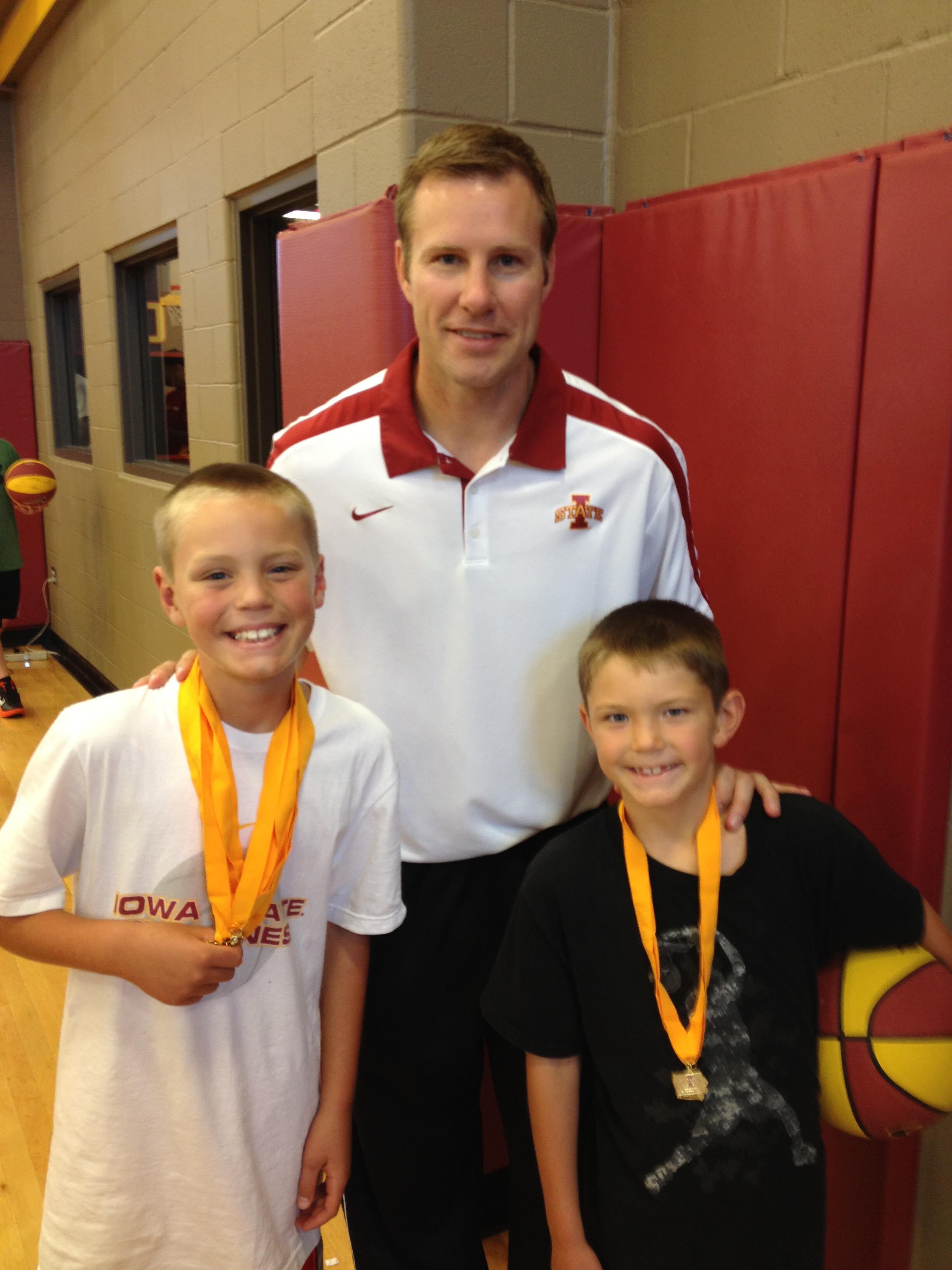
As youngsters, the Sandforts attended Hoiberg’s summertime Iowa State basketball camps, but their basketball education began long before then. Their first coaches were their parents and grandfather.
“I remember a lot of workouts with my grandpa, my brother and me,” Pryce Sandfort says. “I can’t tell you how many form shots I took. To master that form; getting the mechanics and the hand position, to put the proper backspin on the ball and your hand extending. Grandpa was trying to hammer into us the basics of shooting the basketball.”
That quick release Scott Cross marveled at wasn’t taught so much as it became a byproduct of learning to shoot the ball with the proper mechanics, time after time.
“After a while, it becomes automatic,” Pryce Sandfort says. “Muscle memory. By focusing on mechanics, it became easier to position my hands to where I’m going to catch it to shoot it correctly and quickly.”
Stars in high school and beyond
The brothers were apt pupils and became standouts at Iowa’s Waukee High School. Payton was a two-time all-state selection and in 2021, his senior season, was chosen the Iowa Basketball Coaches Association Player of the Year. In 2020, Pryce joined his brother at Waukee, where he took over as starting point guard. Together with Tucker DeVries — whose father Darian eventually coached him at Drake, West Virginia and Indiana — the Sandforts led the Warriors to a 4A state title runner-up finish. The next season, Waukee won the championship.
Had Hoiberg not left Iowa State for the Chicago Bulls in 2015, Payton might have ended up a Cyclone. Instead, he signed with Iowa. Then-Hawkeyes coach Fran McCaffery knew his team had landed a gem of an in-state recruit.
“His game is incredibly mature,” McCaffery told Blue Ribbon College Basketball Yearbook in 2021. “He’s got great feel. We all know he can shoot. But he moves so well without the ball. He can pass it. He rebounds. He’s got length. … He doesn’t make mistakes. You can tell he’s been well coached from a very young age.”
Payton was a key reserve his first two seasons — he was the Big Ten Sixth Man of the Year in 2022-23 — and then in his last two started all 67 games, averaging 16.4 points as a junior and 16.7 as a senior. He also led the Big Ten in three-point shooting (34.0 percent) his final season.
When his brother left for Iowa, Pryce transferred to Waukee Northwest High School, where in 2023, this time playing the post instead of the point, he averaged video game numbers — 24.9 points, 11.0 rebounds, 2.8 assists, 2.7 blocks and 1.7 steals — earned Iowa’s Mr. Basketball award and led the Wolves to the 4A state championship game.
Pryce grew up idolizing Hoiberg and, like his brother, had dreamed of playing for him at Iowa State. Though by 2019 Hoiberg had returned to college basketball at Nebraska, family ties dictated Sandfort’s college decision, even though Hoiberg and his staff applied a full-court recruiting press.
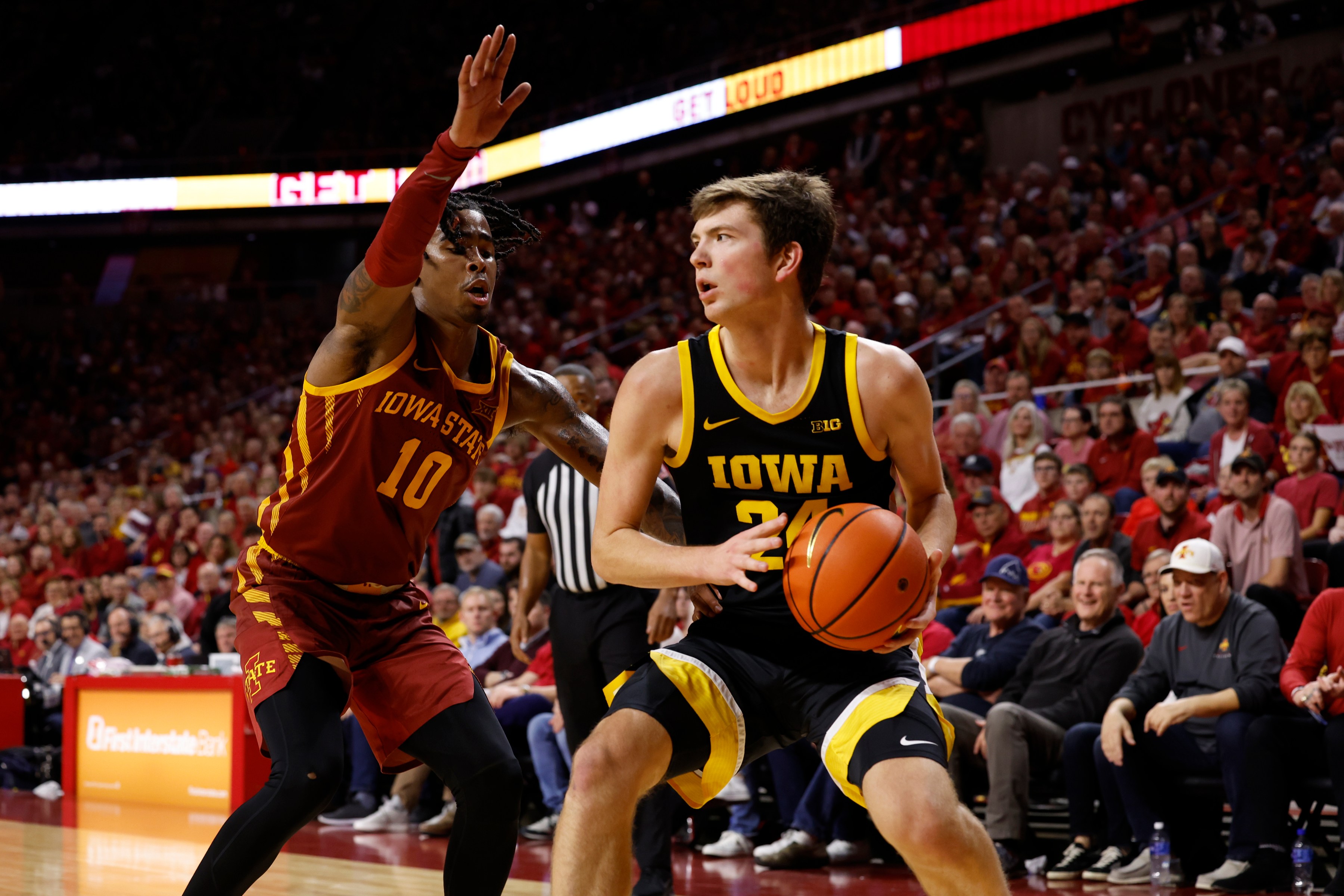
“It was tough to say no to coach Hoiberg and go to Iowa,” Sandfort says. “But it was hard to pass up the opportunity to play with Payton for another two years. I thought that was probably the last time in our lives we would play together.”
Suffice it to say McCaffery was thrilled to land another Sandfort brother.
“He is somewhat like Payton,” McCaffery told Blue Ribbon in 2023. “He was the starting point guard on a team that won the state championship. Then when he switched schools, he had to play inside and block shots and rebound. He played all five positions in high school.”
At Iowa, just like his brother before him, Pryce grew into a role. As a freshman in 2023-24 he averaged just 8.7 minutes and 2.3 points, but the next season, he averaged 22.4 minutes and 8.8 points and shot 40 percent from three in a good number of attempts (56 of 140).
But after the season, McCaffery’s 15th at Iowa, he and the school parted ways. With the coach who recruited him and his brother gone, Pryce felt no need to hang around Iowa City, so he entered the transfer portal.
At last — a chance to play for Fred Hoiberg
As soon as the portal opened, the first call Pryce received was from Hoiberg. And Nebraska had another recruiting edge — associate head coach Nate Loenser, who had worked with Hoiberg at Iowa State and the Bulls, had ties to the Sandfort family. He coached against Sandfort’s grandfather many years before when Loenser was a high school assistant in Iowa.
“I knew that Pryce, being the younger brother, was always competitive and eager to prove he belonged with Payton and Tucker DeVries. Pryce had a chip on his shoulder, and he was ready to unleash it,” Loenser says.
Last season, Sandfort averaged 18.1 points and shot 41.6 percent from three-point range — both career highs — in earning first-team All-Big Ten honors. And those former weaknesses were vanquished, too. Sandfort improved his rebound average by two a game over the season before and shot a personal best 85.5 percent from the free-throw line.
Two other numbers were owed in part to that in-home court, where Sandfort spent untold hours putting up shots. He led the Big Ten in three-pointers made (129) and attempted (310) and shot 61.5 percent inside the arc. Behind Sandfort, the Cornhuskers won their first 20 games, the best start in school history, and advanced to the NCAA Tournament’s Sweet Sixteen as Sandfort averaged 21 points in the three games. His 16 threes tied UConn’s Alex Karaban for the most in the tournament, and he was the only player in the field to average five threes while playing in two or more games.
Hoiberg had always believed Sandfort could excel in his system.
“Fred does a great job at giving our players confidence; that’s one of his superpowers,” Loenser says. “A guy like Pryce was always a good shooter, but some adjustments had to be made. The biggest thing was slowing him down a little bit. Free throws are like a three-foot putt. You think you should make them, but you can’t rush them. Focus at the line was a big emphasis.”
Sandfort’s junior season was even more impressive considering he played the last third of it with a sports hernia. He first noticed some pain after a Feb. 17 game against Iowa.
“I couldn’t run up and down the court and I knew something was up,” Sandfort says. “I give credit to our staff and doctors for helping me get through. I didn’t go live in practice the rest of the season. It was very painful. But it was just something I had to fight through.”

Once again, that toughness Sandfort learned by jousting with his brother paid off.
“He didn’t say a word about it or complain one time,” Loenser says. “The only thing he said was ‘I’m playing no matter what.’”
After the season, Sandfort underwent surgery, and doctors discovered he had a double hernia. He missed most of summer workouts but will be ready to lead a rebuilt team, regardless of what opposing defenses throw at him.
“I’ve seen just about everything,” Sandfort says. “Box and one, triangle and two, switching, trapping. The ability to adjust my game based on what defenses are throwing at me is important.”
Hoiberg’s offense gives Sandfort freedom. He can shoot off the move or the catch, ball fake and drive to the basket or stop and take midrange pull-up jumpers. Hoiberg also uses Sandfort in the post, where he can shoot over smaller defenders or drive around larger, slower ones. Sometimes, Hoiberg doesn’t want Sandfort to even touch the ball, because he’s a dangerous decoy who draws defenders away from the basket and opens driving lanes for teammates.
“He’s such a tough cover,” Hoiberg says. “He truly is a three-level scorer. We’ve been able to use him in so many different ways. He’s been a lot of fun to coach.”
Besides helping lead Nebraska back to the NCAA Tournament, Sandfort’s other goal is to prove to NBA scouts he’s worthy of playing at the next level. “I’ve gotten some good feedback,” Sandfort says. “I’ve been working on my ballhandling. That, rebounding and defending one on one were all big things for me.”
Once again, Sandfort has the example of his older brother to follow. Coincidentally, the Cornhusker’s first- and second-round NCAA games last March were played in Oklahoma City at Paycom Center, the Thunder’s homecourt. The night before Nebraska faced Troy in the first round, Pryce and some of his teammates were at a restaurant, and a television was tuned to the Thunder’s game in Brooklyn. Payton got in the game and knocked down a three for his first NBA points. “Everybody went crazy,” Pryce says.
The next night, with about 20 minutes to go before the ‘Huskers faced Troy, Pryce looked up in the stands and saw Payton, who wasn’t supposed to be at the game. Little brother proceeded to put on a show, scoring 23 points and draining seven of 12 three-pointers.
“That was one of those full-circle moments I’ll never forget,” Pryce says.
Meet your guide