
Editor’s Note: This story is part of a recurring “This Time When … ” nostalgia series that Hoops HQ will be publishing throughout the summer.
It was the fall of 1996, and I was in my second year on staff at Sports Illustrated. My job title was Reporter, which put me at the bottom of the editorial totem pole. But I was on the pole, dammit, and though I spent most of my time fact checking other people’s stories, once in a while I drew a really cool writing assignment. Now, for the first time, an assignment required me to get on an airplane.
The destination: Salt Lake City. The assignment: Preview the Utah Utes. The target: Rick Majerus.
It was a big target, literally and figuratively. Majerus was 5-feet-10, and if he wasn’t 400 pounds, he was very much in the neighborhood. He was also a brilliant basketball coach who was entering his seventh season as the head coach at Utah. The Utes were coming off a Sweet Sixteen, and with many of their top players returning they had high expectations. Hence, my trip to Salt Lake City.
Majerus was not only a big target, but a moving one as well. He was energetic, distracted, and hard to pin down. He was also charismatic, funny, mercurial, and always hungry. A lot of coaches say they live for the game, but Majerus took that to extremes. He wasn’t married and had no children. He didn’t even have a house, a condo, or an apartment. His full-time residence was the Salt Lake City Marriott. He must have accumulated more Marriott points than any human in history.
I landed in Salt Lake City, picked up my rental car and drove straight to campus where the Utes were having practice. It was amazing watching the man work. Over the years, I’ve watched more practices than I could count, but I don’t know that I saw any other head coach master the craft like Majerus. He was intense, insightful, and really really tough. His appearance was unkempt, his language salty. After practice, I watched him conduct a video session, and I was mesmerized. It was like he had his own language.
I had never met Majerus before, and I assumed I was all set up to interview him. But after I met with a couple of players, I approached the big man in a hallway. “I’m sorry but I’m going to the Jazz game,” he said. “You’re only going to use a few sentences, right? How about I just give you a few sentences?”
“Well,” I demured. “I came a long way to see you. I was kind of hoping for a little more than that.”
“Tell you what,” Majerus said. “I’ve gotta go home and get changed for the game. Why don’t you ride with me and we’ll talk along the way.”
“Sounds great,” I said. “Thank you, Coach.”
“You’re Jewish, right?”
“Yes.”
“You want a bagel?”
“No thanks.”
We walked out of the arena and climbed into Majerus’ SUV. I turned on my tape recorder and we talked on the short drive to the hotel. We continued the interview as we entered the lobby, rode the elevator, and entered Rick’s room. You might think he had a palatial penthouse, but it was just a standard suite with a bedroom, living room and bathroom.
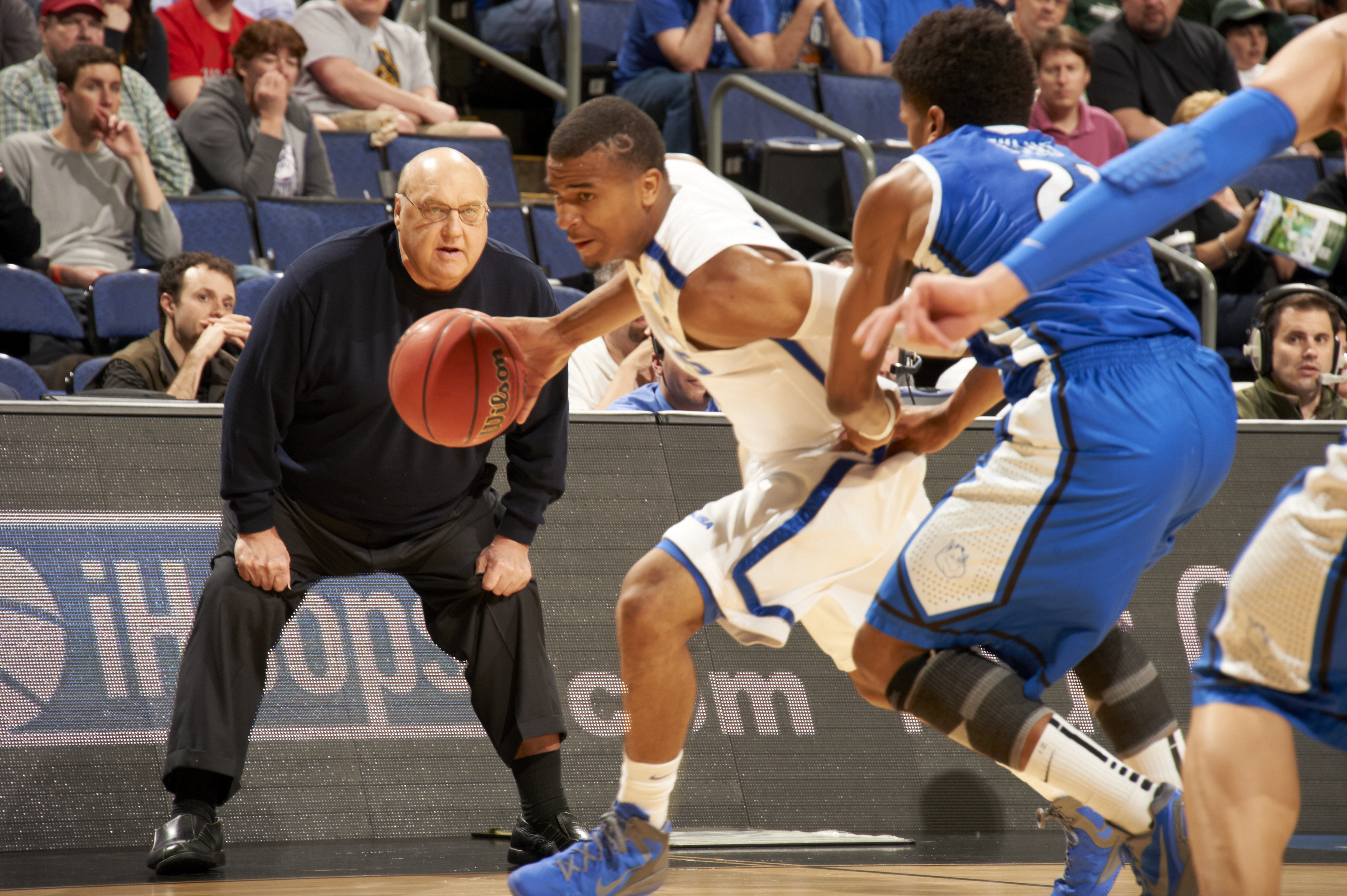
Rick was still in his Utah practice gear when we got into the room. He continued to talk about his team as he unzipped his jacket and removed it. He kept right on talking as he took off his shoes and socks, and then his shirt, his pants, his shorts, and finally his underwear.
There stood Rick Majerus. A man in full.
“Gee, I hope I’m not embarrassing you,” he said.
“Not at all, Coach,” I replied.
That was the truth. It was unexpected, to be sure, but as we say in the journalism dodge, I was getting good shit. Majerus kept right on yapping while he showered and got dressed for the game. I walked out with him, watched him get into his car, and thanked him for his time.
That was my most memorable encouter with Majerus — with just about anyone, really — but fortunately it was not my last. I had lots of reasons to talk to Majerus over the years that followed, not least because his teams were always so good. Rick was generous with his time, his insights, and his company. There was nothing like walking into a restaurant with Majerus and his pals, and spending the next couple of hours stuffing our faces and talking ball. When the waiter came over, he would always say, “Just keep bringing us food. I’ll tell you when to stop.” When you around Rick, you laughed a lot, you learned a lot, and you ate a lot.
Majerus was a classic Falstaffian character and a man of many dimensions. He was not easy to play for, however. For all his shtick, he could berate his players with the best of them. Quite a few did not like him, and many did not stay with him. Those who did got a coach for life. Majerus’ single-minded devotion to the game was not always healthy for him, but it was the only way he knew how to do the job. The game consumed him just as he consumed everything else.
Majerus left Utah in 2004, claiming he needed to take care of his personal health. Later that year, he accepted the USC job after the school fired coach Mike Bibby mid-season. He held a press conference, but a few days later he backed out, again citing his health. He spent three years working for ESPN before taking over at Saint Louis in 2007. He left that job five years later, and in 2012 he died of heart failure at the age of 64.
Majerus was a brilliant coach and one of the most interesting people I’ve been around. That story in his hotel room has been my go-to after-dinner-speech story for years, and it crushes every time. That day served as my welcome-to-journalism moment, but it was also the start of a beautiful friendship. It was an image I can’t unsee and an encounter I won’t ever forget. Nor would I want. Whatever anyone might say about Rick Majerus, it was refreshing to be around someone who had nothing to hide. I miss the big guy.
Meet your guide