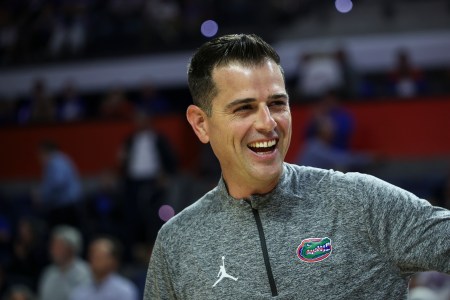
Texas coach Sean Miller’s first trip through the Southeastern Conference was as enlightening as it was successful, ending with a seemingly improbable run from the NCAA Tournament’s First Four to the Sweet Sixteen, where the Longhorns lost by a bucket to No. 2 seed Purdue. Miller and his staff wanted to keep that momentum going into his second season after a strong November recruiting class and, more recently, a portal haul that most analysts rate among the top three in the country.
“I was incredibly impressed with the SEC as a conference,” Miller tells Hoops HQ. “First, you’ve got so many great coaches with varying styles. You’ve got Nate Oats playing fast and shooting threes. You’ve got Rick Barnes playing with great physicality and rebounding. And the talent is exceptional. Even the bottom four teams have players that could play anywhere in the country, and probably the NBA.”
Texas had players with NBA potential too, including Dailyn Swain, the 6-foot-7 junior forward who took the SEC by storm last season after transferring from Xavier, turning himself into an NBA Draft prospect in the process. Most draft analysts think Swain is a certain first-round pick, and he’s decided to forgo his remaining eligibility. But Texas was prepared and addressed the gaping hole Swain leaves with a player Miller thinks possesses Swain-like versatility.
Texas had an edge in its pursuit of former TCU star David Punch, a 6-foot-7, 246-pound junior. Miller recruited Punch when the former was still coaching Xavier. Punch, a native Texan, ultimately decided to stay home to play, but Miller never lost track of him. Last season Punch helped lead the Horned Frogs to the NCAA Tournament. He was TCU’s leading scorer (14.1 points per game), rebounder (6.8), and shot blocker (66), finished second in steals (45) and third in assists (68).
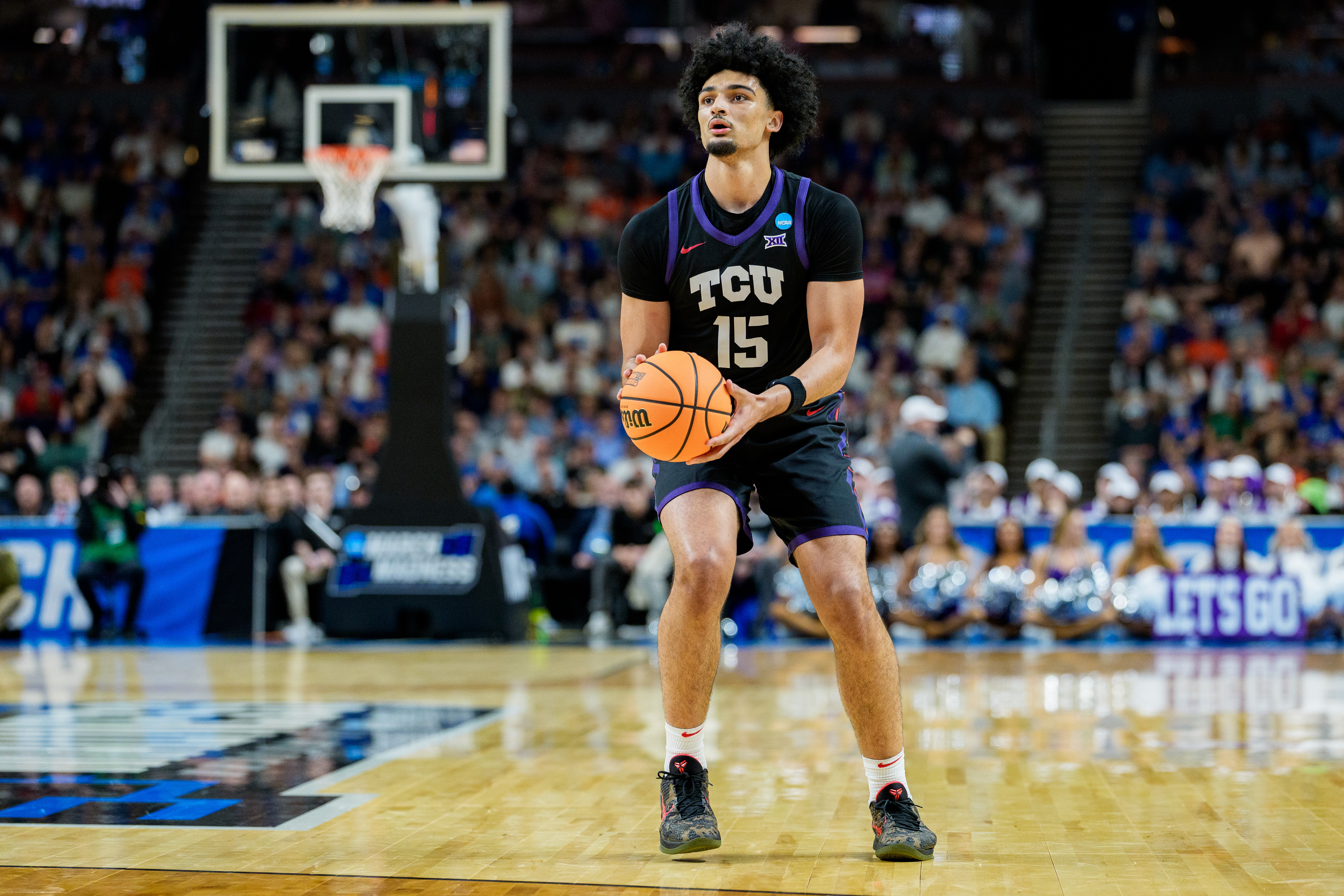
“Another thing that stood out to me in the SEC was that the elite teams have the ability to play with two bigs,” Miller says. “That doesn’t necessarily mean two inside players. I looked at Punch as an inside-outside guy, who could play the four. He’s really good at driving the ball, and in a pinch, would be big and physical enough to play the five.”
Punch will make good company for another Longhorn who, like Swain, quickly made an impact in the SEC. In 2024-25, Matas Vokietaitis, a 7-foot-1 junior, put together a solid freshman season at FAU, but nothing that could have foretold what he did to the SEC (15.6 points and 7.1 rebounds per game). Vokietaitis led the league in field-goal accuracy (61.9 percent) on a decent number of attempts (299), but he also paced the SEC with 284 free-throw attempts. Per KenPom, he was third in the country in fouls drawn per 40 minutes (8.3) and free-throw rate (96.2). When the big man got the ball in the paint, chances were good he either scored or got fouled.
“Matas is much more agile and mobile than he appears,” Miller says. “As he got more experienced, what you saw is a higher ceiling than what probably anyone expected.”
The next step for Vokietaitis is to become as efficient on defense as he is on offense. “He has to be more trustworthy and smarter,” Miller says. “He uses his size on offense in a big way. He needs to do the same defensively. He’ll never be a shot blocker, but he can use his size to be a lot better, to not foul as recklessly as he did, and to hold his ground.”
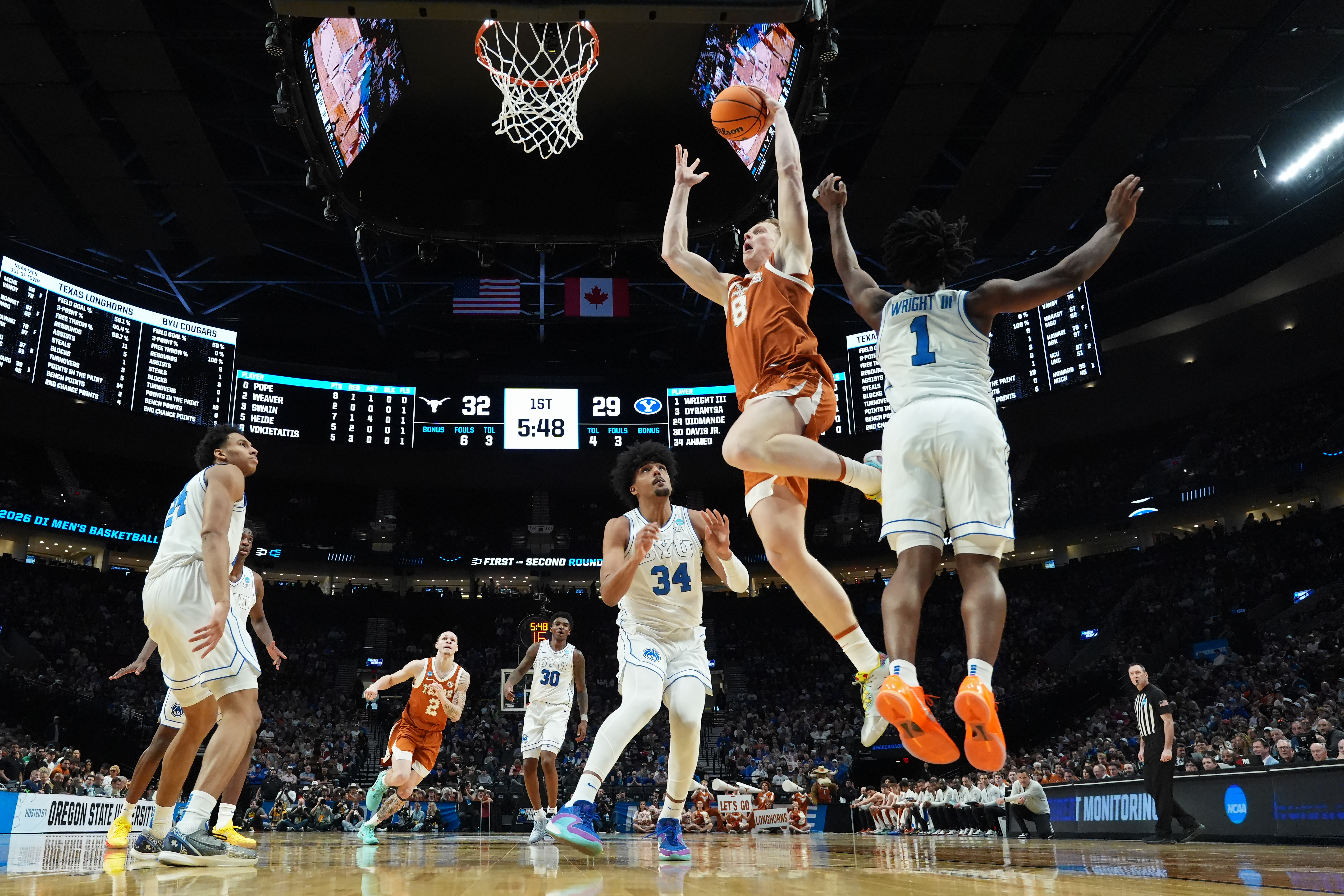
Despite heavy personnel losses — including veteran guards and double-figure scorers Tramon Mark and Jordan Pope — Texas didn’t go into the portal season with quite the sense of urgency some other SEC teams did. That’s because the Longhorns put together a solid freshman class in November that includes two perimeter players who are likely to log heavy minutes — 6-foot-5 Austin Goosby, a consensus five-star prospect, and 6-foot-6 Bo Ogden, a consensus four-star prospect and one of the better shooters in the class of 2026.
Besides Punch, Texas used the portal to fill specific needs. One of those was to find an elite point guard, and the mission was accomplished with 6-foot-1 sophomore Isaiah Johnson, who played last season at Colorado. Johnson averaged 16.9 points and 3.0 assists, and his shooting numbers were good across the board — 48.6 percent from the field, 57.3 percent from 2, 37.8 percent from three and 82.1 percent from the free-throw line.
“He’s very efficient,” Miller says. “He scores. Some people would say he’s not really a pure point. But I don’t know who really is. There’s value if you have a guy who can score at that position. It’s like (Darius) Acuff at Arkansas.”
Last season Acuff was just the second SEC player to lead the SEC in scoring and assists. The other was LSU’s Pete Maravich. Miller isn’t expecting that kind of performance from Johnson, but another season like the one he produced at Colorado would work.
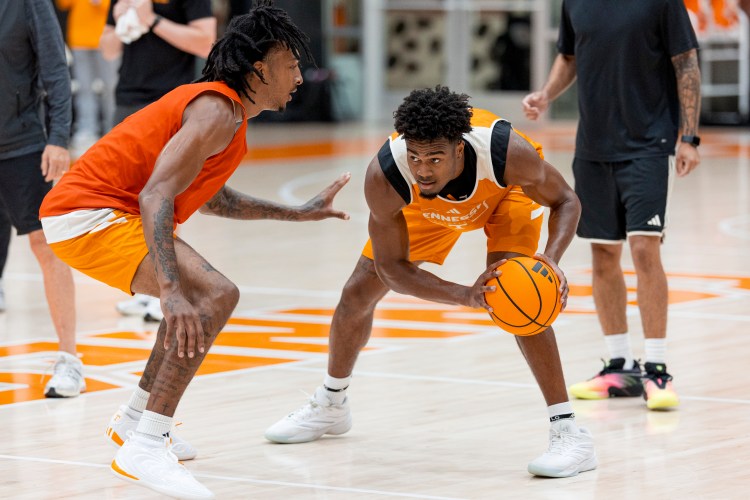
Texas also looked to some of its SEC opponents to find bigger wing players. Elyjah Freeman, formerly of Auburn, is a bit on the slender side, but taller at 6-foot-8. Former Tennessee guard Amari Evans is a solid 6-foot-5 and 220 pounds. Defense is his forte, but as a freshman he showed glimpses of offensive skill.
Evans is another player Miller recruited when he was at Xavier. “He’s from Pittsburgh, I’m from Pittsburgh,” Miller says. “So we had a connection. He ended up choosing Tennessee over us. We know he’s got a big upside, and we were excited to be able to get him. Looking at our team last year, it was obvious we had to get tougher to score on. What we like about guys like Amari and Punch is that they’ve already proven they can defend at the highest level.”
The Top 100 Players in College Hoops: Part Two
Hoops HQ delivers you the definitive ranking of the top 100 players in college hoops for the 2026-27 season
Freeman started his career at Division II Lincoln Memorial, but he quickly adjusted to a higher level of competition. He wound up starting 21 games for the NIT-champion Tigers and averaged 9.2 points and 5.2 rebounds.
Before Miller and his staff considered their team complete, they had to find another versatile guard. They were fortunate that longtime Saint Mary’s coach Randy Bennett was finally pried loose from that job by Arizona State. That in turn sent some of his players into the portal, where the Longhorns found 6-foot-3 junior Mikey Lewis. Last season, Lewis averaged 13.9 points and 2.1 assists, but just as importantly, he shot 36.8 percent from three.
“We loved that he was well coached and played in a system with other good players,” Miller says. “We needed another experienced ball handler who could shoot it. So getting Mikey was pivotal.”
Meet your guide