When Michigan State won the national championship in 2000, the Big Ten’s first title in 12 years felt less like the end of a long drought for the conference than the resumption of normality.
The Big Ten’s previous title, thanks to Rumeal Robinson’s free throws in 1989, was the fifth for the Big Ten in the previous 14 years, dating back to Indiana’s undefeated season in 1976. Surely, the Spartans had turned things around for the league back to where they had been before.
Yet here we are, 26 years later, and the Big Ten is still looking for another title. It’s not like Big Ten teams haven’t had a regular dosage of No. 1 seeds. It’s not like there aren’t teams in the league that rate highly in Ken Pomeroy’s efficiency ratings, the AP poll or the NET. It’s not like they haven’t made the Final Four, or even the title game. They have. Often.
They just haven’t won it. Over and over again.
The hope is alive again this April, with Michigan, the No. 1 seed in the Midwest, and Illinois, the No. 3 seed in the South, both emerging from what Ken Pomeroy’s data indicates was the second-best of the power conferences. The Big Ten had six teams in the Sweet Sixteen and four in the Elite Eight, with at least one guaranteed to advance when Illinois played Iowa in the regional final. Two did.
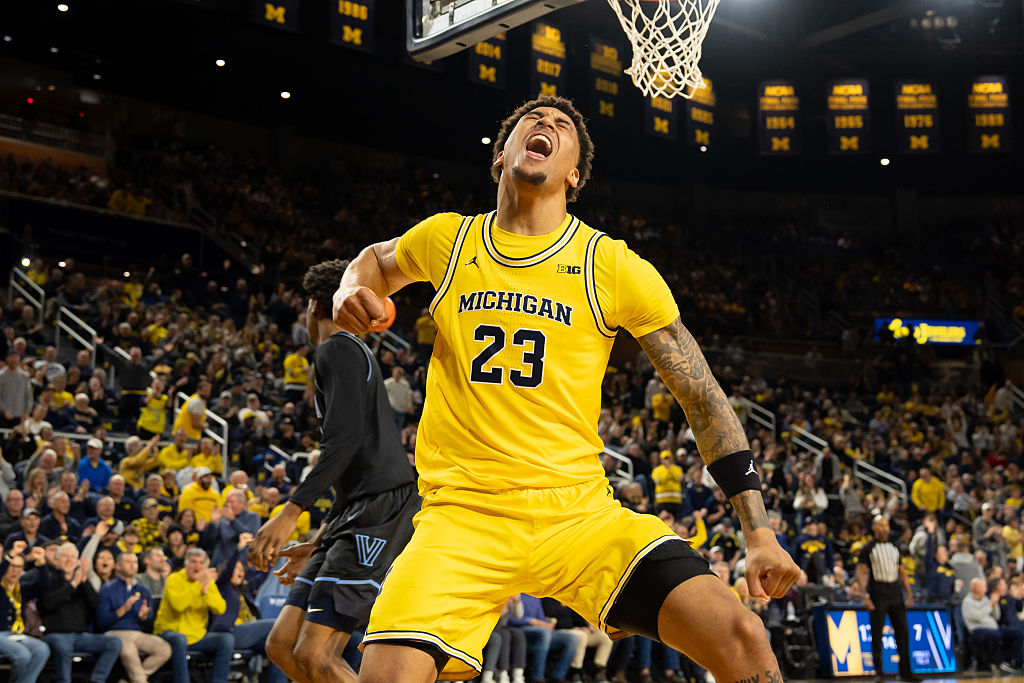
The SEC was No. 1, but all of its teams are gone. Duke, the No. 1 overall seed, was flushed out by UConn in one of the great finishes of any tournament game ever. Arizona remains a threat, but if the Big Ten can’t finally get over the top this year as a betting favorite in both semifinals, will it ever?
“It’s no surprise to see a few Big Ten teams have success in the Elite Eight, Sweet Sixteen, and now the Final Four,” Michigan’s Nimari Burnett said Sunday in Chicago after the Wolverines clinched their spot. “It’s a blessing to be here and also a blessing to be here with some Big Ten teams, as well.”
It’s been a long time since Mateen Cleves and the Flintstones beat Florida in Indianapolis. The building where Michigan State won it, the cavernous Hoosier Dome, was demolished and replaced by a convention center years ago. The streak lives on.
CHAMPIONSHIP PEDIGREE
In a sport where the teams that win titles tend to have won it before — only two of the past 18 champions were first-time winners — eight current Big Ten teams have won a combined 23 NCAA titles, but all but three came before 1990, and two-thirds of those before Magic Johnson and Larry Bird changed the game forever in 1979. The league has championship pedigree, it’s just buried deep in the lineage now.
Since the Big Ten’s last title, the ACC and Big East have each won eight, the SEC four, the Big 12 three and the American one, although that UConn title should probably be credited to the Big East, since it was during their football-imposed purgatory between the old and new Big Easts. (There are a lot of similar anomalies in there; Syracuse and Louisville’s titles accrued to the Big East, not the ACC, and if you go by current membership then the Big Ten’s drought retroactively ended in 2005 when Maryland won. Congrats?)
Twice since 2000 the Big Ten has gotten two teams into the Final Four, and Wisconsin actually did the heavy lifting in Indianapolis in 2015, when the Badgers and Spartans were both there, by beating previously undefeated Kentucky in Saturday’s second semi. But the Big Ten went 0-2 against Duke and the drought has lasted another decade. The other Big Ten double, in St. Louis in 2005, ended in similar fashion to a different shade of blue, with North Carolina beating Michigan State and then Illinois.
And there’s no argument that the Big Ten hasn’t had its chances, nobody more than Michigan, which has lost twice on Monday night: to Louisville in 2013 and Villanova in 2018. All told, six different Big Ten teams have combined to go 0-7 with a chance to win the title since 2000. That’s a rough century so far.

Michigan and Michigan State, the last two Big Ten teams to win it, have had more chances than anyone else to do it again. Counting the Wolverines this year, Michigan and Michigan State have combined for nine Final Four appearances and a 3-8 record since the Spartans’ title. Michigan State’s all-too frequent Final Four vanquishers, Duke and UNC, have a total of 12 Final Four appearances with a 14-6 record and six titles. The opportunity has not been dramatically different, but the results have.
“We play in the best league in the country,” Illinois coach Brad Underwood said Saturday, “so anything’s possible when it comes to winning a national championship.”
Anything is possible. Chance obviously plays a role — it’s inherent in a sport that decides a champion based on one game that can come down to one play or one shot that determines everything, as the endings of Duke’s past two seasons can attest — but there’s more to it. Like style.
A MATTER OF PACE
Apocryphally, the question among basketball pundits has always been whether the physical style of the Big Ten translates to winning six games in a row against elite competition. While it’s hard to debate the results, that also never slowed down the old six-foul Big East in March. And at a time when referees all work multiple conferences, even if they have a primary home, the differences from conference to conference aren’t as stark as they once were. Teams are also likely to have familiar officials as they go deeper into the tournament these days; typically, the NCAA tends to get at least one referee who works primarily in each team’s conference onto a crew by the time the second weekend arrives.
A better question is whether the Big Ten’s style, which almost always translates to a slower-paced game, is the issue. And that may have a demonstrable impact.
Of the 161 Big Ten teams to make the NCAA Tournament since 2000, only 24 of them played faster than the average national pace, per KenPom data. (And five of those were Fran McCaffery-coached Iowa teams.) The percentage has crept up in recent years; since 2024, a third of the Big Ten’s representatives have met that standard — a huge leap forward, relatively speaking. But for more than two decades, the Big Ten has played at a slower tempo than the rest of the country. That’s indisputable.
That matters because games with fewer possessions can have more variance, leading to less predictable and less consistent results. The better team is typically going to win more often in a 75-possession game than in a 60-possession game. That’s not always 100-percent true, especially at even faster paces, but as a rule of thumb it works pretty well. It certainly would explain some of the Big Ten’s issues.
Perhaps that bodes well for Michigan this weekend. The Wolverines are 22nd in adjusted tempo, the fastest-paced team left in the tournament, with Arizona not too far behind at 56th. Illinois is a more traditional Big Ten representative, well below the national average, while UConn plays even slower. Only six of the other 67 tournament teams played at a slower pace than the Huskies.
The fastest team doesn’t always win, but when the fastest team is also the best — and that’s Michigan, analytically speaking — it should give its superior talent more chances to win out in the end. Whether that’s enough to end a drought old enough to have exhausted its college eligibility at this point is, as always, up to how the basketball bounces.
Meet your guide