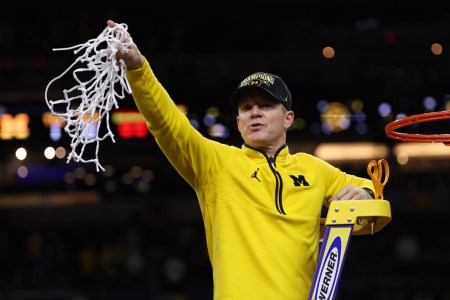

St. Louis head coach Josh Schertz joined Seth on The Hoops HQ Show. Stream the full episode on YouTube or live on the Fubo Sports Network.
Seth Davis: Hello, everybody, and welcome to The Hoops HQ Show. I am your host, Seth Davis. Normally I’m joined by my partner in crime, Andy Katz. Andy is taking this week off from the show, but we’ll have him back soon. So we have half the power we usually have in terms of hosts, but we have 10 times the power in terms of guests, because Josh Schertz, coach of the Saint Louis Billikens has joined us.
Josh, you’re fresh off the big win, at home against Missouri, the first time in a quarter century those two teams have played. I hope you guys keep playing, by the way, because it’s an incredible spectacle for the fans in that great state. I know how much they love basketball.
Let’s get right to the big news for Saint Louis, and that is, of course, Robbie Avila, who is a sixth-year senior, a cult hero in college basketball, not to mention one heck of a player, uniquely suited to your offense. He was with you at Indiana State and you brought him with you to Saint Louis. We thought his college career was done. He’s trying to get eligible, like a lot of guys are, as a fifth-year senior. He actually won a judgment — a temporary restraining order — to be able to play, with the added wrinkle that you guys are already at your 15-scholarship limit. The judge said it was okay to add a 16th player. The College Sports Commission (CSC), which is overseeing implementation of the House settlement, put out a statement that said you guys opted into the House settlement, which mandates a 15-scholarship limit. So it’s a total mess.
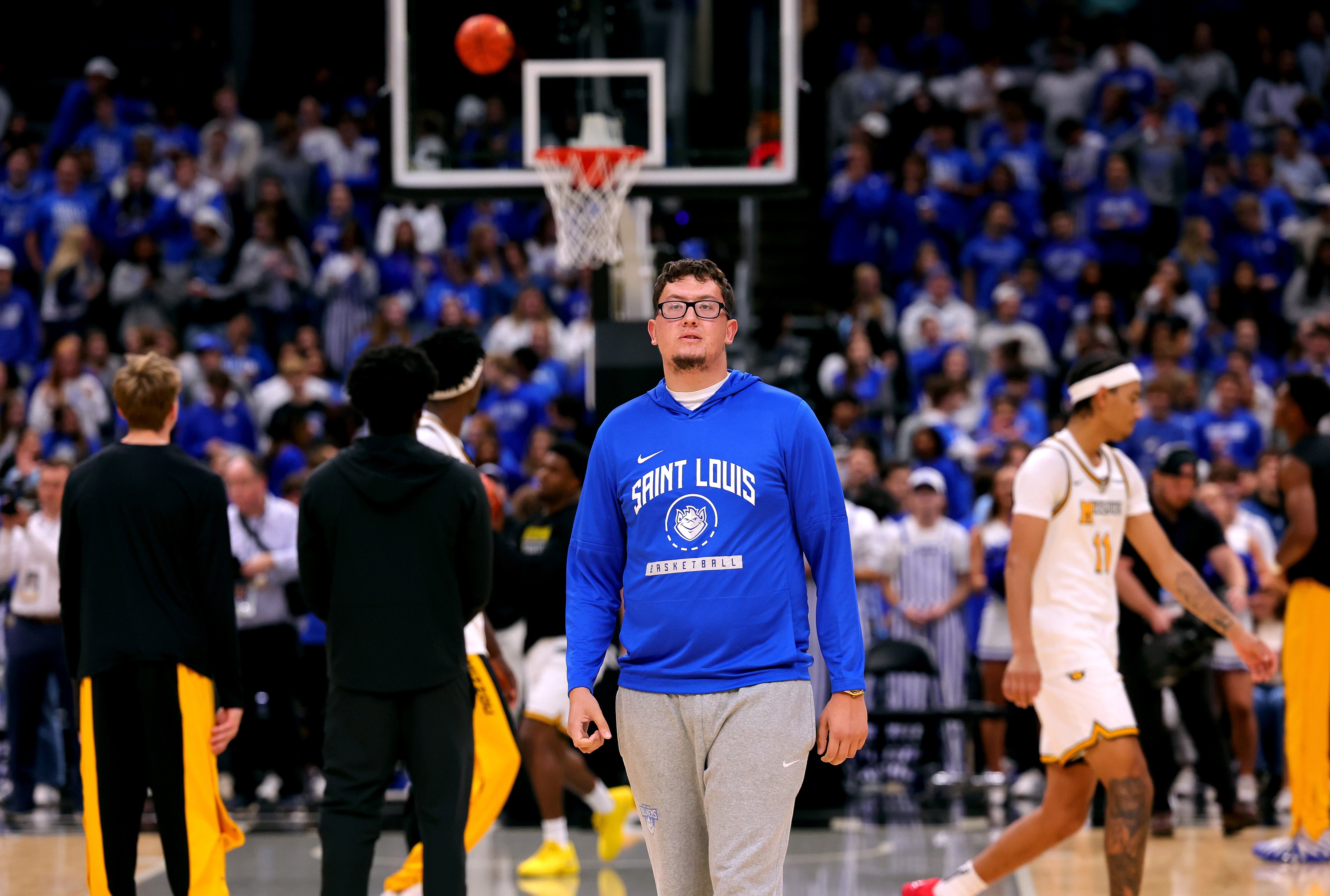
Robbie Avila is a great player. I know you love him like a son. Where are we with this thing, and where is it headed?
Josh Schertz: Yeah, Rob and I met today and we’ll meet again tomorrow morning. It certainly was frustrating. The person I feel the worst for is Robbie, because he’s been back and forth and jerked around. He finished his playing career, his four years. He’s in the class of ’22. He played two years at Indiana State and two years at Saint Louis.
When we lost to Michigan, I approached the spring as though the rules were the rules, which were that the four-year guys are done. The fifth year was whispered, but it wasn’t something that was definitely going to happen. So we went to work to fill our roster out. We did that in the spring and finished recruiting in May. Rob played in the NBA Summer League with the Lakers. He didn’t sign his Exhibit 10 — he agreed to it, but never signed it, because you can wait until September. When he called me in July to say he was leaning toward trying to come back and play in college, we supported that a thousand percent. I told him, “Hey, if you can go and cash out for your last year and make a ton of money, do that. If you want to come back here, it would be complicated.”
We had some conversations, and he originally applied to get eligible in Cook County, Illinois. They had the case, it went back and forth, and eventually they ruled that they didn’t have jurisdiction. It came here to St. Louis. They moved it to federal court, federal court kicked it back to state court, and state court ruled in his favor. But it took forever. I think the ruling came down on Oct 23.
He needed two things to play at Saint Louis: He needed the injunction to get a fifth year, and he needed a waiver on the roster cap limit of 15. He received both from the state judge. I didn’t play him, because the injunction was for 15 days, and I didn’t want to play him and then lose him. I wanted as little distraction and disruption to our team as possible, which is hard in these situations. Then the court had a new hearing on the fourth, and on the fifth it was ruled that he was eligible, with a long-term injunction covering both. And then literally maybe two hours before tip — we had been in touch with the CSC — we don’t get notice. They just release a statement. They didn’t call us, and we had obviously dealt with them on this, it wasn’t like blindsiding. It’s a court order.
So we don’t know how that’ll all unfold, or whether they have jurisdiction over it. It’s been frustrating. And like I said, nobody I feel worse for than Robbie, because he’s the one who’s been trying to do it. He was ineligible, then it’s not their jurisdiction, then federal court, back and forth. It’s been a four-month process for him, and he needs resolution — whether that’s playing at Saint Louis or playing somewhere else. He does have the injunction, which allows him to play. The question is, does he want to fight this CSC deal and try to play here? He has opportunities at the high-major level to go play, and he doesn’t have to wait for anything else, because they have spots and money available for him.
Seth: Would he have to go through the transfer portal if he was going to play for another school?
Schertz: I don’t think so. I don’t even know how that works with guys anymore, because there are guys playing who didn’t go through the portal. So I think he would have the ability to play somewhere else on the injunction itself, if that’s what he wants to do. And he had that opportunity when this all first came up, but he wants to come back here.
Robbie’s a guy who, when we left Indiana State and I came to Saint Louis — I’m not trying to blow smoke, but he turned down millions of dollars to come to Saint Louis. Millions. His value was at its highest leaving Indiana State after the 32-win season. Then he averages basically 18 points, seven rebounds and five assists. He comes back again — turns down over a million dollars to do it again — and wins a (A-10) championship. He was in the same mindset: “I can make more, but this is where I want to be.”
But at the end of the day, Robbie’s got to do what’s best for him. He’s got to decide if he wants to fight the CSC deal. I think he has a good case — his legal team does — but how long will that take? We don’t know. If he can play somewhere else and do that immediately, it’s got to be a consideration. As you said, he’s like a son to me. I want what’s best for him. If that’s playing at Saint Louis, great. If that’s playing somewhere else, I’ll support him a million percent and cheer for him wherever he is. But they’ve got to make a firm determination very shortly on what their approach is going to be — in the next 24 to 48 hours.
Seth: Obviously, different coaches have different decisions to make for their programs. There are some coaches who didn’t want to take any five-in-five guys, not only because of the uncertainty, but because they didn’t think it was fair to the players they had.
How much did you have to factor that in? And if you don’t get relief on the 15-scholarship question, is there any scenario where you would take away a roster spot from someone who currently has it to make room for Rob?
Schertz: Yeah, great question. I said when we started this that the two things I always try to do — and look, we’re not perfect — are to operate with the highest levels of integrity and to put our people first. Those are two things that are really, really important to me. On the integrity piece: We played by the rules in the spring and put a roster together. We didn’t save a spot.
I know the rules didn’t change, but people were challenging the rules. That happened this summer. We didn’t get involved in Rob’s situation. A lot of teams, if they knew in the summer that they could have the reigning A-10 Player of the Year, would have monkeyed around with their roster. We’ve seen people create roster space. I’m not going to be specific, but there are a lot of teams that have created roster space as this became more likely in the summer, whether by not recruiting guys or by moving guys who were on their roster. If we were going to do something, we could have said in the summer, “Hey, we’re going to move a guy and create a space.” I wasn’t going to do that. That wasn’t fair to the players we had.
When Rob decided he wanted to come back to Saint Louis, I did meet with every single guy and sat down and explained my thought process on why it made sense. Ultimately, Robbie’s a guy who would make any team he went to immediately better, not just because of the player he is, but because of the teammate he is, the human being he is, the way he treats people. He checks all the boxes you want. So that was my thought process going into it.
But when he was ruled able to play on Oct. 23, we didn’t move him into practice, and we didn’t play him against Lehigh, even though he was eligible. We kept him on the scout team. We’ve tried to operate with the highest levels of integrity every step of the way while keeping our people first. And Robbie is a part of our people. If he wants to be here and he’s legally able to do so, we’re certainly not going to turn our back on a guy who sacrificed so much for us. And if he’s not, there’s no problem there either. Again, I’ve said from the beginning, I want what’s best for Rob. If that’s playing somewhere else, we’re in it. If it’s coming here, great. But he would need both pieces.
We didn’t do any monkey business with the roster. We filled out our roster in the spring, trying to put together the best team we could for the 2026-27 season. Because if you’re saving a spot, you’re not just saving a spot for a guy like Robbie — you’re saving a significant amount of money as well. In this world, NIL is a part of it, and he would be our highest-paid player. And then maybe he’s eligible, maybe he’s not.
Maybe some of these fifth-year guys are going to go ineligible during the year. We just played against a fifth-year guy in Mark Mitchell. I’m thrilled he has the opportunity to come back. If these guys get it and they’re eligible, I am a thousand percent for it. But I hate the fact that it’s piecemeal — this guy’s eligible, this guy’s not. You’ve got guys in their seventh year of college, guys who can’t get a fifth year, guys in their sixth year. It’s all over the board. It was already an inequitable system in terms of competitive equity, and it’s made it more so.
Seth: So if they stick to this 15-man roster limit, he is not playing for Saint Louis. Is that accurate?
Schertz: That’s right. A hundred percent.
Seth: You talk about all the decisions Rob has had to make — what school, does he take more money, does he leave. You are now at the point where you’re having to make those decisions and have those conversations with your family and the people in your inner circle. It seemed that every high-major opening that either came open or was speculated to come open, you were the top candidate. You have certainly earned your way there.
How close did you come this past spring to leaving?
Schertz: You always listen to certain things. There were a couple that were jobs you would have to listen to. But Saint Louis, to their credit, sat down with me in February. When you’re looking at jobs, to me, the most important aspect of any job — more important than any amount of money or investment — is people. Who are the people you’re working with, who are the people you’re reporting to? Our chair of the board, Eric Engler, and the board of trustees — we have amazing people and relationships there. Our president, Dr. Ed Feser, is unbelievable to work with. The president before him, Dr. Fred Pestello, was the same way. Chris May, the athletic director. So I feel great about the people I work with.
Then it comes down to alignment. How aligned are we in terms of what we want to do? If you have great people and you have alignment top-down — not just on what you want to do, but how you want to do it — you’re probably ahead of 85 or 90 percent of the schools in the country, even ones that have more money than you.
The third piece is commitment. When people hear commitment, they think of commitment to me, my contract and how much money I make. When I think of commitment, I think of what we always talk about with our players: There’s got to be a mutual commitment, the players to the school and the school to the players. It’s one thing for the players to want to stay at Saint Louis, but there has to be a commitment from the school back to the players. So there’s their commitment to NIL and their commitment to our staff. They allowed me to retain our staff — we retained all seven guys — and they received raises that get them to a different level in terms of what they’re able to make. Then there’s resources, how we can recruit, how we travel. They committed themselves to all these different things.
Once that was in place, I understood that the job had changed. Saint Louis has become a good enough job that it would take an incredibly special situation for me to consider leaving — not that I would leave, but it would take an incredibly special situation. You have amazing people. You have true alignment, from the Board of Trustees and the president, to the AD on down. And you have this commitment level, this investment level, not just in me, but in my staff and in the players and their quality of life. So I recognize that it’s a great job. You can’t predict the future, but once they made those investments, I was locked into staying. And to their credit, Chris and those guys started addressing it in February, and over basically five or six weeks, we got to where we wanted to be.
Seth: Good stuff. Now, we know what you did at Indiana State. In the 13 years before you coached the Sycamores, you were down in Harrogate, Tennessee — a nice Jewish boy from Brooklyn in Harrogate, Tennessee — for 13 years at the Division II level. Every coach’s goal is to win a Division I national championship. You did very, very well at the Division II level for 13 years.
What was your mindset going through that experience? Did you always think you would get to the level you’re at now, or was there a part of you that thought, “I’m doing really good stuff, but no one’s ever going to find me here. Am I going to die in D2?”
Because I know you’re ambitious, and I know you appreciated what you had, but you also had that ambition.
Schertz: Yeah, it’s interesting. When I took the job, I really wanted to be a head coach. Lincoln Memorial was a job where they had lost 20 or more games seven years in a row. They’d never been to the NCAA Tournament and had never won a conference championship at the NCAA level. So when you took the job, there was this question: Was it possible? And they were the only school that would hire me. I interviewed for some D2 jobs, and I didn’t get them. I get this job in the middle of nowhere, Appalachia, and my wife and I were miserable the first year. And then, as we got there, we really came to love it.
I had a few opportunities from a Division I standpoint, but not very many. Back in those days, there was this perception that you couldn’t jump from D2 to D1. I think people really believed that. The jobs I could have had were probably jobs that, over time, weren’t better than the one I had, and there weren’t many. No one was beating my door down.
Then I finally thought I got my opportunity. In 2018, I got offered and accepted the job at Arkansas-Little Rock. And the next day, the chancellor changed his mind and wound up not hiring me, and told the AD they were going to go a different route. My wife and I were in Atlanta, recruiting, when I got offered the job, and we went to a really nice sushi dinner and celebrated that I was going to be a Division I head coach. The next morning it all fell apart. That was crushing.
I remember telling her at that point, “Hey, I love where I’m at. I love what I’m doing. I’m going to be in Division II. This is what it is, and it’s fine.” I was truly okay with my life. I was with great people. Same thing — the greatest resource is people. I was with amazing people at Lincoln Memorial, the people I worked with and the people I worked for, and we had the program running.
Then Indiana State really came out of nowhere. The opportunity to bypass the low-major level and go to a mid-major league in the Missouri Valley was just unheard of. After the Little Rock deal imploded and the AD called me back and rescinded the offer, I did think I would probably spend my career as a Division II coach at Lincoln Memorial. And I truly believe I would have been okay doing that. I really loved what I was doing to the point where, when I went to sign the contract at Indiana State — I was driving to Lexington, Kentucky, to meet with the AD and the people there. We were about 10 minutes from the exit, and I told my wife, “Hey, I don’t want to do this. Let’s go back.” We turned around and started driving home. And I called my old AD at Lincoln Memorial, and he convinced me to turn the car back around, go back to Lexington and sign the contract.
Seth: Was it the PTSD of having it taken away from you, or did you not want to go?
What made you want to turn around?
Schertz: I think I was comfortable, and I think it was a little bit of PTSD. I was comfortable where I was. And look, the way it works: I didn’t play basketball at a high level. I certainly don’t look like a basketball coach. There are a lot of things working against me. I don’t have a lot of the superficialities that people look for. And I knew Indiana State was going to be a hard job. I’m a Division II coach going to a mid-major, replacing a guy who was popular in the community. There were all these articles coming out at the time trashing Indiana State for letting him go and then trashing them for hiring me. I was just like, “Man, I don’t think we should do it.” I literally turned the car around, and my wife and I started driving back. I called my old AD, who had been with me for a number of years at Lincoln Memorial, and he convinced me it was the right thing to do. About 20 minutes later, I turned the car back around and finished the drive.
Seth: Really amazing stuff. You’ve been very open about your childhood and your upbringing. You started off as a great tennis player. For one summer, you were the best 12-year-old tennis player at Camp Equinunk. That’s for a larger conversation. Everyone should know we were at Camp Equinunk for one summer and have no memory of each other. Obviously, I made no impression on you.
Schertz: Or me on you.
Seth: You’ve talked about the presence of your father in your life. You were a really good tennis player when you were younger, and your dad — you’ve been so open about it — was literally the nightmare sports parent. This was to the point where you left tennis, ended up living with your grandfather, went in a whole new direction and almost accidentally discovered basketball. But you really didn’t have any relationship with your dad. I know you’re in-touch by text. You told me before we started that you haven’t spoken to him in 10 years. There are so many questions I’d want to ask, but the main one starts here: Now you’re coaching players, and you’re recruiting players and their families. I see a lot of things I don’t like in youth sports, and things I think are unhealthy from parents, especially from dads.
How did your experience with your father impact how you recruit, who you recruit, and the conversations you have with sports parents and sports dads?
Schertz: I think it’s really manifested itself in the way I coach. Everything I didn’t like about my childhood as a tennis player, I try to keep off our players. I want the work to be fun. I want them to know that they’re cared for and loved. We always say: uncommon and unconditional levels of care. Our commitment level to them is not based on how they play. “Hey, we love you, good or bad.” That doesn’t mean we don’t have high standards and hold you accountable, but our feelings for you are not based on whether the ball went in or not. We try to bring some joy to the process.
Where parents struggle — and you see it a lot with parents of any athletes, whether they’re good athletes or not — is that they live vicariously through their kids. They’re putting their self-worth and how they feel about themselves on their kids. Or they’re trying to give their children this curated life where they never experience failure, never experience adversity, never experience not getting exactly what they want when they want it. So whether it’s living vicariously through their kids, or, in this weird way, trying to protect them from the things they’re actually going to have to endure in life, you have parents who wind up being negatives. It’s a very hard thing.
We talk a lot in our program about headwinds and silent forces. There are things like: How do you manage ambition versus agenda as a player? You want to be ambitious, but you can’t have an agenda, and you have to thread the needle there. Or embracing and accepting roles, or jealousy, or outside noise — all these different things. To me, the hardest silent force is inner-circle noise. It’s the hardest one because it’s the people who love you. It’s the people who want the absolute best for you as a player or as an athlete. But they also have no idea what the team needs from you. And they’re the ones who have access to you. They can talk to you every day. If Mom or Dad is telling you, “Man, the coach doesn’t know what he’s doing. You need to shoot more. Your role’s not what it should be. You should be playing more,” you’ve got to be able to understand that your parents, or whoever it is, love you and want the best for you — but they also have no idea what the team needs.
In a lot of ways, it’s shaped how I coach: trying to take the weight of the world off the guys, trying to have joy, trying to love them unconditionally and let them know this is not an either-or thing, and trying to put them in position to enjoy coming to work every single day as much as they can. So I think it’s had a major impact on how I deal with parents and hopefully how I coach.
The other thing, since you asked about recruiting, is that we do look at the kid’s inner circle. That’s a big deal to us, because if that’s a headwind to a team, it can derail a team — and inner-circle noise can derail a team. We’ve got to make sure the people in that kid’s circle are people we want to deal with on a consistent basis. It’s not just the kid anymore. The parents, or whoever’s in their lives, are a part of it.
The Hoops HQ Shot Clock Challenge
Seth: We’re going to end with what we call our shot clock. These are quick, lightning-round answers. You ready?
Perfect date night with your wife?
Schertz: Sushi and a good TV show.
Seth: What’s your favorite show to watch right now?
Schertz: Gosh. I’m watching Hard Knocks with the Seahawks, but I always love Curb Your Enthusiasm, too. You can’t go wrong with that.
Seth: Gotta love Curb. You can lay off the sports. I’m sure your wife is not interested — or maybe she is, I don’t know.
Schertz: She’s not. She falls asleep during that. She’s knocked out.
Seth: I’ve never met your wife, but whatever it is, she gets to pick. That’s the only rule I know. Person, living or dead, you’d most like to meet?
Schertz: Ooh. Martin Luther King.
Seth: What’s one thing nobody knows about you?
Schertz: I’m probably too transparent. Everybody knows everything. Let’s see, one thing nobody knows about me: If I didn’t coach, I was going to work with kids with special needs. I have my degrees in special education.
Seth: Favorite TV show growing up?
Schertz: Ooh, TV show growing up. I loved Flash Gordon.
Seth: Finish this sentence: NIL has…
Schertz: Changed the world.
Seth: How many cups of coffee do you have in a day?
Schertz: Usually three or four.
Seth: Three or four. Last one: LeBron or Michael?
Schertz: That’s a great question. In terms of career, you’ve got to go LeBron, for longevity. But if I have to win and you’re asking me who I want in Game 7, I’m taking Michael all day, every day.
Seth: Just like a coach. You don’t want to pick one great player. You want them both.
Schertz: Exactly. I want both. Give me either one.
Meet your guide