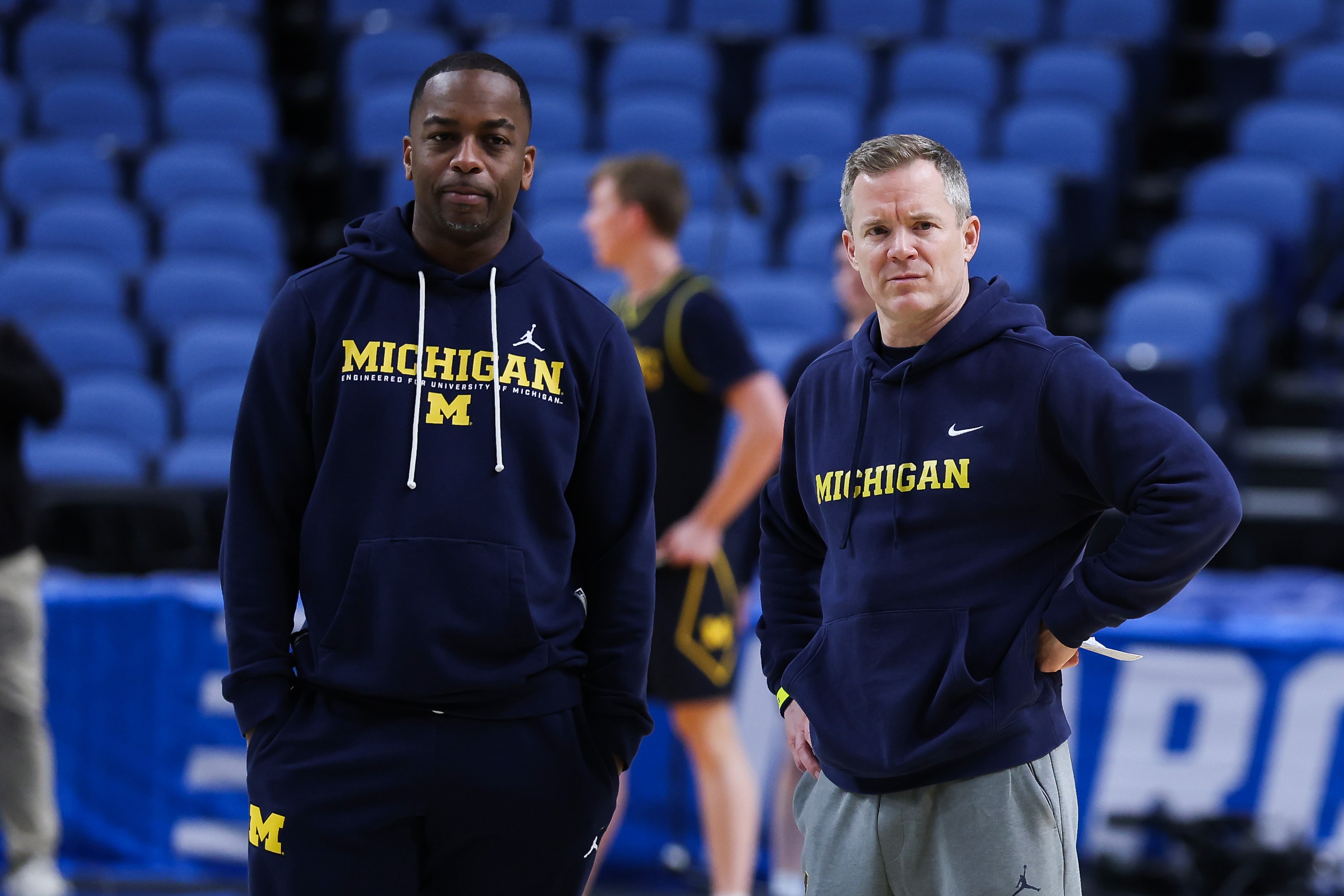
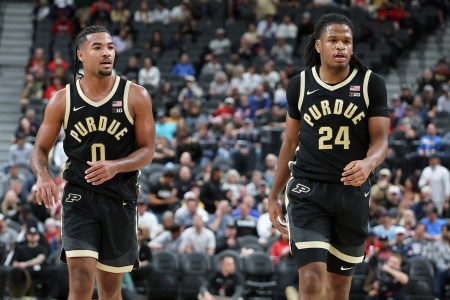
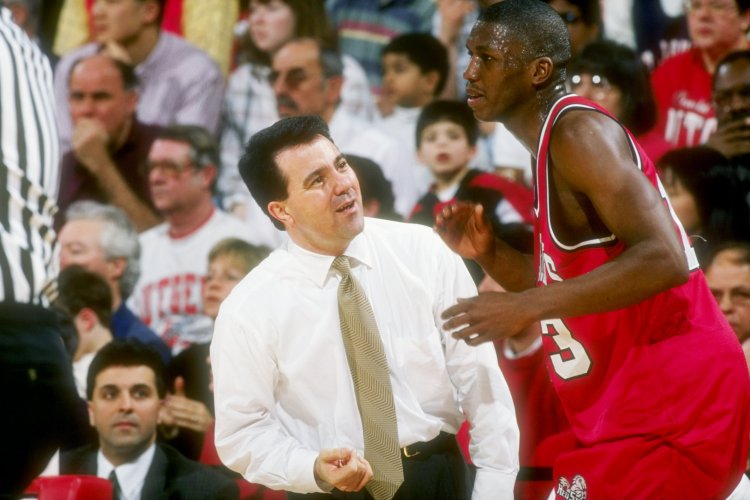
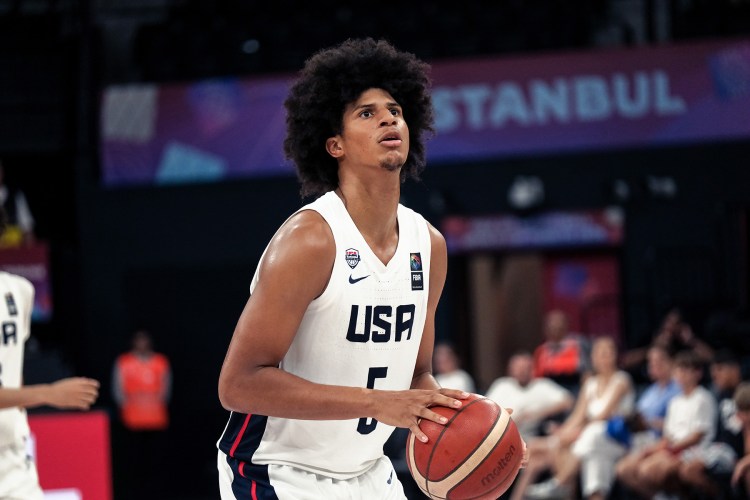
Michigan's road opener was an NCAA Championship rematch against UConn
Icon Sportswire via Getty Images
Michigan coach Mike Boynton joined Seth a brand-new episode of The Hoops HQ Show. Stream the full episode on YouTube or live on the Fubo Sports Network.
Seth Davis: Hello everybody and welcome back to The Hoops HQ Show. My usual partner in crime, Andy Katz, has the week off, so I am flying solo today. Unfortunately, we only have half the host power, but that’s okay because we have twice the guest power. Here is Mike Boynton, the current head coach of the University of Michigan. Mike, glad to have you with us.
Tell me about the season so far, in particular your game last Friday night against UConn. Obviously, it’s the type of game you schedule knowing it’s going to be a tough one. You guys fell down really big early in the second half, fought your way back to make it a competitive game, but ended up losing.
What’s the most important thing you learned about your team in that UConn game?
Mike Boynton: That for stretches of that game, we went toe to toe with them. There’s been some concern about how this team would adjust to the expectations and noise and all the stuff that happened over the summer with the transition — obviously losing three lottery picks, but also our head coach was a lottery pick. I joke that we had three guys picked in the top 12 of the draft, but our coach was picked first.
So with that transition, we were just seeing if our guys can match what’s necessary to compete against the top dogs in college basketball. UConn absolutely fits into that category. I think they are certainly a national championship-worthy program and they have a national championship-worthy team this year. They played a lot better than we did in some aspects of the game, although I think we held our own on the glass. We didn’t shoot the ball nearly well enough in that game, against that type of physicality, to give ourselves a chance to make it a one-possession game in the last minute.
Seth: I know you schedule these types of games because you want to get exposed. You’re not afraid to lose.
What’s the most significant weakness that got exposed in that game that you want to shore up?
Boynton: We’ve got to find a better ability to put some pressure on the rim. We’re naturally going to be a heavier three-point-shooting team — certainly heavier than we were last year, when we had a frontcourt that’s not only all in the NBA, but all playing for their teams as rookies. Our team is a little more perimeter-oriented, but we still have to find a way to get rim pressure, get ourselves to the free-throw line and get easier baskets than we were able to on Friday. A team like UConn, which is historically one of the better defensive teams in the country, gives you an opportunity to see what you need to do in practice, starting today, to shore those things up.
Seth: One of your most important players is Roddy Gayle Jr., who, when the season ended last year — I’m sure you all assumed, I assumed, everyone assumed, I’m sure Roddy assumed — was done playing in college. He’s what we call a five-in-fiver. He’s one of those guys who’s eligible to play because of a court order. Some guys are not eligible to play and are still trying to get there. It’s been wackadoodle, we know that.
What are your expectations with Roddy Gayle? How closely do you follow his legal situation, and do you have any degree of confidence either way about whether he’ll play the rest of the season?
Boynton: I don’t know exactly the next date of an appearance or whatever it is. I would imagine they’ll fight his case like they have all these other guys. But we’re confident that, considering the landscape of college basketball, Roddy’s got as good a case as anybody to play another year. This five-in-five isn’t new. It just wasn’t something that was widely accepted across the board. However, several guys in the last four or five years have played five years, and everybody moving forward will have five years to play. It obviously has a lot of people scratching their heads as to why (the NCAA) is fighting this so aggressively. But they are. So we continue to follow the guidelines provided to us by our compliance office and by the court in the jurisdiction he’s in. Until we’re told differently, he’s going to continue to be a significant part of what we’re doing this season.
Seth: Are you following his legal case at all? Or is it just, if he’s in your gym, you’re coaching him, and if he’s not in your gym, you’re not?
Boynton: Yeah, we are. His case has been filed in Niagara Falls, which means if he ever has to appear, he’s not in practice and he’s had to do that twice already. So even for us, there’s a little bit of instability in our day-to-day operations. But I certainly hope that at some point they say, “You know what, the season started.”
I don’t believe this notion that a bunch of kids have lost scholarship opportunities so other guys can play this year. I really just don’t see any data that that’s happened anywhere. I haven’t heard anybody say that it’s happened. People keep saying that it would have happened, or that it’s going to be a consequence. But we actually increased our scholarship limit from 13 to 15 just a couple of years ago, and many schools weren’t using 15 scholarships anyway. So several of us, including Michigan, obviously had the room to add a player.
For us in particular, once Brandon McCoy was injured this summer, Roddy became that much more important for us to pursue this opportunity for. And he’s at Michigan, working on finishing his degree. He’s a great kid. He means a lot to this community and to our team this year. So yes, we’re following it, but as far as worrying about it every day — at this point, I’m just trying to coach the team as best I can on a day-to-day basis.
Seth: You mentioned the UConn game. That game was set up because it was a rematch of last year’s championship game. Both teams are different. But there’s this — I don’t even know if it’s expectations anymore, Mike. I think people understand that you guys are a different team, but you are in fact the reigning national champions. Now, you and I are grown-ups. We know that means diddly-squat. But your players live in a much different world than we do.
How much do you have to manage that dynamic with this team?
Boynton: I’ll be honest, I think Friday was actually a really good thing for us, because I’ve been talking for about two months about the fact that last year’s team did win the national championship. But JP Estrella lost to that national championship team. Moustapha Thiam didn’t play in the NCAA Tournament. Kenny Noland was a senior guard at Columbia. Quinn Costello and our other freshmen were high school players. Those guys are not defending a national championship.
I think I’ve done a good job with this team, and Friday was a good example of it: We have to establish our own identity. The more we talk about last year’s Michigan team, the more it means this year’s team has yet to establish its own identity and what people should be talking about them for — whether it’s Trey McKenney’s ascension from a role player off the bench to a starter at the top of a scouting report, or whether Moustapha Thiam and JP Estrella can get people to start talking about the force of Michigan’s frontcourt, versus what last year’s team did. As we move forward and the games get played, people will see that we’re built differently. We’re going to play stylistically very similar, but the way it ultimately helps us win will look very different as we move through the rest of the season.
“The more we talk about last year’s Michigan team, the more it means this year’s team has yet to establish its own identity.”
Boynton on his new-look Wolverines
Seth: Speaking of last year’s team:
How much contact do you have with Dusty May right now?
Boynton: Dusty and I talk very frequently. He’s a tremendous friend, and I’m so happy that he’s been able to find some success this early in his season, especially having Morez (Johnson) and one of our assistants, Drew Williamson, with him as he goes through this transition. He’s been a tremendous mentor. He’s somebody I probably talk to at least two or three times a week. He’s obviously got a very busy schedule, and I have a very busy schedule, but we’re still leaning on each other for significant coaching and personal advice.
Seth: What’s he telling you about life in the NBA?
Boynton: It’s a bear. When he looked at his schedule, I think he assumed it would be daunting. I remember in the very first week of the season, they played a back-to-back. They played in Indianapolis on Friday, then they were home Saturday morning and played that night against another team. It’s hard to keep up with how quickly you have to turn the page from one game to the next. And you almost feel like you’re always traveling. Even when you’re playing at home, it feels like you’re either getting ready to travel again or you just got off the road. So that’s probably been his biggest adjustment, other than the fact that you can’t hang on to losses or wins for any time in that league.
After parting with Oklahoma State, Boynton was Dusty May’s assistant coach for two years at Michigan
Getty
Seth: I don’t know if people realize — it’s not like you guys were best buds before he brought you to Michigan. He knew you a little bit, and he liked that you had head coaching experience.
What surprised you most about Dusty May from being his assistant coach for two years?
Boynton: I think just his commitment to learning and his openness to being vulnerable about things he’s not sure about. As a young coach myself, there were things I knew I wasn’t sure about, but I probably wasn’t as comfortable, or didn’t have enough willingness, to expose that to other people and get help. Dusty’s always seeking learning. He’s always reaching out to people about ways we can tweak things. And that’s why our staff was so good: He allowed us to have autonomy within our program and gave us tremendous responsibility. But he set the vision, and he led us with great respect and obviously we all wanted to win for him and for this program. Now he’s doing the same thing, and I can watch it unfold in the NBA. It looks like Kyrie (Irving) and Cooper (Flagg) bought in pretty quickly, and we know it’s not always easy to get the superstars in the NBA to buy into a coach who hasn’t done it there.
Seth: I guess he’s one of your mentors, but your other big mentor in your coaching career is, of course, Brad Underwood. You look at those two guys and say, “Wow, they’re really different.” They’re different generations, different types of personalities. Although, Brad is this analytical, forward, Moneyball guy. Who knew? Maybe he’s younger than we thought.
What would you say is the biggest similarity between Dusty May and Brad Underwood, and what’s the biggest difference?
Boynton: Man, they’re both competitive sons of guns. Every single day, they both want to rip their opponent’s guts out. Brad’s a little more out in the open about it. Dusty seems a little happy-go-lucky —
Seth: I was going to say, nice little Dusty wants to rip their guts out? That doesn’t sound like nice little Dusty. He’s like Richie Cunningham.
Boynton: I’m telling you: You get that dude on a basketball court, put nine other people out there and say, “Let’s play,” and at 50 years old, he’s still getting after it.
Seth: Biggest difference between them?
Boynton: Brad has started to look at the game more analytically. He was very hard and fast in the way he approached the game when I was with him at Stephen F. Austin and Oklahoma State. And I think over his time at Illinois, he’s gotten a little more progressive about allowing ideas and being open to changes. Dusty, I think, has always been that way. He wants to be ahead of the game in terms of things changing and trending. We obviously played big — that wasn’t new to us, because they played big when he was at Florida. And then he obviously had to adjust to his resources at Florida Atlantic, so he played four guards. Johnell Davis was his four, and Alijah Martin was kind of a point forward. His ability to adapt in real time, situationally, is truly impressive.
Seth: We all know your situation. You are technically the permanent head coach at the University of Michigan. You’re making a nice, healthy salary this season. They gave you a two-year contract and only one year is guaranteed. So no one’s crying for you, but that is nobody’s definition of a long-term commitment. In your previous job as a head coach at Oklahoma State, they fired you, which a lot of coaches think is literally the worst thing that can happen to any human being.
How much does having already gone through that experience — “They fired me, and I’m still here, and life is still pretty good” — take the pressure off having to, quote-unquote, prove yourself to get this job?
Boynton: Yeah, I’ve always tried to pride myself on having a high sense of humility. This stuff is about these programs and the players in them, and our ability to serve them and help them be the best they can be. Getting fired was always kind of a thing you hoped never happened. But you look around this game and think about the coaches who’ve been fired — why would I be immune to being fired?
Seth: A lot of people better than you have been fired, right?
Boynton: If you look at the Hall of Fame coaches, they probably all have been fired at some point. The key for me — I’m 44 now — is that I’ve had tremendous opportunities at two great institutions. I’m still learning how to lead a program as I grow in this profession, and I feel more prepared than I was the first time around because of that experience. Dusty’s been a tremendous help. Having a really good staff is something I learned from him and something I’m trying to put forward.
As far as the contract: To be honest, I don’t really think about it very often at all. I try to be smart with the money I’m making now, certainly, because that’ll help me if a bad day happens. But at the end of the day, the profession demands that you be successful. People are less patient at all these jobs. I would bet if you polled half the country a week into the season, all the 0-2 teams want their coaches fired. A lot of the 1-1 teams want their coaches fired because they won their first game and lost their second one. Some of the 1-1 teams want their coach fired because they lost the first one and didn’t win the second one by enough. And the 2-0 coaches are just holding on until they lose their first game.
Mine (situation) is pretty simple. It’s in black and white. Everybody knows what the deal is.
Boynton on his two-year contract with Michigan
Seth: So everybody’s miserable. Look, I’m 56, so 44 seems young to me, but you do have a mature perspective on that. I feel like with so many coaches I talk to, it can creep in on their mental health and how they perform and how they sleep. You seem relatively relaxed about that part of it.
Boynton: Part of it is because I know there are only certain things I have control over. I think my situation is much more unique than, say, a coach who’s had a couple of bad years and thinks he has three more left, with no idea. Mine’s pretty simple. It’s in black and white. Everybody knows what the deal is. So we’re moving forward as a staff, trying to coach this team the best we can. We’ll have a new administration at some point this season — that’s another factor in this deal. We just got a new president here at Michigan. I think they’ll be great leaders for this program, and they’ll make a decision on what they think the direction of Michigan basketball needs to be at the end of the season.
If I focus on myself so much that I’m not trying to help Trey McKenney figure out how he’s being guarded differently this year than last, or help JP Estrella get over the hump — he’s been to three Elite Eights in his career, and he came here to see if he could get to the next step — then I’m doing those guys a disservice. And I’m doing a disservice to my staff, who all decided to stay here and do this with me.
J.P. Estrella lost three consecutive Elite Eight games with Tennessee
Getty
At the end of the day, even if something were not to go our way, as a young guy I’m going to keep moving along, because I’ve always done that. I grew up in Brooklyn, New York City. Competition is at the top of the things that are most important to me. And I have a family to fight for. While I fight for this program, I’ll always fight for my family even more. I believe we’ll get it done and secure some more time here in Ann Arbor, and we’ll let the chips fall where they may from there.
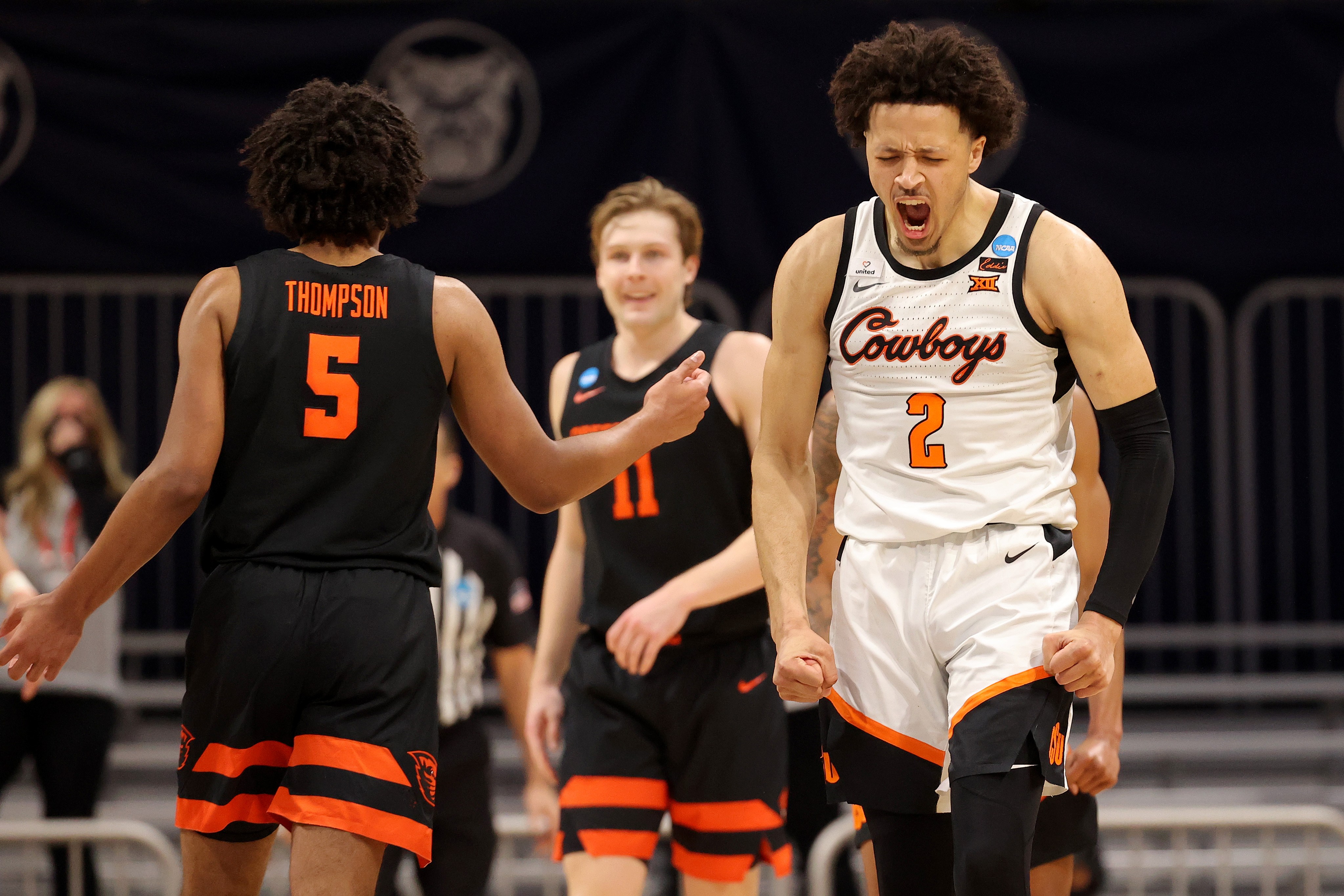
Seth: I want to ask about a couple of players you’ve coached who are now two of the best players in the NBA. The first one is Cade Cunningham. You only had him for one year at Oklahoma State. He was never under the radar. He was not a diamond in the rough. Everybody knew he was the best high school player in the country, and everybody knew he was going to be the No. 1 pick in the draft. He played like it as a freshman.
You’ve seen so many kids ruined by that kind of hype over the years. Why did it not ruin Cade Cunningham?
Boynton: Seth, I’ve seen kids with half his talent and half his real ability not make it because it ruined them before they even got there. The fact of the matter is, Cade’s foundation is his family. His mom and dad set a great example for him about what it means to be a great human first.
I go down to see the Pistons quite often — I’m fortunate to be 45 minutes away from where they play. I’ve seen him practice. I’ve been around their organization. Everybody raves about the type of person he is, and that’s where it starts with him. He wants his teammates’ respect, and more than anything, he wants them to believe that they’re as good as he is. He wants them to know that because he’s with them — not because he’s so good, but because he’s with them — they’re going to win together.
I watch the Pistons a lot. I think they’re a good team. I don’t think anybody thought they could win 60 games last year and be the No. 1 seed in the East. But it’s his will and desire to bring people up and uplift people. At Oklahoma State, we had really good players, but we only had one NBA player on that team, and it was him. And he made our team good enough to be a 4 seed in the NCAA Tournament and to be a couple of possessions away from winning the Big 12 Tournament championship, in one of the best seasons in Oklahoma State’s recent memory. So it’s his humility and his work ethic, but also his ability to raise the level of the people around him and make them believe they’re better than they are by themselves. That’s second to none.
No. 1 Draft pick Cade Cunningham was Boynton’s only rising NBA player at Oklahoma State
Getty
Seth: The other guy, of course, I have to ask you about is Yaxel Lendeborg. We all know his story. Eleven varsity high school basketball games — I’ll repeat that, he played 11 high school varsity basketball games — then junior college, two years at UAB, and obviously last year winning a championship with you all. I remember Andy Katz talking about it and writing about it, and I agree: I don’t know that I’ve been around someone who was so appreciative of what was happening. Seeing him at the Final Four, he was so great with the media because it was like he still couldn’t believe this was happening.
Now he’s the — I know it’s early — prohibitive early front-runner for NBA Rookie of the Year, absolutely dominating. Steve Kerr made the comment that in the NBA, when you’re 23 years old, we think you’re done, so we shouldn’t draft you. “We should have drafted him when he was coming out of junior college and didn’t know how to play.”
To what degree are you surprised by the success Yaxel Lendeborg is having in the NBA? And how do you explain that he’s this good this soon?
Boynton: I was very fortunate to be part of his recruitment to Michigan and to spend a lot of time with him last year. I think the only thing Yax needed was for somebody to believe in him. The day he walked into our gym, I thought, “This is an NBA wing.” And he played center at UAB. But I put him through a shooting drill, and his shot was beautiful. His form, his release — there weren’t any technical things we needed to fix. He just didn’t have enough reps doing the things we were going to ask him to do last year. And Dusty poured a lot of confidence into him.
He didn’t know if he could really do it at this level. He was questioning himself a little bit. Part of that is that even Michigan was so big for him, right? Think about playing at a small high school in New Jersey and then at a kind of off-the-radar junior college in Arizona, and then — with all due respect to UAB — not having a national spotlight on him, even though he was playing really, really good basketball there. Then to come to Michigan, where people talked about him being the No. 1 transfer portal guy and all the money he was going to make — that could have sent him down a bad path as well.
But he embraced the opportunity to be at Michigan and to see what the possibilities were for his game to grow. And now he’s on the biggest stage in the world playing basketball, with arguably the best shooter in the game, and even that guy’s giving him confidence.
I tried to tell scouts — and this is by no means tooting my own horn — but every scout who called, I would say, “Guys, listen, I think we’re overthinking the age here, because he has so much more room to grow as a basketball player.” Partly because he just hasn’t played that much. Think about the guys in his draft class. I would bet everybody in the top 10, his teammate Morez Johnson included, had played probably 5,000 more basketball games than he had to that point in his life. So you get to unlock some of these things. And he has no real injury history, because he hasn’t played 75 AAU games every summer. There are some things they still ought to tap into.
And he’s brilliant. He’s an incredibly smart basketball player. He’s a willing passer. He’s super unselfish. And he loves playing defense. So when you walk into a program as the No. 1 portal guy, like he did last year, everybody thinks you’re going to be a first-team All-American. And when the thing you want to do most is defend and pass, everybody’s guard is let down. No one feels like you’re trying to be territorial and be the man at Michigan. He walked around all year last year, Seth, telling people, “We don’t have a best player.” And I would be like, “Yes, we do. It’s you. You’re the best player. And it’s okay. Everybody knows it.” But his mindset was that he wanted everybody to be a part of it.
Lendeborg was a selfless leader for Michigan’s championship squad
Getty
Now you can see his teammates at Golden State have embraced him. It looks like the front office has, too. I saw Joe (Lacob), the owner, talk about it last week. They feel like they have a franchise-building player that they drafted 11th in a historically great draft. So I’m super happy for him and his family, because I know everything they’ve been through, and his humility is something I’m really, really proud that he’s held on to.
Seth: Well, I believe you when you talk about his humility, but he’s also got kind of a different personality, right?
Boynton: No filter.
Seth: It’s like the second or third game, and he’s talking trash to Luka on the court and after the game. He got into it a little bit with Draymond about the Michigan–Michigan State thing.
Is there any part of you that’s like, “Yo, Yax, maybe a little more of a filter between the mind and the mouth”? Or are you saying, “Hey, man, just be you”?
Boynton: I think that’s the part where the 23-year-old still has some growing to do from a maturity standpoint. But here’s what I tell people about that stuff: Yax has never done anything that’s been super detrimental. He’s talking some trash, right? If the worst thing that’s going to happen is he talks trash as a basketball player, I think I can let him be himself, as long as he makes sure the basketball part is always first and foremost, and that he produces for his team and puts them in position to win. We just have to let him be himself, as long as it’s not anything that’s going to hurt the franchise or hurt him or hurt anybody else, physically or otherwise.
Seth: Last thing before our speed round. I want to ask you about your background. You mentioned growing up in Brooklyn, and everyone says that’s where you got your toughness. I think it’s the fact that you had four sisters — and I think you were the fourth of five.
Boynton: No question about that. Yes.
How did having four sisters make Mike Boynton who Mike Boynton is?
Boynton: Well, it did multiple things. My wife would appreciate that it taught me how to be respectful of women and how to be quiet at times.
But I also learned the value of male friendships and relationships. That’s why I’ve always valued being on teams. It’s why I’ve loved being a part of teams my entire life. It also forced me to go outside and get to know other people, because I wasn’t going to hang out and play dolls and makeup with my sisters growing up. I went to the park, played basketball and developed great relationships. And this game has taken me on a ride that I hope doesn’t end for a much longer time than it has so far.
Seth: There’s no toughness like feminine toughness, by the way. I’ve said if men had to deliver babies, it would be the end of civilization. We wouldn’t put up with any of it.
Boynton: A hundred percent.
The Hoops HQ Shot Clock Challenge
Seth: OK, I’m going to put you on the clock. Sixty seconds. Just give me some quick answers and let’s have some fun. You ready?
Favorite player when you were a kid?
Boynton: Jamal Mashburn.
Seth: What’s your wife’s biggest complaint about you?
Boynton: There’s a long list there, but I’m just kind of mindless around the house. I’ll leave the refrigerator door open. I won’t put the toilet seat down. Just normal, irresponsible male stuff, I guess.
Seth: Do you leave drawers open? Like, you put something away and don’t completely shut the drawer?
Boynton: I do, I do. I’ll take one shoe off and leave it somewhere, and the other shoe will be somewhere else. All those things.
Seth: Our wives should talk. My wife has the same complaint. Who would play you in a movie?
Boynton: Probably Denzel Washington.
Seth: Me too. Life skill you wish you had?
Boynton: I wish I could fly a plane. Or cook.
Seth: Favorite TV show growing up?
Boynton: Martin.
Seth: Now I’m going to get you in trouble with your wife. Actress or singer you secretly have a crush on?
Boynton: This is no secret to her: Beyoncé.
Seth: How many cups of coffee do you drink in a day?
Boynton: Zero. I’ve never drunk a cup of coffee in my life. Won’t have a sip, hopefully til the day I die.
Seth: Never in your life? Wow. If you weren’t coaching basketball, what would you be doing?
Boynton: I’d be an attorney.
Seth: What do you want to be remembered for?
Boynton: Just being a great dude and a great teammate, and never taking the value of relationships for granted.
Seth: Good one to end on. Hey, Mike, I know how busy you are. It’s an exciting time of year. We finally have games to talk about. Best of luck with everything. We appreciate the time, and thanks for joining us on the Hoops HQ Show. Go Blue.
Meet your guide
Seth Davis
Seth Davis, Hoops HQ's Editor-in-Chief, is an award-winning college basketball writer and broadcaster. Since 2004, Seth has been a host of CBS Sports and Turner Sports's March Madness NCAA basketball tournament. A writer at Sports Illustrated for 22 years and at The Athletic for six, he is the author of nine books, including the New York Times best sellers Wooden: A Coach’s Life and When March Went Mad: The Game Transformed Basketball.