In the summer of 1981, a few months after I joined Sports Illustrated, I was assigned to the National Sports Festival in Syracuse, N.Y. Well, the story started in Syracuse but didn’t really end for me until seven months later when Georgetown coach John Thompson paid me back, as he saw it, for the story. He was kind of right. And kind of wrong.
The festival was a since-forgotten event on the summer calendar that ran from 1978 until 1995, bringing together amateur athletes across the board — softball, swimming, soccer, you name it. Though the organizers didn’t want to admit it, it was an idea based upon what the Soviet Union and East Germany used to do — they called it Spartakiad — and was designed to generate interest between Olympic years. It was a great concept.
My assignment was to showcase three college freshmen-to-be, all of them seven-foot centers — Greg Dreiling, Stuart Gray, and a kid named Patrick Ewing. In the process I would also get a look at North Carolina-bound Michael Jordan, who had been tearing it up at summer camps, and a player with whom I was fascinated, a rising high school senior southpaw named Johnny Dawkins, who was already committed to Duke. I loved left-handed point guards, and, at the time, I was more enamored with Dawkins than Jordan.
But, hell, what did I know? As Thompson would eventually point out.
The genesis of the story was predictable. This was still the era when we were obsessed with size, three years before the Portland Trail Blazers chose center Sam Bowie over Jordan; four years before centers Benoit Benjamin, Jon Koncak and Joe Kleine (not to mention No. 1 Ewing) were taken in the first six picks; five years before the 1986 draft when center Brad Daugherty was taken before Len Bias—okay, we know how that turned out—and two other centers, Chris Washburn and William Bedford, were the third and sixth picks respectively. We loved our bigs.
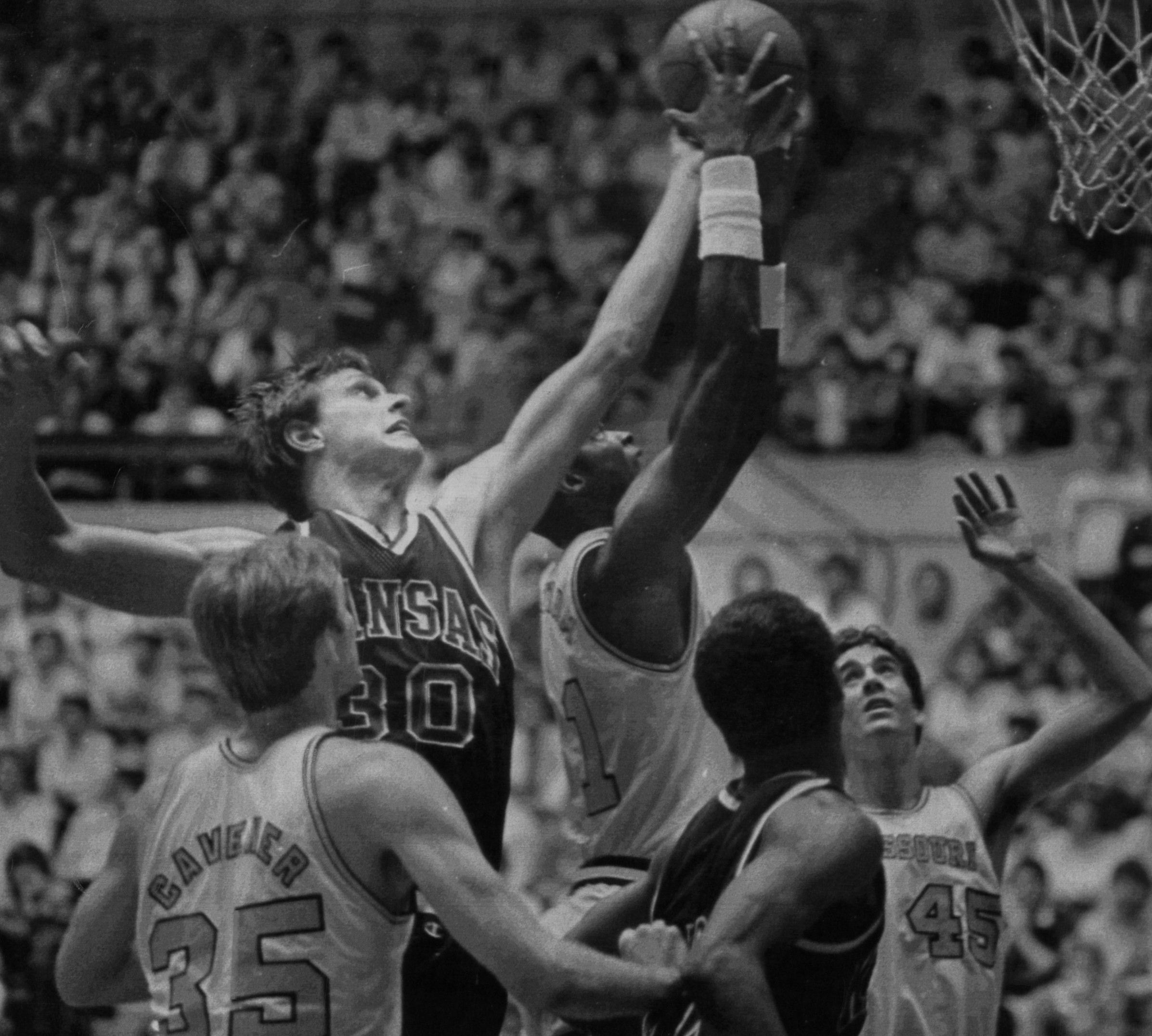
It was also before high school stars were covered like pro stars. True, the McDonald’s All-American game had begun a few years earlier—Magic Johnson, Dominique Wilkins, Ralph Sampson, Isiah Thomas and James Worthy had already been McDonald’s All-Americans—but there was not a national obsession with youth. Of the three centers, we mostly knew Ewing, a ferocious rebounder and defender from Cambridge (Mass.) Rindge and Latin High School, but I had never seen him play, not even a video clip as I recall.
It’s a long-standing tenet of journalism that the best interviews take place in one-on-one situations. No distractions, no outside influences. I was able to get Gray and Dreiling — Gray, the son of a military science professor at UCLA, where he was heading, was particularly polished — alone, but Ewing was a no-no. Ewing spoke only after games (and said little) and his coach-to-be, Thompson, was never more than a few feet away, a lurking, hulking omnipresence. I remember spotting Ewing and a few of his East teammates chilling in a parking lot after a game and headed over with notepad poised. Magically, Thompson appeared, wearing a victorious smile, to stop nary a question. The coach had already announced that the no-talking-to-freshmen rule (which was really a Ewing Rule) would carry on throughout the Georgetown season. (Dean Smith was imposing the same restriction for Jordan, who was affable, camera-ready, and, in those days, eager to talk to anyone with a set of eardrums.)
Gray played extremely well during the tournament—which his West team won—and in the story I wrote the following sentences:
Gray easily outshone Patrick Ewing, who is headed for Georgetown
and Greg Dreiling, who is bound for Wichita State.
His [Ewing’s] play on the court was often disappointing, too, for
someone who came in trailing reams of newspaper copy behind him.
Both statements had the virtue of being true. At the same time, I also wrote glowingly of Ewing’s defense, which I’ll admit, did not require an act of genius observation:
He’s [Ewing’s] far ahead of both Gray and Dreiling in
shot-blocking ability, and certainly the most apt comparison
that has been made about Ewing is the one with Bill Russell.
So, the story comes out, life goes on, and Ewing blows up during his 1981-82 freshman season, averaging 12.7 points and 7.5 rebounds to go with 119 blocked shots. It’s anyone’s guess how many other shots he discouraged or altered as Georgetown became the most feared team in the nation because of its stifling defense. Dreiling had a decent season at Wichita State but was outshone by talented teammates Antoine Carr, Cliff Levengston, Aubrey Sherrod and a fellow freshman named Xavier McDaniel. Stuart Gray? Although he started 26 of UCLA’s 27 games, Gray was a disappointment with averages of only 4.9 points and 4.8 rebounds.
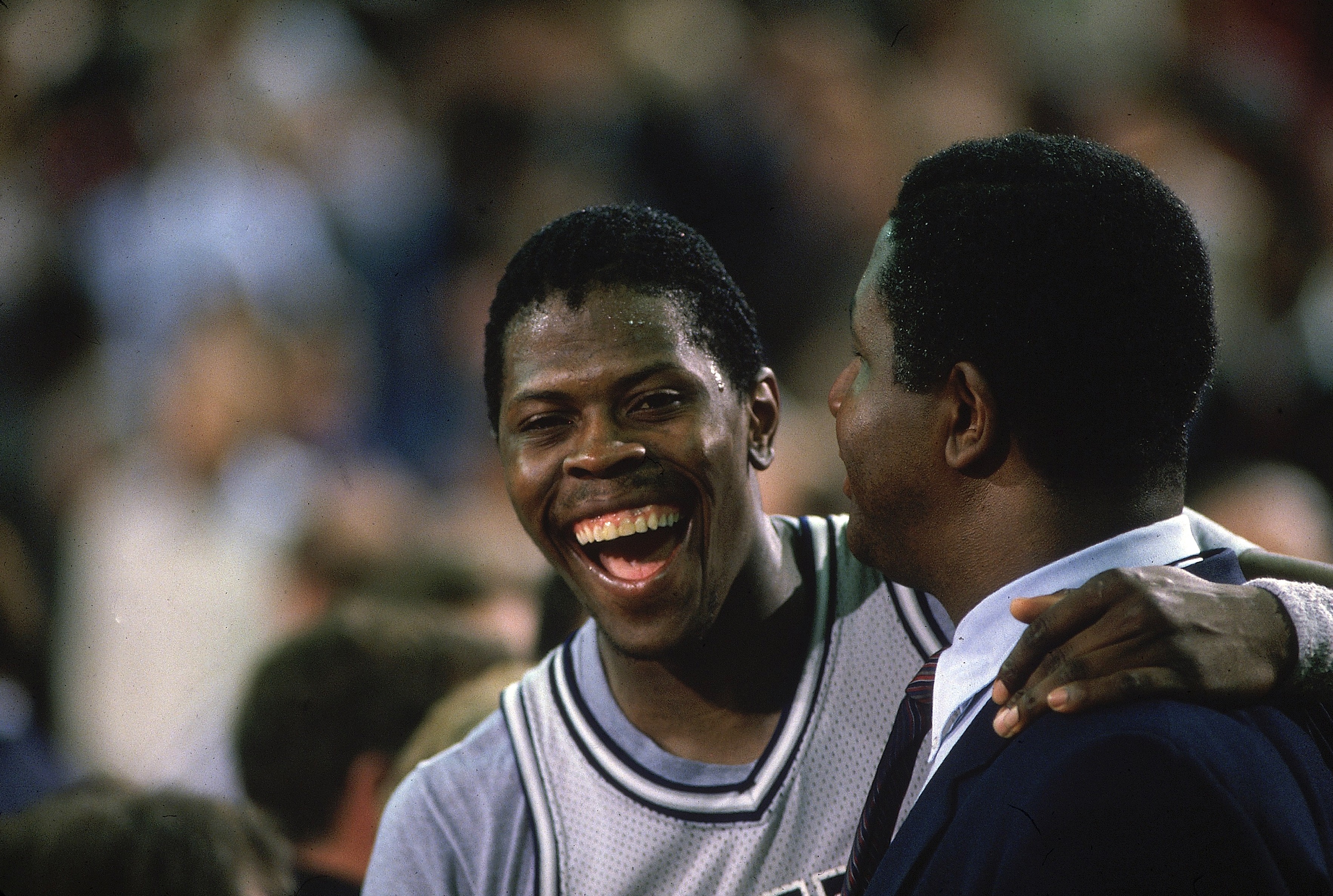
So, mid-March of 1982 found Dreiling and Gray watching the Madness on television and Ewing in Utah, where the Hoyas were the No. 1 seed in the West Regional. I was assigned to cover that regional, and the pre-tournament story line was set—Georgetown as the menacing outsider, the anti-hero, the Team You Absolutely Don’t Want to Mess With. The term “Hoya Paranoia” had already been coined (I know not by whom), and Thompson, cunning and calculating, played into it, settling his team into the Salt Lake City Hilton, which was 85 miles from the first two rounds in Logan, Utah, and 90 miles from the final two rounds at BYU in Provo. “Like Hannibal,” I wrote, “they [the Hoyas] must travel great distances to get to war.” The joke was already circulating that for the Big East Tournament at Madison Square Garden the following season the Hoyas would domicile in Canada.
Anyway, after a press conference at BYU or Georgetown’s hotel—I can’t remember which—Thompson spotted me in a gaggle of reporters waiting to ask a few additional questions. A wide smile came over his face followed by the booming voice: “There’s the fool who said that Stuart Gray was better than Patrick Ewing.”
Those who knew Thompson, who died in 2020 a few days shy of his 79th birthday, can conjure up the enunciation. The words Stuart Gray were spit out with as if he were talking about waste-water runoff, and fool came out like foo, as if I were so pathetic I didn’t even deserve the final l.
Yet, you have to understand that Thompson’s jab came across as humorous. It wasn’t cruel or adversarial. It was Thompson doing what he always did—protecting his players and throwing shade at the media. I laughed and don’t remember having a rejoinder. What could I say? I could hardly recite huge swatches of the story.
In retrospect, yes, I had probably overrated Gray’s upside, and I did it partly to provide a surprising take in the story. Even in 1981, it wouldn’t have been a leap to write that Patrick Ewing was going to be 10 times better than the earthbound Gray or the robotic Dreiling, who did squeeze out 10 pro seasons, though I don’t remember writing a word about him during my years of covering the league. Gray? He hung around for seven uninspiring seasons, finishing with the New York Knicks in 1991. Ewing’s Knicks.
Parick, as you know, became an immortal with whom I interacted with many times over the years. He never made it easy. In the interest of saving time (he said) during his Knicks days I almost always had to interview him while he was getting a post-practice rubdown. We had a great one-on-one years later, though, when I was writing a book on the Dream Team. I asked him if he remembered the first time we met.
“No idea,” he said.
I explained the story to him, and he just nodded. “I didn’t play well in that tournament, but I knew I was the best center there.”
You know what, Patrick? I did, too. I swear I did, John Thompson.
Meet your guide