
CHICAGO – Mack Brown didn’t know Rick Barnes personally when longtime Texas athletic director DeLoss Dodds asked him to meet with Barnes and talk him into leaving Clemson to come to Austin. Brown only knew Barnes by reputation.
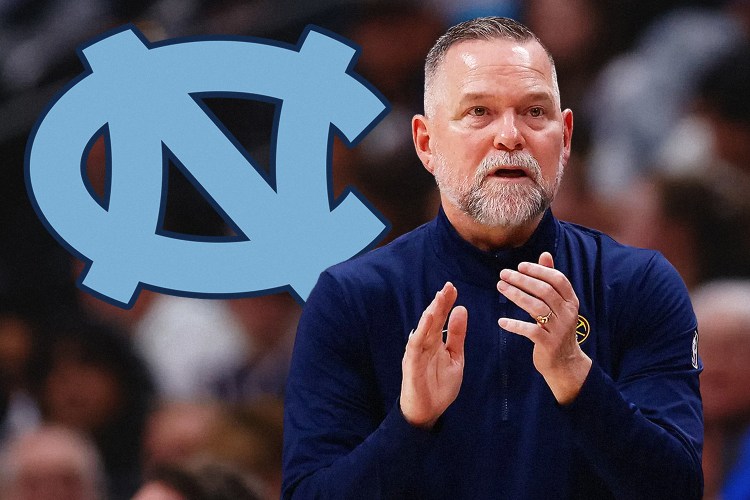
Brown had been the football coach at North Carolina when Barnes famously went nose-to-nose with Dean Smith, refusing to back down from the iconic UNC coach as they exchanged pleasantries on the sideline of an ACC Tournament game. Despite his allegiances at that time, Brown couldn’t help but be impressed by Barnes’ moxie. And years later, when he got to know him, he definitely wanted Barnes to join him at Texas. He wanted that fighter, someone who would fight for a basketball team at Texas that was always going to be in the shadow of Brown’s program.
“He thought at that moment it was his job to stand up for his players, no matter who was on the other bench,” Brown told Hoops HQ. “And obviously it was one of the greatest coaches ever. This was someone who could make it work at Texas. Absolutely.”
Brown’s instincts were right. Barnes got Texas to the Final Four in 2003, a few years before Brown won a national title in football with the Longhorns. They have remained close friends for decades, long after their departures from Texas. Brown is retired now, but all these years later, Barnes is still coaching at age 71 and once again on the verge of getting back to the Final Four.
Tennessee plays Michigan on Sunday at the United Center in the Midwest Regional final, the Volunteers’ third consecutive Elite Eight appearance. It took Barnes eight frustrating years at Tennessee to build a team capable of competing at this level in the postseason year after year after year, with a long string of March disappointments preceding this run.
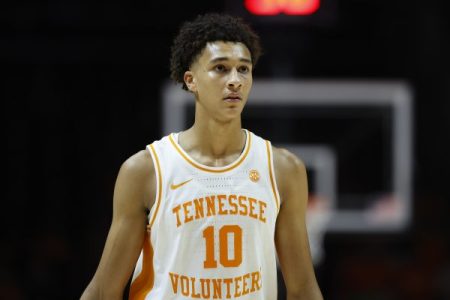
Tennessee Heads Back to Elite Eight With ‘Some Unfinished Business’ To Take Care Of
Vols overpower Iowa State relatively easily to move to Sunday’s Midwest Regional final against top-seeded Michigan.
The real story is so much longer than his 11 years in Knoxville. It starts in Hickory, N.C., a blue-collar furniture town at the foot of the Blue Ridge Mountains. It runs through a string of apprenticeships and interrogations, an ongoing search for basketball knowledge that Barnes still applies today, no matter how old school it may seem. It picks up pace in difficult head coaching jobs, George Mason and Providence and Clemson and then Texas, where he was fired one day and hired at Tennessee the next. And it ends here, if not yet, at a place where Barnes is clearly at home, a man of deep faith who believes he has been led to where he is meant to be.
In a sport where many coaching friendships are transactional and itinerant, Barnes has built a cadre of close associates, relationships measured in decades instead of years, all of whom are rooting for him Sunday. They tell stories of the Barnes people don’t see, the one who quietly donates a healthy chunk of his $6 million salary to missions and orphanages, the prankster who once got Hickory cops to fake arrest then-Texas A&M football coach R.C. Slocum on a coaches’ golf trip to North Carolina.
They also affirm that what you see with Barnes is actually what you get: a demanding, no-nonsense taskmaster who has, over the course of his career, achieved an old-school balance between rigor and freedom. Like some of his generational peers who still are coaching, his players are given tremendous latitude on the court as long as they meet Barnes’ standards in practice and, especially, under the rim, where the toughest player wins.
It’s hard to reconcile that with all those years of March disappointment, although Barnes appears to have figured that part out now.
“Did I make mistakes back then in coaching, probably, in this tournament? Certainly, I think I did,” Barnes said. “Probably putting way too much pressure on guys and maybe changing up what we did maybe too much. But I will never take away from those guys because I know how hard they worked. I know that. Yeah, I mean, I know we lost some heartbreaking games. I can tell you that. We did.
“I lost a game to Ohio State. I’ll never forget it. The last game on the second night, like at 9 at night. They had like a 40-foot shot on us. But I’m proud of all those teams. I really am. Do I wish we could have won national championships and all that? All I can tell you is we just stay in the arena. We’ll keep fighting as long as we can.”
Where does that come from? Hickory, to be sure. Barnes started with nothing and has spent his entire career searching for better. A better system. Better drills. Better players. Better ideas. He has spent his coaching life in pursuit of the unattainable basketball ideal, a quest that has no end, although a championship certainly would slake that thirst.
After playing close to home at then-NAIA Lenoir-Rhyne in Hickory, Barnes worked for Eddie Biedenbach, Gary Williams and Wimp Sanderson on his way up before getting his first head coaching job at George Mason. He fought the Big East wars at Providence. And he’s spent the rest of his career battling his way out of the shadows at schools where football always will come first.
Bob McKillop, the longtime Davidson coach who Barnes calls “one of the greatest coaches ever to coach this game,” worked alongside Barnes on Biedenbach’s staff at Davidson, along with Jeff Bzdelik, all three future Division I head coaches. They were all young and hungry, but even then, Barnes’ hunger left an impression.
“We just rolled up our sleeves, but what I noticed about Rick was he had this incredible competitiveness,” McKillop told Hoops HQ. “I mean, he was a fighter. He was born on the other side of the tracks and his whole life he was fighting to show he could advance from the other side of the tracks. I watch his teams play and they carry the same characteristic.
“What I also noticed was the inquisitive nature that he had. He always had questions, and a remarkable capacity to remember the answers and carry the conversation forward weeks and even months later. I was just stunned by how hungry he was to be a great coach and how hungry he was for information to make that happen.”
When he was at Texas, Kentucky came calling, perhaps the best chance of his career to coach at a true basketball school — although Barnes was the focal point of just about every NC State coaching search since time immemorial, partly because of his North Carolina roots but more because of the feud with Smith that made him a beloved figure among NC State fans. Dodds sent Brown to find out what it would take to keep Barnes happy at Texas. Barnes got what he wanted to stay.
Along the way, he picked up bits and pieces that still influence the way the Volunteers play today. At Providence, his team could zone-press anyone but Lou Carnesecca’s St. John’s teams. When Carnesecca retired, Barnes was at his door to learn his press offense. He still uses defensive drills he learned from Hugh Durham and Charlie Spoonhour, who learned them from Henry Iba. His teams never have compromised on toughness. They fight like their future depends on it.
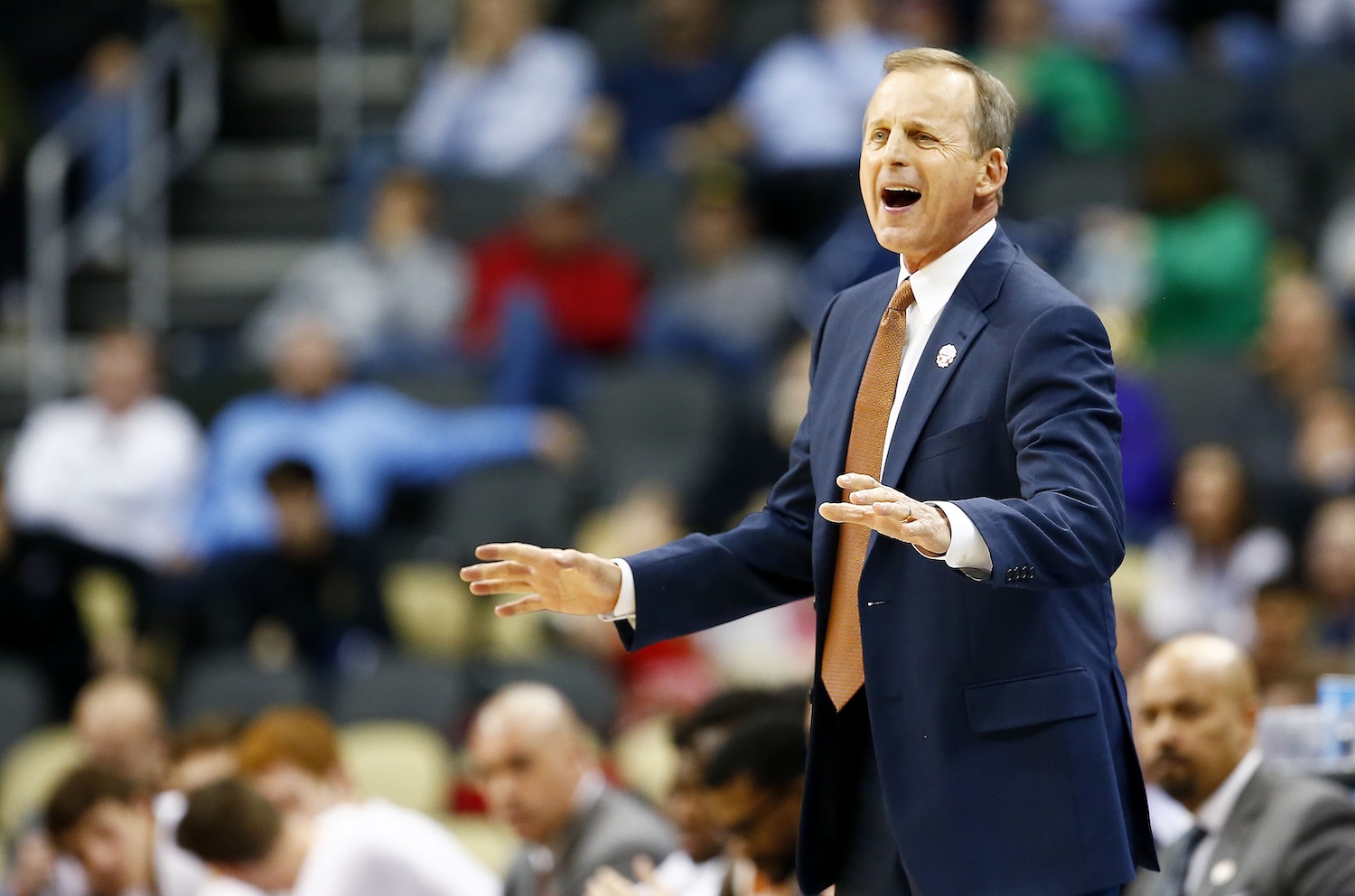
“He’s got a great combination of loving the players and discipline,” Brown said. “That’s hard to do, but that’s a great combination for a coach. If you can love them and make sure they know you love them, then you can get on them. And they take it because they understand he is trying to do what’s best for them and to help their team with the game. He’s all in.”
As he showed against Smith, Barnes never has shied from a fight either, although he does know when to pick his spots. In a heated atmosphere for his first return to Providence with Texas in 2004, P.J. Tucker went the length of the court for the winner at the buzzer. Barnes had a good view and was certain he got the shot off. The officials were not.
As Barnes, Providence coach Tim Welsh and the three officials huddled around a monitor, Barnes begged referee Bob Donato, “I know it’s good; let me get my team out of here before they kill us.” He and his team were showered with beer, along with a few of the cups it was served in, when he was proven correct. Barnes and John Clougherty, one of the other officials, have the photo of that scene hung on their office walls.
Yet those deep roots have allowed him to bend with the wind like the giant Carolina pines where he grew up. When the game has changed, Barnes has changed. Monday, Kevin Durant played in the United Center, still an elite NBA player at age 37, scoring 40 points for the Houston Rockets against the Chicago Bulls, 19 years after he was one of the first players to enter college explicitly as a one-and-done recruit.
Durant chose Texas over basketball powers like Duke, Louisville, North Carolina and UConn, in large part because of Barnes. Barnes, conversely, was willing to embrace the changes in college basketball and take a one-year player even if that was a completely new phenomenon, at a time when some basketball powers were not.
Barnes still speaks of Durant with awe: His work ethic, his humility, his teamwork. Last spring, Durant was a big part of Barnes’ recruiting pitch for blue-chip freshman Nate Ament. During the last meeting he had with Ament before his decision, Barnes showed him clips from Durant’s 32-point game against Kansas on a balky ankle. At one point, after a 25-point first half, Durant had to leave for treatment. He got a standing ovation from the Allen Fieldhouse crowd when he returned.
“‘If you don’t want to do this, we don’t want you at Tennessee,’” Barnes said he told Ament. “‘This is what we need you to do. But right now, if you do’’t want this, you need to tell me and I will get up and walk out, and I hope and pray you have a wonderful career.’”
Ament’s response? That’s what I want.
“I knew that coming into it, I needed to kind of increase my motor and become a more of an effort player,” Ament said. “I learned so much that way on the defensive end. Coming here, I’ve grown so much offensively and defensively. I think I’m a completely different player than when I first got here.”
Barnes’ adaptation continues. Last season’s Tennessee team was built around four-year stalwarts like Zakai Ziegler and Jahmai Mashack, with a few senior transfers mixed in. After that team’s Elite Eight loss to Houston, Barnes rebuilt in a very 2026 way with 11 new players, using Tennessee’s resources to his advantage. He may not like the new model of college basketball, but he’s making it work for him. As he likes to say, NIL means “Now It’s Legal.”
“It’s easier today than it was back then,” Barnes joked. “It’s easy. You can recruit a guy now for a week and get him. You know what I mean? Hey, what’s the number?”
And he’s still doing it. He may hand over the reading glasses he wears around his neck to an aide before taking the podium, but Barnes said Saturday he’s in such a good situation, he can’t envision the end yet. He told a story Thursday about working for Sanderson at Alabama, walking into the old coach’s office in the hours before the first game of the season. Sanderson was lying on the sofa in his office, motionless, hands over his face.
“I said, ‘Coach, are you OK?’ He said, ‘This would be a great job if you never had to play games,’” Barnes said. “I love practice. I could practice seven days a week, four hours a day. I love it. I just love watching guys get better, put it all together. But, really, I love it. I just like doing that.”
McKillop and Barnes still talk several times a week, and they spoke a few days before Friday’s win over Iowa State, a game in which the Volunteers dominated in the lane by almost unbelievable numbers — rebounds, blocks, points in the paint, everything — while playing suffocating second-half defense. It was a game that epitomized the way Barnes’ teams have always played at their best.
Whether another performance like that Sunday is good enough to get Barnes back to the Final Four is almost immaterial at this point.
“He told me he’s at peace,” McKillop said. “He’s at peace with his life. He’s at peace with his career. Because he’s so well-grounded in his faith. Here’s a guy with a chance to get to the Final Four and that’s the kind of statement he makes.”
There’s dignity in the determination to get better, regardless of the results. There’s solace in Barnes’ belief in a higher power. For his entire career, and certainly Sunday, the quest has always been the goal.
Meet your guide