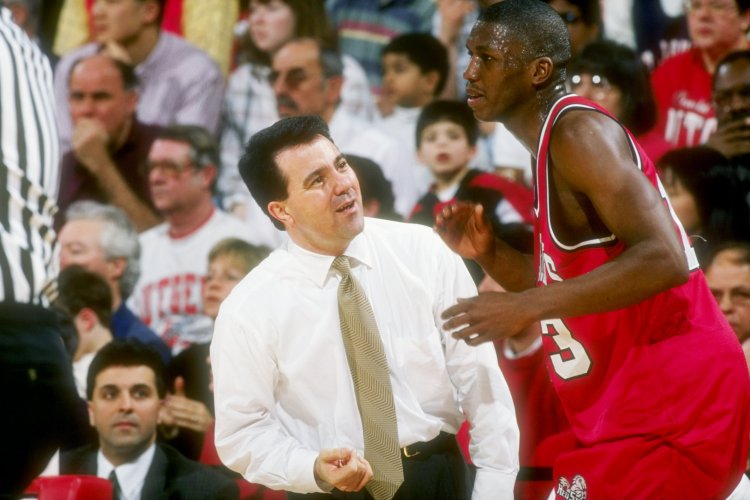
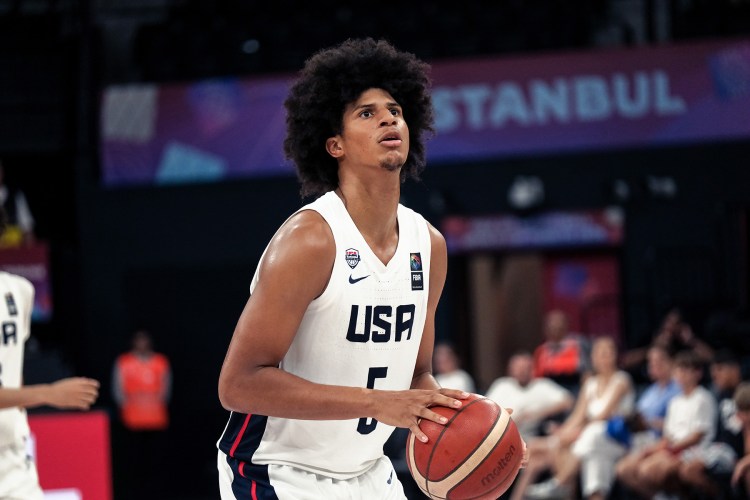
Baylor coach Scott Drew joined Seth and Andy on The Hoops HQ Show. Stream the full episode on YouTube or live on the Fubo Sports Network.
Seth Davis: Guess what, everybody? We have actual basketball games to talk about. The season is officially underway, and I can’t imagine a better guest to join us for that discussion and so much more about his life and career than Tom Crean, our great friend and a repeat guest on the Hoops HQ Show. So welcome back, Tom.
I was thinking about how I’m introducing you. You’re now a veteran coach and a veteran broadcaster, which is a nice way of saying that you’re getting old — but so are Andy and I. The three of us together have a lot of tread on our tires. We’ve got a lot we want to talk about with you, but I’ll start off with this: I don’t know that there’s anybody who prepares more intensely for his work as a broadcaster — and I’m including myself, certainly — especially the amount of video you watch in preparing for the season.
From what you saw on opening night and during exhibition season, what are the two or three things you’re most looking forward to seeing unfold this season?
Tom Crean: I think the big thing, in a nutshell, for the teams that have reloaded or added a few people to their rosters is how quickly they mesh. A lot of times when you join a team, especially if you’re a little bit older, you have to really fight the independent-contractor mindset — “I have to score this,” or “I need to shoot that.” And it happens to older guys more often than it happens to younger guys. The younger guys come in and want to prove that they’re NBA players. The older guys want to show what they’ve been working to become NBA players. And you just can’t do that. The quicker you can get shot selection down, the quicker you can get ball movement down, the quicker you can understand how to impact your teammates — I think that’s huge.
For guys who are moving up levels, I love watching how they deal with the speed, the athleticism, the physicality at the rim, the physicality on the ball. Can they get by people? Can they separate? I love that part. But probably the biggest thing I’m looking for early on this season is that there are a lot of returning guards. Big men are a huge, huge premium in college basketball, but point guards are as well. A lot of guys have either moved on or returned, and I want to see how they fit, because most of them would have liked to have been in the NBA at some point. Obviously the money is so great right now that you don’t have to do that, but at the same time, that’s where they want to end up. And there are reasons they’re not there yet. It might be their shot, their size, their defense.
Whatever it is, you can’t come out the first night and try to prove you’re ready for that level based on what you’ve been working on in the summer. I’m really anxious to see — especially with how strong the games are in November, and how strong they’ve already been with the exhibitions — who’s absolutely playing to win on their team, not to prove who they are, but to show what they’re doing to help make their teams better.
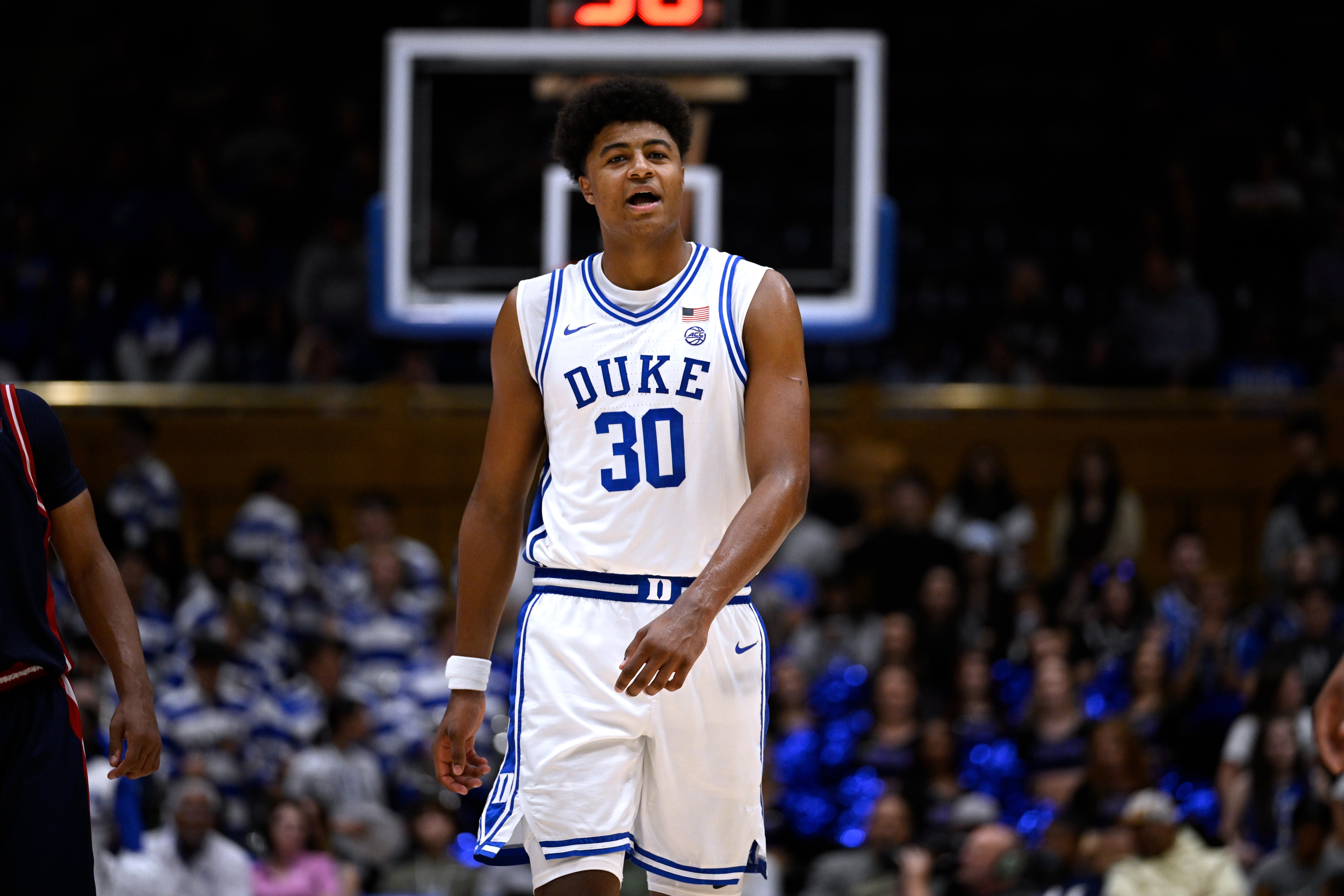
The other big part is that to win big in college basketball right now, obviously you’ve got to have size, talent, shooting, guard play and big-man play, but you’ve got to have depth. And right now, I don’t know if anybody has the amount of true depth that Duke has. If you’re taking the top three players in college basketball in a lineup, it’s probably Florida. If you’re looking for the top five or six, in my mind it might be Kansas. But if you’re looking for the top ten, it’s Duke. There’s a whole bunch of other teams we could talk about, but I’m really anxious to see how the depth gets developed and how it comes out — who’s playing well together, who understands what they need to do, and who’s handling maybe not having the role early on that they thought they were going to have, but is impacting winning nonetheless.
Tom Crean believes Duke, led by star freshman Joaquim Boumtje Boumtje, are the deepest ten-man rotation in the country
Getty Images
Andy Katz: So, Tom, I’m thinking back to the early part of my career — in college, when Bob Knight was coaching, and I’m dating myself here — Bob Knight, Jud Heathcote, Lou Henson. Or when I was starting out as a reporter: Rick Majerus, Don Haskins, Boyd Grant, Stew Morrill —
Seth: Tarkanian. Andy, you covered Tark at Fresno. Come on.
Andy: You knew exactly what their teams were going to look like. You knew how they were going to coach and what you were going to expect when you covered them, or if you were an opposing coach going against them.
How has that shifted, now that we can’t always predict how a certain coach is going to coach because the personnel keeps changing year after year?
Crean: Well, I think unless you’ve got a lot of guys back — like UConn has a lot of guys back. You watch them and you see (Na’jai) Hines and you see (Nik) Khamenia, and early on in the exhibitions and after game one, those guys have done a really good job fitting into the way Danny Hurley wants to play. They’re not quite (Tarris) Reed and (Alex) Karaban yet, but they’re on the move that way.
I think it morphs into different parts of the season. Right now in November — I’ve seen this already in the exhibitions and even watching games from last night — there are teams trying to run too much offense. They’re trying to run too many plays. They’re trying to show their playbook rather than figure out how to win the game. The worst thing that can happen in a game is when you’ve got issues inside of the game — players squabbling, or coaches who want to do this or that — and timeouts become chaotic. At the end of the day, we’ve just got to land the plane. We’ll fix it tomorrow. We’ll fix it in film after the game. But right now we’ve got to figure out how to win the game. And I think, in a nutshell, that’s the season.
People have their styles, and it’s become much more five-out oriented, a lot less three-out, two-in. But at the end of the day, how do you win early on? You get to the free-throw line, you get offensive rebounds, you get back on defense, you throw the ball ahead on the break. How do you lose? You take quick shots and don’t have balance to get back. You don’t get fouled. You settle for jump shots in the middle of the clock. You get down into the shot clock, you’ve exhausted your dribbles, and nobody’s open because they’re being denied, because the screening sucked — and all of a sudden you’ve got to shoot a shot with three or four seconds to go.
The coaches who win are the ones who can figure out how to win the game — how to maybe shrink the playbook while continuing to work on the concepts, the skills and the development they want to get to. Especially given how important the November games are. As you guys know, they are hugely important for the tournament, and now with eight more spots up for grabs, it’s even that much more important. Then, as you get into the middle of December and into league play in January, now you’re running your team the way you want to run it, and you have to make your adjustments, because now you’ve been scouted 10, 12, 15 games. But right now, with so many new players and so many guys trying to adjust, unless you have a lot of guys back, you’ve got to maybe put the playbook pages in the drawer for a couple of weeks and run the three or four things you know you can count on — that you can get fouled on, get a bucket on, get an offensive rebound on, and get back and stop people in transition on.
Seth: There are so many factors in today’s game that you didn’t have to deal with. So much of it is about fit, culture and whether they’re connected. I watched Memphis beat Iowa State in their first game, and two things stood out. First, Penny Hardaway is really good at bringing in talent. When I watch this team, maybe there’s not as much NBA, quote-unquote, talent, but they look like a team already. These guys look connected, at both ends of the floor. And from Iowa State’s standpoint, I’m wondering how do you even scout a team like Memphis, where they basically have an entirely new roster? It’s all part of early November basketball.
Look, Tom, let’s go back to some of your coaching days, specifically some of the guys you coached who are now in the NBA. I want to start with the newly crowned NBA champion, OG Anunoby. Obviously he’ll be forever remembered for that epic tip-in. Andy and I covered your Indiana teams when he was there. If memory serves, Tom, he was thought of as a good recruit, but not some great future NBA player. Even when he was drafted, maybe there was some doubt about the skill set, even though the athleticism was always there.
What do you remember about OG Anunoby at Indiana that maybe projected to what we’re seeing in the NBA? And what was it like watching him get that done with the Knicks?
We saw you on our screens — I think you were with Taylor Swift and all the celebrities, like a big Ben Stiller.
Crean: I didn’t get to go to the tip-off game (Game 4). I went to Game 5, I should say. I was in San Antonio with my daughters for the championship. But when he got the tip, I was in my hotel room in Rock Hill, South Carolina.
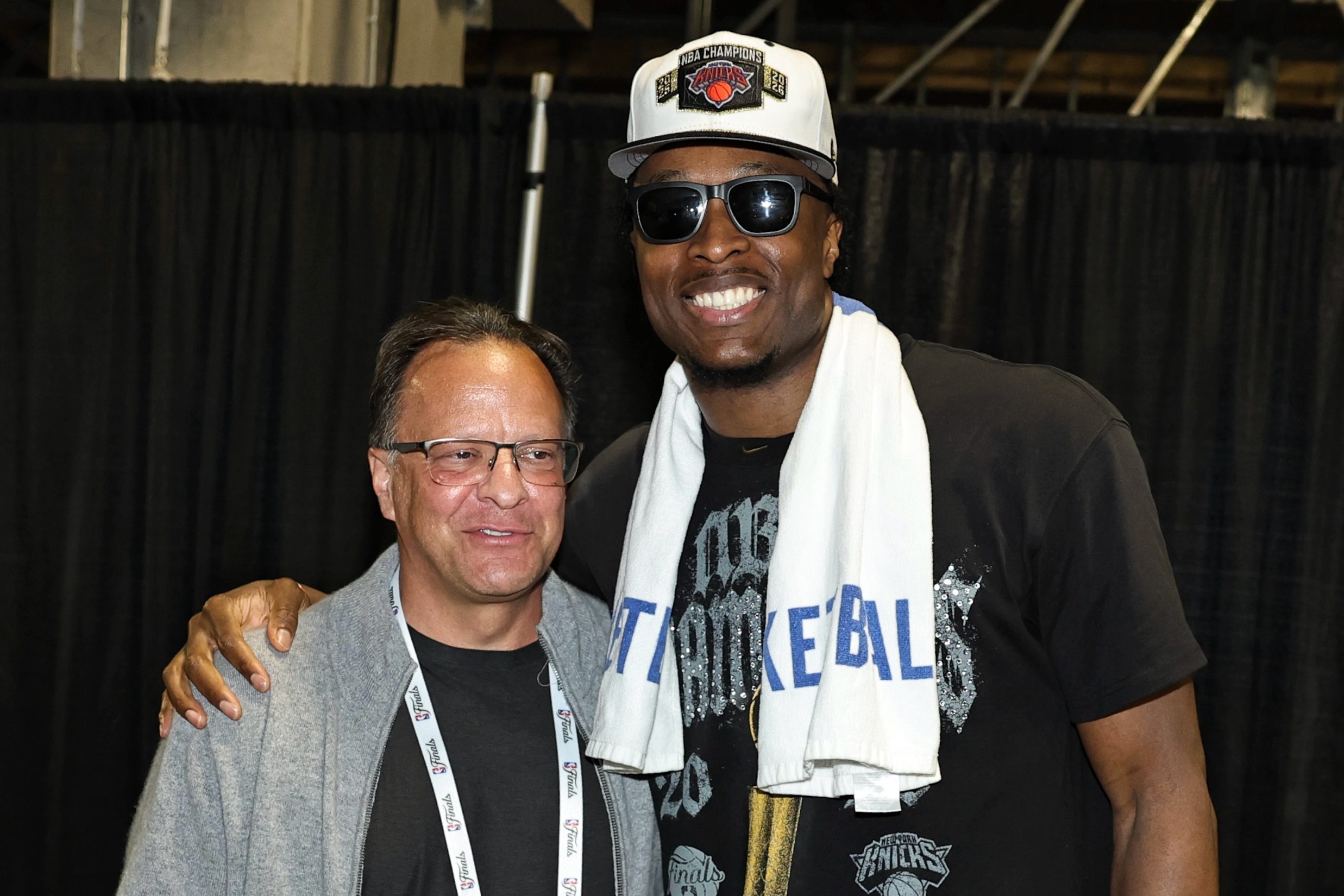
Crean recruited Anunoby out of high school and coached him for two years at Indiana
Getty
Seth: OK, so what was it like watching him get that done with the Knicks?
Crean: At first, it was amazing. I said, “Man, I think OG tipped that, right?” And all of a sudden they start running it back, and the first thing I focused on was not how he tipped it, but how quickly he ran after the tip. I think he knew, as soon as Brunson went to the dribble, that the ball wasn’t coming back to him, and he darted to the basket. Basically, he was in the air before anybody from San Antonio even realized he was there. It was just the perfect tip. Obviously he was open. Brunson goes into the move, and because OG’s played with him and knows he’s going to take the shot in that situation, he got that jump start. It’s little things like that that show how smart and tough OG really is. I mean, think about the play he made on Fox, getting back.
What OG has, we could see early. Again, recruiting is so crazy. He’s from Jefferson City, Missouri, and only one school in the entire state of Missouri offered him a scholarship. The people we recruited him against were George Mason, Iowa, Georgia, Ole Miss. It was just a conglomerate of people, and it wasn’t that many. After we offered him at Indiana, he ended up getting about 12 offers within the next week. But I loved the athleticism. I loved the length. I loved how hard he played on both ends, his ability to go end to end. He had that early, and that’s one of the biggest reasons they won the championship: He’s such a two-way, end-to-end player, and he just doesn’t waste motion.
But the thing that will always stand out to me is that he wasn’t hard to recruit. He was hard to convince that I truly believed he could be an early NBA player. There was no doubt in his mind that he wanted to be an NBA player, but he hadn’t been recruited like that. He wasn’t one of those accolade guys. I think he ended up ranked something like 287 when the rankings came out. So he was skeptical about people believing he could be a pro. I look back at that recruitment, and we had more talks about that — me convincing him of what I saw in him — than anything else. Obviously he ended up believing me, and it worked out that way.
Missing him for 18 games when we did was such a hard part for us. It absolutely killed us when he got hurt in the Penn State game. But amazingly, he leaves us after two years. He’s basically drafted as a redshirt, I think, by Toronto, where they believed they were going to have to sit him out for the year. He ends up going in the 20s. A lot of teams missed and passed on him, and all of a sudden he’s starting, I think, 65 to 70 games as a rookie on the No. 1 seed in the East. He’s one of those guys: The moment you underestimate him, he either dunks it on your head, blocks your shot, steals a pass, or makes a tip-in like that against San Antonio to help win a championship.
November 9: In another week of marquee nonconference matchups, Duke takes on Michigan State while Kentucky vies for legitimacy versus Kansas
Andy: Tom, I sat with Mark Few and Tommy Lloyd in Las Vegas for a sort of chalk talk. One thing I love about the way they’ve coached and learned — and I do think it applies to you — is the way they empower their assistants, who then go on to be head coaches. They empower and build trust with their lead players. They’re not the only voice in practice. They don’t think they know it all. You worked for Tom Izzo. I’ve covered him long enough to see that whether it was you or Gregory or now Doug Wojcik, or Dwayne Stevens, or Garland — I don’t care who it is — he listens, he wants to hear those opinions, and he wants to absorb that. And then there are the relationships with the guards. You had all of that at each of your stops.
How critical is it to being a successful coach to empower your assistants and your key players, to listen and not think you know it all?
Crean: Well, I think it’s incredibly important. I was very fortunate in the people I worked for while I was going to school at Central Michigan — Ralph Pim at Alma College and Denny Kuiper at Mount Pleasant High School. Then, after one year where Tom Izzo was the associate head coach and Jud Heathcote was the head coach, I was with Ralph Willard for five years. If you didn’t come in with answers and solutions with Ralph Willard, it was not a pleasant day.
When you did scouting reports — I tell my son this all the time, and he’s now an assistant coach with the Orlando Magic — if the other team had 24 plays, you had to know those 24 plays, and you weren’t pulling out notes. The work you were pushed into, to believe you could do it and to have the answers that were required, made me as a young assistant absolutely value and appreciate what assistants could bring, and what they had to bring. The things I never had a lot of interest in were somebody who didn’t do the work, somebody who didn’t want to do the work, somebody whose words I had to filter, or somebody who was playing favorites with a recruit or a player. Those are the things that get assistants in trouble. In this world, you don’t want to recruit independent contractors — well, you don’t want to hire independent contractors. I’ve done that a couple of times, and it’s burned me, and it’s not good.
So I’ve always had great respect for assistants. Even though you want to be demanding of them and tough on them, my number one responsibility was to make them great every day, because that’s what my guys did for me, that’s what Ralph did for me, and that’s the standard Tom Izzo held me to. There are so many things about Tom Izzo, but the one thing I’ve always started with when it comes to his leadership is that he never let the sun go down on a problem. Ever. It wasn’t, “The problem will get handled tomorrow,” or “We’ll wait till the weekend’s over,” or “It’s Sunday, we’ll get it on Monday morning.” No. If there was a problem, he was on it. The rules were a little different back then, but I’ve been in situations where I’ve gone to pick a player up at 2, 2:30, 3 o’clock in the morning and take him to his house when I was at Michigan State, or bring him into the office. And when I got to Marquette, I did the same thing.
When you’re raising people and raising their standards and their own expectations, and then you realize how many expectations other people have around them, one of two things is going to happen. They’re either going to go above and beyond those expectations and standards and have great success, or they’re going to give in to people giving in to them. And the last thing a coach can do is give in to them when the standards, expectations and attitude are not being raised. You cannot do it on your own.
I think the thing that’s always separated Tom Izzo is the same thing I hope happened with me: I never lost what it was like to be a Division III assistant, a graduate assistant. I never lost that mentality of how important those things were, no matter how much money you make. Tom Izzo’s never lost that. He’s never not done a job that he’s expecting of somebody else. Even with all the money and accolades and wins he has, he’s never stopped showing up for the recruit, for the film session, for the meeting with the player. You name it. He doesn’t delegate what’s most important. That’s the thing as a coach: You want to energize yourself by being around people who bring you enthusiasm, ideas and solutions, who can help you solve problems and manage the limits. But as the leader, you’d better be the one helping energize them as well and helping hold that standard. That’s exactly what I’ve tried to do, and that’s exactly what Izzo does.
“Even with all the money and accolades and wins he has, he’s never stopped showing up for the recruit, for the film session, for the meeting with the player. You name it. He doesn’t delegate what’s most important.”
Tom Crean on Tom Izzo
Seth: Of course, Tom was a graduate assistant and then a longtime assistant coach for Jud Heathcote. And Jud kind of went behind the athletic director’s back and installed Tom as the head coach, because they didn’t want him to be the head coach. They wanted to win the press conference. Where have we heard that before?
All right, we’ve talked about this so many times over the years, but I want to go over it again. I’m going to put you in the hot tub time machine and take you back to when you first got to Marquette in 1999, and you got a chance to coach a young man named Dwyane Wade. I cite Dwyane Wade as one of those great examples of not letting other people dictate who you are — similar to what you were saying about OG Anunoby. When Dwyane Wade was going into his senior year of high school, he was not invited to either — this is old school now — the Nike All-America Camp, which had about 500 kids, or the ABCD Camp.
Crean: Exactly.
Seth: So the people whose business it was to identify the next great players did not consider Dwyane Wade one of the top 800 high school players in America. X number of years later, he’s one of the top five players in the world. Part of this was academics — I know he had to sit out his first year.
But similar to OG, you saw something in Dwyane Wade that basically nobody else saw. What was it?
Crean: Empathy. His concern for others. Because I was on the phone with him before I ever saw him play. I’ve said this a thousand times: We don’t start recruiting him if I don’t have Tim Buckley on my staff — he’s now with T.J. Otzelberger at Iowa State — because he knew Jack Fitzgerald, his high school coach, and he had seen Dwyane when he was an assistant at Ball State. So I talked to Dwyane before I’d ever seen any film. Film wasn’t anywhere near what it’s like now, obviously.
The first thing I’ll never forget — I know I’ve said this before — is the drive I made. You could start making phone calls on June 20th, and you could only get him on Tuesdays and Thursdays. I talked to him on June 21st. He was at his girlfriend’s house at the time — Siohvaughn, who ended up being his first wife. Long story short, there was a window to call him, and you didn’t really know why. Well, he really wasn’t at home. And I’ll never forget that 25-minute conversation driving from my office at Marquette in downtown Milwaukee to our house out in Mequon, and how I felt after that. Even though you don’t know how good he is, you get off the phone praying and begging that he’s as good as you hope he is, just based on the way you talked to him and the way he talked back.
Over a period of time, we talk a few more times, and then I start to see him play. We needed an athletic uptick at Marquette. We had some good players, but we really needed to get more athletic, so you knew that was there from the very beginning. When I saw him play, he was coming off the bench for the Illinois Warriors, starting half the games, and you’d see him make these plays — a dunk, a drive to the basket. I’ll never forget the old Bill Walsh quote about seeing Jerry Rice play on some obscure channel before a game in San Francisco. He watched him make a play, and the quote goes that if he can do it once, we can get him to do it again and again.
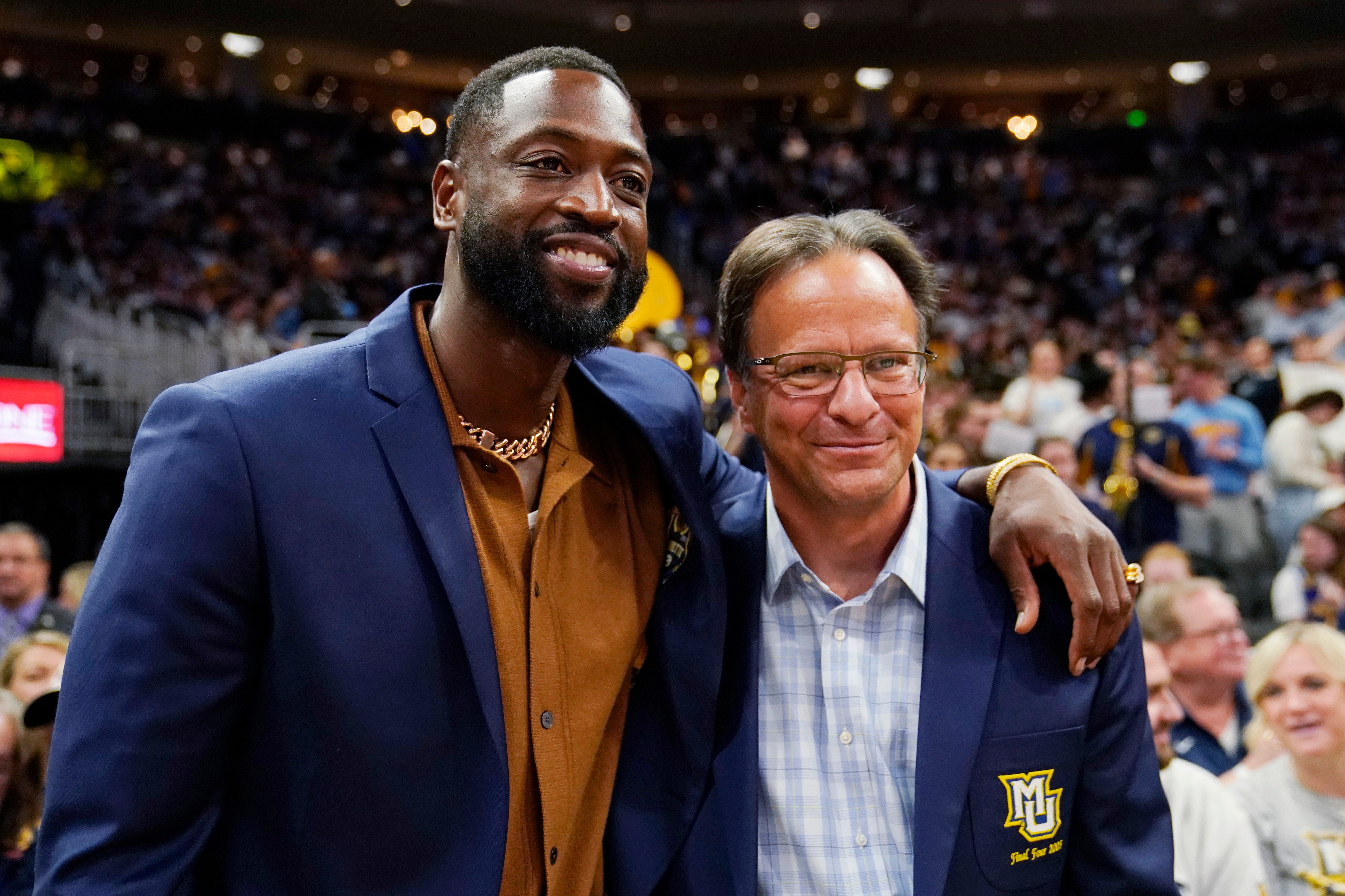
Dwyane Wade and Tom Crean were both honored at National Marquette Day in February
Getty
That’s kind of how I felt sitting there watching Dwyane. Nobody was really recruiting him other than Illinois State and Bradley. A lot of people were messing around, but they were worried about the academics. All I saw was a guy with a great heart, who I loved talking to, with athletic and basketball upside I was really excited about. But even back then, there was no way we could know what we were getting.
One day during a Christmas tournament over his break, Dwayne Stevens was watching him play. They played at 10 o’clock in the morning and then 7 o’clock at night, and he ended up scoring 90 points over two games that day and got up to 28 or 30 rebounds in the two games. I’ll never forget how excited Dwayne was talking about him. There are all these little watershed moments that lead up to getting him, coaching him and being with him.
And again: that empathy, that care for others, that honesty, that work ethic. And then seeing his vision, his burst, his explosiveness, his poise, his quick twitch, his hand-eye — all those intangibles that were part of his athletic makeup and his character makeup helped him become one of the absolute greatest players that’s ever played. It was all those little things that made this big thing. At the end of the day, he never, ever lost that empathy. Highly confident, never arrogant, with a level of empathy and care for others. I think anybody who’s been around him or followed him has seen that all across the world.
Andy: One quick follow-up before we get to our shot clock — correct, Seth? I think we’re up on the clock. Staying on the Marquette through line here: This doesn’t always happen. That’s two jobs ago for you, with broadcasting in the middle. And they honored you — Mike Broeker, the athletic director now. That was an incredible moment, and I just thought it was a great thing for you and your family.
What did it mean to you when you got that call — that they weren’t just honoring the team, or Dwyane Wade, which they had done, but they were honoring you?
Crean: I actually heard from Shaka and Mike the same night. There’s no question I had tears in my eyes, and I was a little choked up. I didn’t expect it until it came up. And then to know that something like that was going to happen put so many things into focus about what we built. It just went to show that a guy like Mike, who was a part of that, and Shaka, who walked into it a couple of coaches after me, respected the work we put in. They respected the way the players handled it — not only what happened with the Final Four, but the way the program had to build back up again after we lost that team. And then we had Jerel McNeal, Wes Matthews, Dominic James, Lazar Hayward, and the way the program built and was able to sustain success. To me, that’s what it was all about anyway. It was an unbelievable labor of love to build that program — to build it back up, I should say. It wasn’t like it wasn’t there. But to have them respect that, to have the fans feel like they did…
The best thing that happened for me in that is Joani was able to come back with me for it. She got maybe a bigger ovation than I did at halftime. But the thing that put the bow on it was how many former players were there. Dwyane came on a red-eye from LA after being at a movie premiere for his wife, Gabrielle Union, the night before, just to be there for it. So many players, some former coaches. And I got to address them. If it was all over for me in basketball at that point, it would have been worth it right there, just to have that day.
The Hoops HQ Shot Clock Challenge
Andy: All right, here we go. Sixty seconds. You ready? Favorite Anthony Edwards moment.
Crean: I would say watching him get the 38 coming back against Michigan State, and us seeing what he was capable of. Even though we didn’t win the game, we got to see that level of what he was capable of.
Andy: What’s Dwyane Wade’s best move on the court?
Crean: The up-and-under that turns into a backboard shot.
Andy: What do you remember most about your time at Indiana?
Crean: How passionate and crazy that fan base was early, as we were building it, and what it was like when we were really, really good. There are so many things, but I’ll put that home court up against anybody’s when it’s rolling in there.
Andy: All right, last question, got to get it in. What color looks best on you? Michigan State green, Marquette’s multiple colors, Indiana’s crimson or Georgia’s red and blue?
Crean: If I was picking colors, I like the blue and gold of Marquette. But I don’t have a problem with any colors.
Andy: All right, Marquette, there you go. I think it was close to 50 seconds.
Crean: I just wear blue more because that’s better for TV. I don’t wear a lot of red in the studio or at games, and I certainly don’t wear a lot of green. So I’m going with the blue.
Meet your guides
Seth Davis
Seth Davis, Hoops HQ's Editor-in-Chief, is an award-winning college basketball writer and broadcaster. Since 2004, Seth has been a host of CBS Sports and Turner Sports's March Madness NCAA basketball tournament. A writer at Sports Illustrated for 22 years and at The Athletic for six, he is the author of nine books, including the New York Times best sellers Wooden: A Coach’s Life and When March Went Mad: The Game Transformed Basketball.
Andy Katz is Hoops HQ's senior correspondent, an analyst for Turner Sports and the Big Ten Network, and a national correspondent for NCAA.com. Previously, he spent 18 years at ESPN as a college basketball reporter, host and anchor. He is a former president of the United States Basketball Writers Association. Follow him on X at @theandykatz.