The noise started slowly, then built in intensity until it sounded as though thousands of rabid basketball fans were stomping their feet on metal bleachers. My first thought, as I was watching the 2008 SEC Tournament second-round game between Mississippi State and Alabama at the Georgia Dome in Atlanta was, “Why would fans be stomping for this game?” Kentucky was waiting in the wings to play the final game of the night against Georgia. Were the legions of Wildcats fans who always show up for the SEC Tournament just warming up?
No sooner did that thought leave my mind, the answer to my question arrived when, behind me and to my left, a giant hole was ripped in the Dome’s fabric roof, and the entire arena seemed to sway. Debris rained down like artillery fire. A bolt the size of a small flashlight came within inches of my laptop, forcing me to take refuge under the press table.
What manner of hell was this?
Word soon spread throughout the arena. In retrospect, that noise didn’t sound like people stomping their feet on bleachers. It was much more ominous than that. Suddenly, those local TV news post-tornado video clips of some poor soul standing in front of a pile of rubble that used to be their home came into sharp focus: “It sounded like a locomotive.” If I’ve heard that once, I’ve heard it 1,000 times. And now I knew exactly what those folks were talking about.
A tornado really does sound like a locomotive.
Over the years, I’ve wished so many times that I’d grabbed that plus-sized bolt and kept it for a souvenir, but the quicker-thinking writer beside me made off with the trophy. At the time, I thought he was nuts for retrieving it. Wasn’t he worried about getting conked in the head? Let him have the damn thing. I stayed under the press table for as long as I could before finally deciding to make a run for it — out of the arena and into the concourse.
I’ll never forget the site of the escalator at the Georgia Dome that was adjacent to the media room. Gallons of water were pouring down it, so much it looked like a whitewater raft ride at some theme park. How could this be happening?
The instigator of this chaos and destruction was an EF2 tornado, powerful enough to generate winds up to 130 mph. This twister made history, because it was the first to hit downtown Atlanta. In addition to trashing the Georgia Dome and jeopardizing the SEC Tournament and the league’s automatic NCAA Tournament bid, it blew out windows at CNN Center and nearby hotels and wreaked havoc for blocks and blocks. This thing was a beast, but for all the damage it did, it could have been far worse.
The shot that saved lives
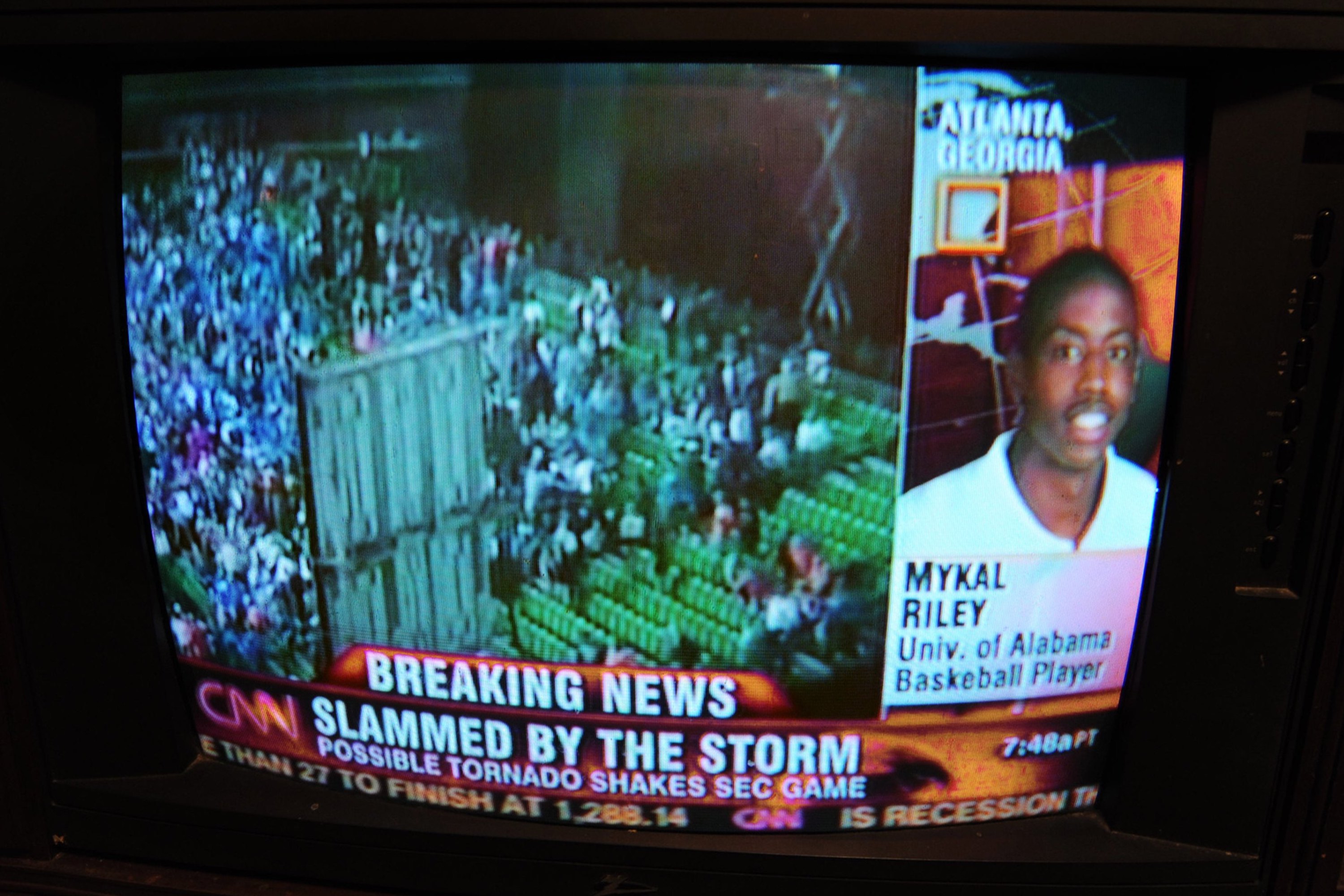
The game that was going on as the big wind blew was a close one between Alabama and Mississippi State. The Crimson Tide trailed 59-56 with two seconds to play and had to inbound the ball from halfcourt. The play drawn up by Alabama coach Mark Gottfriend was for guard Mykal Riley to come off a staggered double screen and shoot a three-pointer. Mississippi State coach Rick Stansbury thought Riley was going to take that last shot, so he assigned guard Ben Hansbrough to foul Riley before he could.
Hansbrough didn’t get to Riley in time. Riley caught the pass, gave Hansbrough a ball fake to the right, then swung to his left and let fly with a 23-foot shot that rolled around the rim, hit the square on the backboard and fell through the basket. Overtime.
With 2:22 to play in the extra session, the tornado struck. “It sounded like a train was rolling over the top of the building,” Gottfried told me for a story I wrote for the SEC Tournament program in 2011, the next time the event was played in Atlanta.
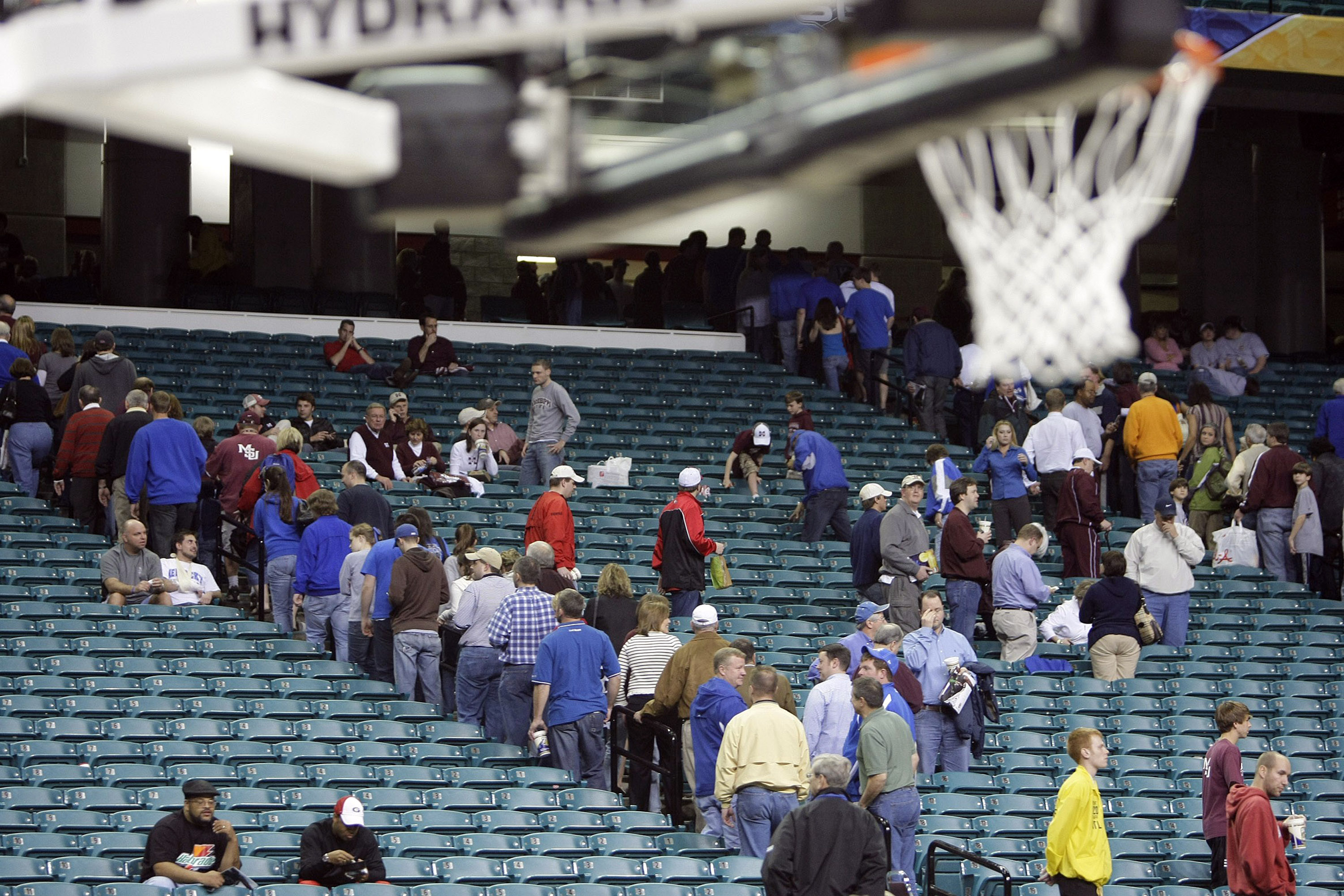
Play was stopped after Alabama’s Alonzo Gee was fouled with 2:11 to play, and that’s when all hell broke loose.
“When play stopped, the officials were able to look across at the far side [of the Dome] and people were just bailing out of there,” Gottfried said. “They were running like ants. Then I looked up and saw a lot of the scaffolding swinging very hard.”
Both teams were quickly hustled off the court. During a 64-minute delay, one of Riley’s teammates, Brandon Hollinger, came up to him. What he said shook Riley to his core.
“Do you realize you probably saved some people’s lives that could have been going outside right now?” Riley said Hollinger told him. “I didn’t really think much of it until after people were thanking me for saving their lives. The next morning, we got a call from CNN, and they asked me some questions about the night before. That’s when I knew it was a big deal.”
It took some effort to track down Riley, who was playing professionally in France at the same time I was writing my story. But it was worth it. With a few years to ponder his shot, he decided divine intervention had played a part. Because the door that hundreds of fans would have used to exit the stadium was directly in the path of the tornado.
“I am a spiritual-type guy, and I think that God could have used me to make that shot so that nobody would go outside in that storm,” Riley told me. “And people definitely would have been going outside if the game had ended. Maybe not all the people, because there was another game after our game, but I do believe I saved some lives that night.
“It makes me feel good to have done it, because people still write me today and say they were there when I hit the shot at the Georgia Dome against Mississippi State.”
SEC officials and Georgia Dome staff eventually decided the building wasn’t going to collapse and allowed the Alabama-Mississippi State game to be finished. As fate would have it, Alabama was again trailing in the closing seconds, and Riley took the final shot. This one bounced off the rim.
“I felt bad at the time,” Riley told me. “But I hit the shot I was supposed to hit.”
Saving the tournament, and an unlikely winner
SEC officials quickly cancelled the Kentucky-Georgia game. That was the easy decision. Much tougher was deciding how to complete the tournament so the league could claim its automatic NCAA bid. One of Georgia’s most hated rivals, Georgia Tech, came to the rescue, allowing the SEC to use its Alexander Memorial Coliseum so the tournament could be finished.
I remember listening in on the SEC’s deliberations and how critical Georgia coach Dennis Felton was of the SEC’s plan, because it meant his team would have to play two games in one day. In a way I could understand — Georgia had finished 13-16 and 4-12 in the regular season and Felton was already afraid for his job. But surely, he hadn’t forgotten the many AAU tournaments he had scouted during his career, where teams play two or three games in a day. Young kids can bounce back quickly. Or maybe he wasn’t thinking clearly at the time. This was an extraordinary event, an act of God for which no one could have had a contingency plan to solve the problems it caused.
The next day, I showed up at Alexander, which before its renovation could best be described as a cracker box, with a seating capacity of about 9,100. Thousands of fans who had traveled long distances for the SEC Tournament had to go home, because every team still involved was allotted a limited number of tickets. As I entered the building, I was struck by how many blue-clad Kentucky fans were standing in line. Those folks are among the more resourceful in college basketball. They always find a way to get tickets.
Despite the obvious advantage of many more fans backing them, the Wildcats lost to Georgia. Later that day, the Bulldogs beat Mississippi State to advance to the Sunday finals, where they defeated Arkansas to win the league’s automatic Big Dance bid and, for a short time at least, save Felton’s job. He didn’t even last the entirety of the following season; Georgia fired him on Jan. 29, 2009.
But the irony of the Bulldogs winning, on the homecourt of their archrivals, was one of those crazy occurrences in life I’m glad I got to witness.
Taking sum of a crazy night, and a crazy career
After the tornado ruined the Friday night session, I ran into two members of Tennessee’s staff — Steve Forbes, now the head coach at Wake Forest, and Mark Pancratz. They didn’t have a ride back to their hotel, so I told them to hop in my car. As we drove slowly through the debris-strewn streets of Atlanta, we couldn’t believe the damage the tornado had done.
“It looked like a bomb had gone off,” Forbes told me recently, when I called to ask about his recollections of that crazy night.
At some point during our short ride, Forbes and Pancratz, remembering that I had been involved in a plane crash earlier in my career, had a good laugh at my expense. A bit of dark humor, you might say.
“Dortch,” Forbes said, “You’re either the unluckiest son of a b- – – – I know, or the luckiest.”
“I haven’t figured that one out yet,” I told Forbes. “But you know what? I’m still around to tell those tales.”
Meet your guide